

Contradictory Positions Across Different Forums On Debt Quantum Bar Creditor From Pressing Insolvency Proceedings: Supreme Court Imposes ₹5 Lakh Costs
The Bench clarified that the Dena Bank precedent does not grant an absolute right to bypass civil execution, especially where the debt is seriously disputed.

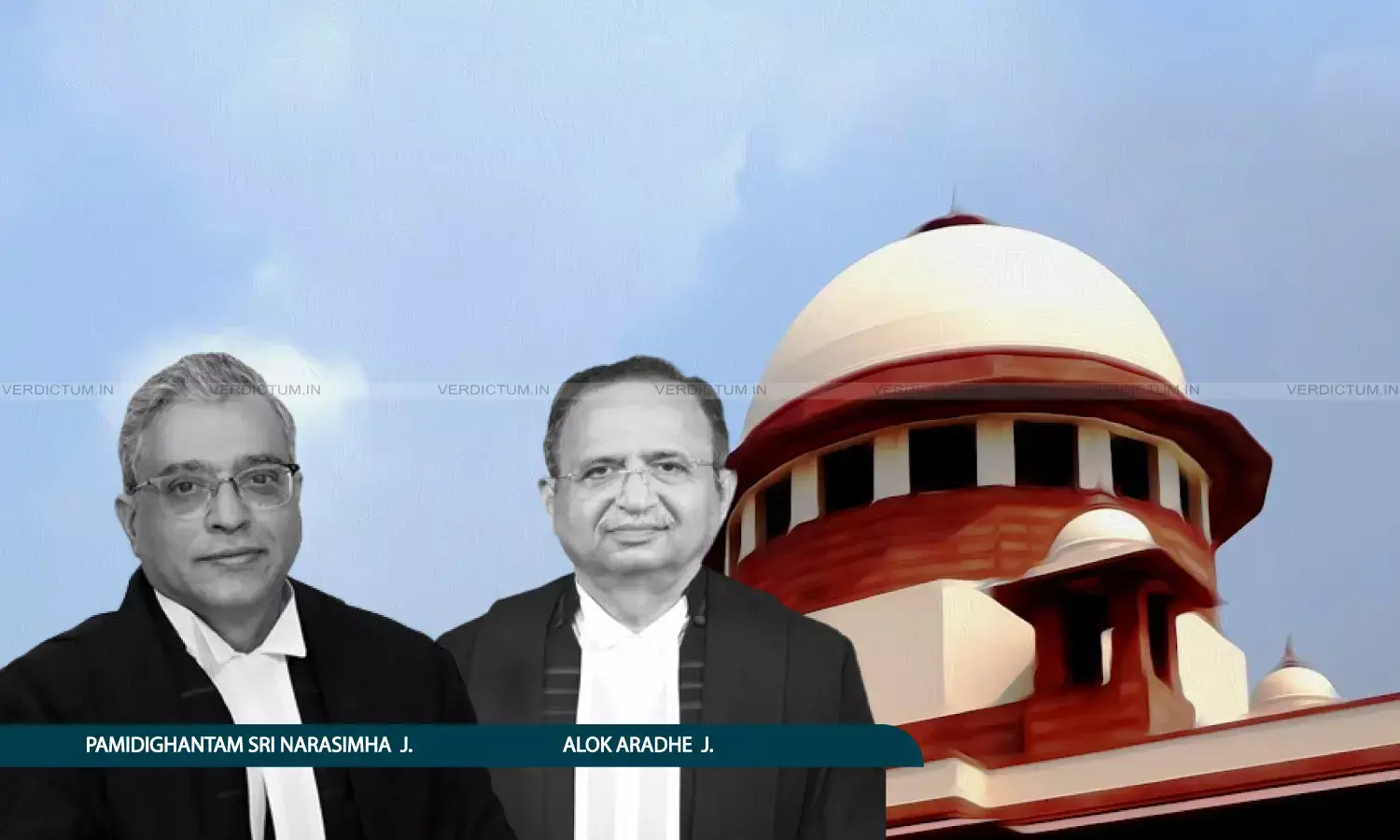
Justice Pamidighantam Sri Narasimha and Justice Alok Aradhe, Supreme Court
The Supreme Court has held that a party taking contradictory positions across different forums regarding the same set of facts cannot be permitted to treat a debt as an undisputed fact for the purpose of initiating insolvency proceedings. It observed that while a money decree does provide a fresh cause of action under Section 7 of the IBC, 2016, as held in Dena Bank (Now Bank of Baroda) v. C. Shivakumar Reddy (2021) 10 SCC 330, this principle does not operate in a vacuum and does not entitle every decree holder to invoke the insolvency process as a matter of right in preference to civil execution.
Consequentially, the Court imposed ₹5 lakh costs on the respondent, holding that insolvency is meant for revival, not backdoor debt recovery, and using IBC to enforce a civil decree against a solvent company is abuse of process.
Justice Pamidighantam Sri Narasimha and Justice Alok Aradhe on the principle established in the judgment, observed, “…A party that takes contradictory positions before different forums on the same set of facts cannot be permitted to press an insolvency proceeding as though the quantum were an established and undisputed fact. The NCLAT, was unable to determine the existence and quantum of the debt as a settled matter. This is hardly the foundation on which an insolvency resolution process ought to proceed”.
Senior Advocate Mukul Rohatgi appeared for the appellant and Advocate Gaurav Singh appeared for the respondent.
In the matter, two short-term loans advanced by the respondent, Shubh Gautam, to Anjani Technoplast Ltd. in 2010 was the subject of dispute. After cheques provided as security were dishonored, the respondent filed a summary suit in the Delhi High Court, leading to a decree in 2018 for approximately Rs. 4.38 crores with 24% interest.
Despite the decree attaining finality after the dismissal of a Special Leave Petition in 2021, the respondent bypassed civil execution proceedings and filed a Section 7 petition under the IBC. The appellant contested the debt's quantum, citing substantial prior payments and inconsistent claims made by the respondent before income tax authorities.
The NCLT originally dismissed the petition, viewing it as a misuse of the insolvency process against a solvent company. However, the NCLAT reversed this decision, holding that the loan agreements established a financial debt and that the decree provided a fresh cause of action.
Upon further examination directed by the Supreme Court, the NCLAT later noted serious discrepancies in the respondent’s computation of the debt, which had ballooned to over Rs. 12 crores despite earlier records suggesting a much lower figure.
The Court, now, held that the NCLAT erred by not considering the appellant's solvency and the respondent's conduct in bypassing established execution machinery. It found that the appellant, having a revenue of Rs. 35 crores and nearly 100 employees, demonstrated the "instincts of an earnest judgment debtor" by depositing over Rs. 3.6 crores during the litigation.
The Court concluded that the insolvency jurisdiction is not designed to resolve disputes over the quantum of a decretal amount, which is best handled by the High Court in execution.
“…The NCLT and NCLAT are not the appropriate fora for this exercise, and the insolvency jurisdiction under the IBC was not designed to resolve disputes about the quantum of a decretal amount”, the Bench noted.
“In the present case, the facts speak for themselves. The respondent held a decree. He did not file execution proceedings. He chose instead to file a Section 7 petition against a solvent, functioning company. The quantum of the ‘debt’ itself, as contemplated under the code, is seriously disputed. The appellant has deposited Rs. 3,60,98,847/- with the Registrar General of the Delhi High Court and has consistently maintained its willingness to pay whatever is lawfully due. The proceedings pending before the Delhi High Court, including the application under Section 151 of the CPC and the proceedings under Section 340 of the CrPC, remain undetermined. In these circumstances, the initiation of CIRP is nothing more than the use of the IBC as a recovery mechanism. We will term it as an abuse of the process”, the Bench thus noted.
Thus, the Court allowed the appeal, setting aside the NCLAT’s order and restoring the NCLT’s dismissal of the Section 7 application. The respondent was granted liberty to pursue the execution of the 2018 decree through civil law.
Cause Title: Anjani Technoplast Ltd. v. Shubh Gautam (Neutral Citation: 2026 INSC 410)
Appearances:
Appellant: Mukul Rohatgi, Senior Advocate.
Respondent: Gaurav Singh, Advocate.