

Appeal Filed Before NCLAT Without Certified Copy Of NCLT Order Ought To Be Rejected At Threshold: Supreme Court
The Supreme Court was considering a matter wherein the institution of an appeal under Section 61 of the Insolvency and Bankruptcy Code, 2016, was in issue.

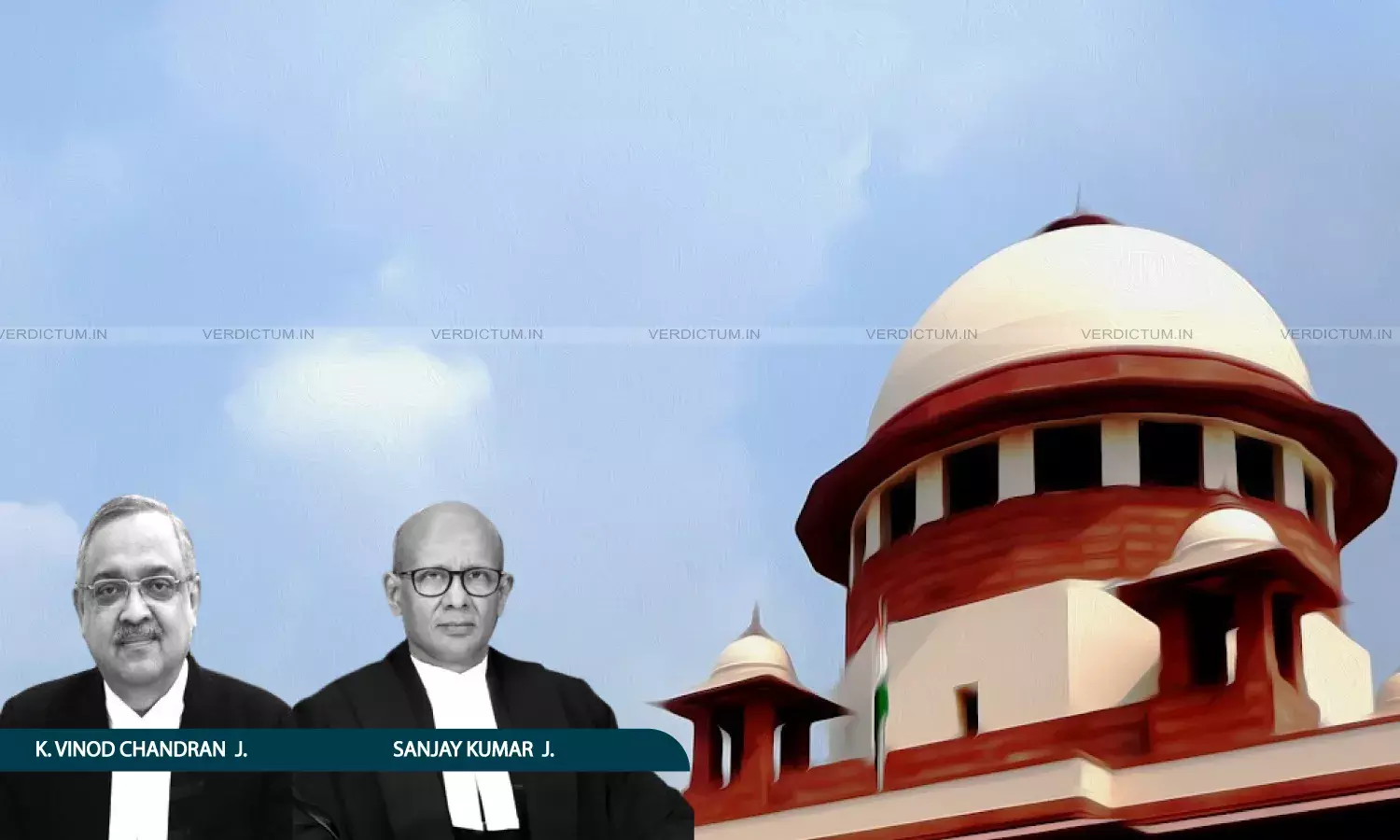
Justice Sanjay Kumar, Justice K. Vinod Chandran, Supreme Court
While observing that a diligent litigant is expected to apply for a certified copy of the order sought to be appealed against before the period of limitation provided under the Insolvency and Bankruptcy Code runs out, the Supreme Court has held that an appeal filed before the NCLAT without the certified copy of the order of the NCLT would be an incompetent appeal and the same ought to be rejected at the threshold.
The Apex Court was considering a matter wherein the institution of an appeal under Section 61 of the Insolvency and Bankruptcy Code, 2016, was an issue.
The Division Bench of Justice Sanjay Kumar and Justice K. Vinod Chandran stated, “In effect, even after the refiling of the appeal on 10.03.2025, one of the glaring defects that still remained was that a certified copy of the order dated 14.08.2024, sought to be impugned in the appeal, was not filed. No doubt, delay in refiling of a proceeding would, ordinarily, not be tested by the same strict standards that would be applied to delay in the filing of such proceeding but we find that, in the case on hand, the appeal which was refiled by respondent No. 1 was defective beyond redemption. Defect No. 07, noted supra, indicates that the appeal was refiled without a certified copy of the order dated 14.08.2024 passed by the NCLT.”
“On the above analysis, we hold that the filing/refiling of the appeal by respondent No. 1 was incurably tainted and the same ought to have been rejected at the threshold”, it added.
Advocate Liju V Stephen represented the Appellant, while AOR Mukund P. Unny represented the Respondent.
Factual Background
A company appeal was e-filed by the first respondent before the National Company Law Appellate Tribunal, Chennai (NCLAT), challenging the order passed by the National Company Law Tribunal, Kochi Bench (NCLT). By the said order, the NCLT had approved the resolution plan submitted by Angelwoods Apartment Allottees Association (appellant). The first Respondent (mother of a suspended director of the corporate debtor, viz., Samson and Sons Builders and Developers Pvt. Ltd.) also claimed to be its financial creditor and sought to challenge the approval of the appellant’s resolution plan.
The Respondent’s appeal was e-filed was with delay and an application was filed by her seeking condonation of the delay of 15 days in its presentation. On October 4, 2024, the Registry of the NCLAT communicated the defects in the said appeal. The defects were supposedly rectified with delay and an application was filed seeking condonation of the delay of 150 days in the refiling of the appeal after the curing of defects.
The two delay condonation applications were taken up together by the NCLAT. Though the appellant opposed the condonation of such delay, the NCLAT opined that, insofar as the delay in refiling was concerned, condonation thereof was a matter exclusively between it and the appellant. Holding so, the NCLAT condoned the delay of 150 days in the refiling of the appeal, upon deposit of costs of ₹50,000 with the Prime Minister’s Relief Fund. As regards the delay in filing, the NCLAT observed that the same was within the permissible upper limit of 45 days, stipulated under the proviso to Section 61(2) of the Code. Both the applications were accordingly allowed and this common order passed by the NCLAT was subjected to challenge before the Apex Court.
Reasoning
On a perusal of the facts of the case, the Bench found that the Registry noted that the period of limitation for filing the appeal, being 30 days, expired on September 13, 2024, and the condonable delay thereafter, being 15 days, was till September 28, 2024. The appeal was e-filed by the first respondent on the very last day, that is, September 28, 2024. The defects in the appeal were intimated by the Registry on October 4, 2024. The Bench noticed that the appeal was refiled on March 10, 2025, though the time stipulated under Rule 26(2) of the National Company Law Appellate Tribunal Rules, 2016, for curing of defects was only 7 days. The Registry of the NCLAT further found that defects galore remained uncured.
The Bench took note of the fact that the appeal, which was refiled by the first respondent, was defective beyond redemption, and one of the defects indicated that the appeal was refiled without a certified copy of the order dated August 14, 2024, passed by the NCLT. “Rule 22 of the NCLAT Rules pertains to presentation of appeals. Rule 22(2) categorically states that every appeal shall be accompanied by a certified copy of the impugned order”, the Bench mentioned.
Reference was also made to the judgment in V. Nagarajan vs. SKS Ispat and Power Limited and others (2022), wherein it has been observed that the act of filing an application for a certified copy is not just a technical requirement for computation of limitation but an indication of the diligence of the party in pursuing the litigation in a timely fashion. The Bench noted that a certified copy of the NCLT’s order that was sought to be appealed against by the first respondent was not filed along with the refiled appeal, but long thereafter. The photocopy of the said certified copy reflected that the first respondent applied for the same only on April 21, 2025 and though the certified copy was prepared on April 24, 2025, it was not collected till June 12, 2025. The Bench noticed that on March 10, 2025, when it was refiled, the appeal was not accompanied by a certified copy of the order dated August 14, 2024.
“Given the strict timelines provided in the Code, which were held to be of essence by this Court, we may note that respondent No. 1 chose to e-file an appeal against the order dated 14.08.2024 on the very last day available to her, in terms of the limitation prescribed under the proviso to Section 61(2) of the Code. However, the filing of such appeal, without even applying for a certified copy of the order dated 14.08.2024, practically meant that there was no filing of an appeal in the eyes of law. As pointed out by this Court, a diligent litigant is expected to apply for a certified copy of the order sought to be appealed against before the period of limitation runs out and, by doing so, such litigant would be entitled to seek exclusion of the time taken to procure the certified copy for the purpose of limitation”, it added.
Holding that the appeal, as filed and refiled, was not a merely defective appeal, wherein the defects could be cured, but was a wholly incompetent appeal that did not satisfy the essentials to pass muster, in terms of the requirements prescribed under the Code and the NCLAT Rules, the Bench allowed the appeal while setting aside the order of the National Company Law Appellate Tribunal.
Cause Title: Angelwoods Apartment Allottees Association v. M. Lalitha (Neutral Citation: 2026 INSC 479)
Appearance
Appellant: Advocate Liju V Stephen, AOR Manu Krishnan G, Advocates Stephen V Thomas, Indu Susan Jacob, Sanjay Johnson Mathew, Jiji Joy, Stephy Elizabeth Jacob
Respondent: AOR Mukund P. Unny, Advocates Vinay Mathew Joseph, Sanjay Nair S.