Mere Existence Of Trees Does Not Make Land “Forest” Or “Deemed Forest” To Invalidate Acquisition For Duly Sanctioned Projects: Supreme Court
The Supreme Court dismissed landowners’ appeals against the acquisition of land for the Jaipur Metro Rail Project, holding that tree cover on part of the land could not by itself convert it into “forest” or “deemed forest” when statutory records and the Master Plan did not recognise it as such.
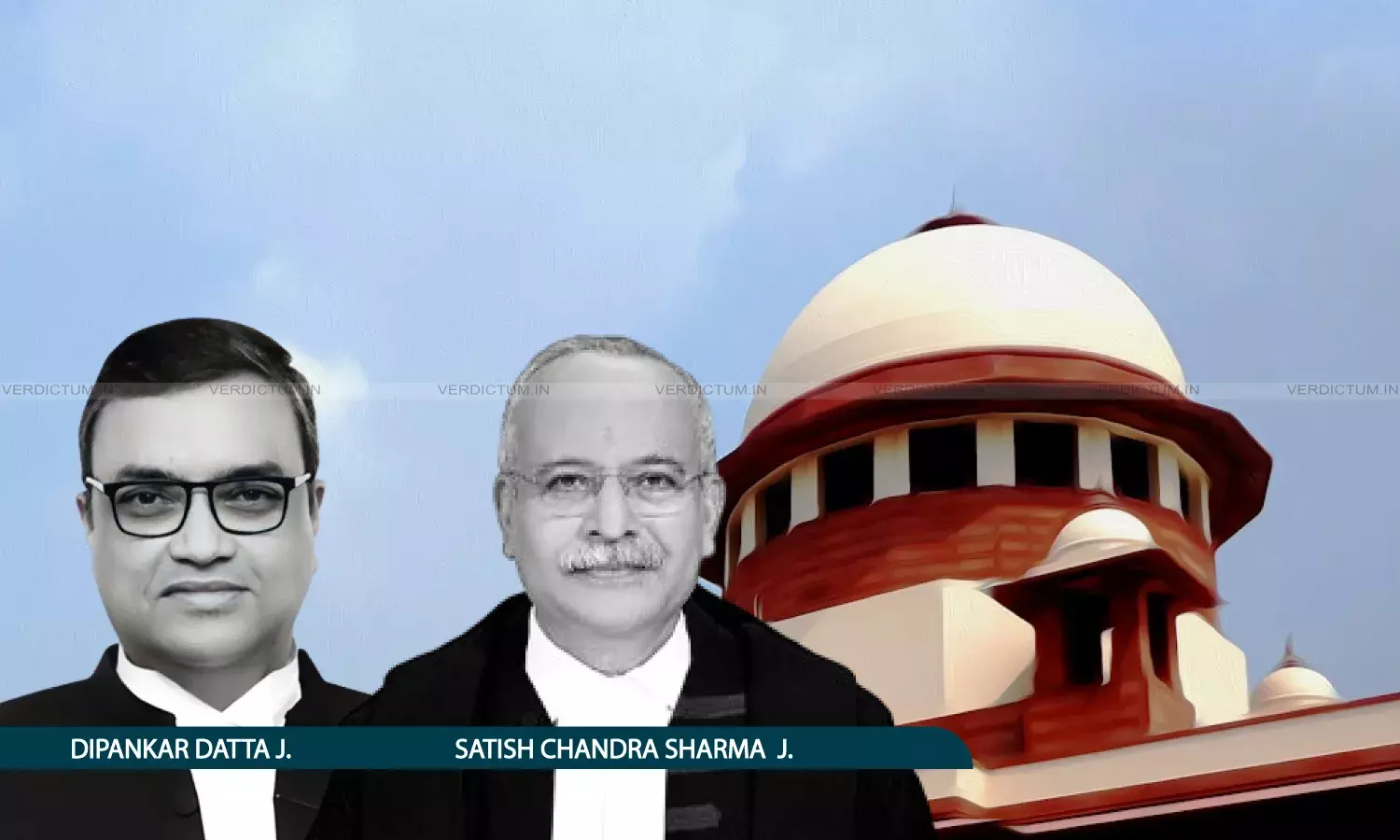
Justice Dipankar Datta, Justice Satish Chandra Sharma, Supreme Court
The Supreme Court has held that the mere existence of trees or vegetation on acquired land cannot elevate it to the status of “forest” or “deemed forest” to invalidate a public infrastructure acquisition, unless the land is recognised as forest land in revenue records, the applicable Master Plan, or other statutory planning instruments.
The Court was hearing appeals filed by landowners challenging the acquisition of land at Jaipur for the construction of a metro car depot forming part of Phase II of the Jaipur Metro Rail Project. The Rajasthan High Court’s Single Judge had quashed the acquisition on the ground of non-compliance with Section 5A of the Land Acquisition Act, 1894, but the Division Bench reversed that decision and dismissed the writ petition.
A Bench of Justice Dipankar Datta and Justice Satish Chandra Sharma dismissed the appeals, holding that the acquisition could not be interfered with either on the Section 5A objection or on the plea that the land had acquired ecological character because of trees.
The Bench held: “We now come to the final objection, which is premised upon the alleged disturbance to the extant tree cover and the ecological character of land being altered. Such contention is equally misconceived. This issue stands authoritatively settled by a decision in Naveen Solanki v. Rail Land Development Authority, wherein it was held that the determination of whether a parcel constitutes ‘forest’ or ‘deemed forest’ must essentially be informed by the original character of the land and the relevant statutory planning framework governing it.”
The Bench further observed: “The afore-stated exposition squarely countervails the objection urged by the appellants. Photographs, still and drone, submitted by the JMRCL, evinces existence of trees or vegetation upon a portion of the subject land but mere existence thereof cannot ipso facto elevate it to the status of a ‘forest’ or ‘deemed forest’. Unless the statutory planning instruments, including the applicable Master Plan, recognise the land as forest land or specifically record the existence of such ecological features at the time of their inception, the subsequent proliferation of vegetation cannot be permitted to subvert or invalidate the expert planning framework. To hold otherwise would enable unanticipated and fortuitous changes in vegetation to frustrate duly sanctioned public projects and import uncertainty into the planning process.”
Senior Advocate Mukul Rohatgi appeared for the appellants, while Solicitor General Tushar Mehta appeared for the respondents.
Background
The acquisition concerned land required for a metro car depot for the Jaipur Metro Rail Project. The landowners objected under Section 5A of the Land Acquisition Act, contending that they had not been given an effective hearing, that their objections were not considered, that alternative parcels of land were available, that the extent of land acquired was excessive, and that the project would disturb existing tree cover.
The Land Acquisition Officer rejected the objections and forwarded the report to the State Government, which proceeded to issue the declaration for acquisition. The Single Judge interfered with the acquisition, but the Division Bench restored it, also directing transplantation and additional plantation in respect of trees affected by the project.
Court’s Observations
The Court first examined whether the procedure under Section 5A of the Land Acquisition Act had been violated. It noted that the landowners were allowed to file a rejoinder to the reply submitted by Jaipur Metro Rail Corporation Limited, but they neither appeared nor filed any rejoinder on the date fixed.
The Court held that the Land Acquisition Officer could not be faulted for proceeding on the basis that the landowners had nothing further to submit.
The Court observed: “On the face of such lack of diligence and interest of the appellants, there is no basis to hold that there was colourable compliance or substantial non-compliance of Section 5A, so much so that the very essence and purpose of the right of hearing was defeated. In the absence of any request from the appellants, we find no breach of duty by the LAO and, consequently, no violation of the right of hearing.”
The Bench added: “We, thus, hold that the mandate of Section 5A was not ignored by the LAO and that there was substantial compliance; also, no fault can be attributed to the LAO in forwarding the recommendation without the appellants being personally heard. Appellants, by their own conduct, abandoned their right of hearing; they cannot now be heard to complain of denial of hearing when they themselves failed to avail the same.”
The landowners argued that the Land Acquisition Officer’s report recorded that “objections are not being considered”, showing non-application of mind. The Court rejected this reading, holding that the report had noticed the objections and the response of JMRCL, and that the phrase meant the objections were not being accepted.
The Court stated: “While it is true that the reasoning of the LAO is brief and each objection has not been dealt with individually, we do not consider the argument worthy of acceptance. Reference to the contents of the report has been made hereinbefore. While the report of the LAO could have been more elaborate, it must be remembered that a report under Section 5A need not be a speaking order in the judicial sense. The requirement is to form an opinion and recommend. Brevity of reasons is not synonymous with absence of reasons. Read as a whole, it cannot be said that the LAO failed to advert to the objections or that it failed or omitted to record the requisite opinion. The brevity of the report does not vitiate it. The purpose of Section 5A, which is to aid the State Government in taking a final decision, stands fulfilled in this case.”
The Court then considered whether the objections had substance on merits. It held that the proposed metro depot was an operational requirement of the Jaipur Metro Rail Project and not an ancillary commercial venture.
The Court observed: “The present acquisition is for construction of a depot constituting Phase II of the Jaipur Metro Rail Project. A depot is not an ancillary commercial venture, but an indispensable operational component without which the metro system itself cannot function. Appellants sought to contend that the project has undergone changes over the years and that the DPR has not attained finality. Such circumstances may, at its best, evince an evolving infrastructural planning, but they do not detract from the essential public purpose undergirding the acquisition.”
Rejecting the objection that no proper survey preceded the notification under Section 4 of the Land Acquisition Act, the Court held that the statutory sequence itself permits survey after publication of the preliminary notification.
The Court explained: “The objection grounded on the alleged absence of a prior survey before issuance of the notification under Section 4 is equally untenable. The phraseology of Section 4 itself furnishes the answer. Sub-section (2) opens with the expression "Thereupon", thereby making it lawful for the authorised officers to enter upon the land, survey it, take levels, dig or bore into the sub-soil and undertake such other acts as may be necessary to ascertain whether the land is adapted for the intended public purpose. The use of the expression "Thereupon" unequivocally signifies that the statutory power to survey kicks in, upon the publication of the notification under Section 4(1). The legislative sequence is thus clear: publication of the notification first; exercise of the powers of entry and survey thereafter. The statute does not posit the conduct of a comprehensive survey as a condition precedent to the issuance of the notification under Section 4. To read such a requirement into the provision would amount to supplying words which the legislature has consciously omitted. We are, therefore, unable to accept the contention that the acquisition process is flawed merely because no survey preceded the notification.”
On the plea that other parcels belonging to public bodies could have been used instead, the Court held that selection of land for a public project is ordinarily within the domain of expert planning authorities.
The Court relied on State of Punjab v. Gurdial Singh (1980), Sooraram Pratap Reddy v. Collector (2008), and a recent order concerning the National Highways Authority, to hold that courts should exercise restraint unless mala fides, manifest arbitrariness, or demonstrable error is shown.
The Court noted that the suggested alternative lands were stated to be earmarked for other purposes, and that such stand had been taken before the High Court as well.
The Court also rejected the contention that the land acquired was excessive. It noted that the revised project report itself assessed the requirement at 27 hectares and the State had reconsidered the land requirement after receiving the report under Section 5A.
The Court held: “Appellants themselves acknowledge that the revised DPR assessed the land requirement at 27 hectares. The determination of the extent of land necessary for execution of a public project is essentially a matter falling within the province of the concerned authorities possessing the requisite technical expertise. It is not for the Court to substitute its view for that of such authorities in the absence of manifest arbitrariness, mala fides, or demonstrable error. Besides, the respondents, upon receipt of the report of the LAO under Section 5A, again reconsidered the requirement of the land requirement and came to the same conclusion. The record does not disclose any material placed by the appellants to substantiate the assertion that the enhanced requirement was unwarranted or excessive. The LAO has also rightly noticed the absence of any supporting material in this regard. The objection, therefore, remains a bare assertion unsupported by evidence and does not merit acceptance.”
Applying Naveen Solanki v. Rail Land Development Authority (2026), the Court held that the original character of the land and statutory planning framework were decisive in determining whether land could be treated as forest or deemed forest.
The Court noted that there was no material showing that the acquired land had ever been identified as forest land in revenue records, the Master Plan, or any statutory record.
The Court stated: “In the present case, there is no material to establish that the subject land has ever been identified as a forest land in any of the revenue records or in any Master Plan or in any statutory record. Any removal of trees, if required, would necessarily remain subject to the applicable statutory permissions and compensatory measures under the relevant environmental and forest laws. The apprehension qua the loss of tree cover is bereft of any substance, since the competent authority has already directed that any such cover affected by the execution of the project shall be duly compensated by undertaking compensatory plantation at designated alternative sites in accordance with the applicable statutory and environmental norms.”
Conclusion
The Supreme Court held that the Single Judge had erred in interfering with the acquisition proceedings on the ground of non-compliance with Section 5A of the Land Acquisition Act. It found no reason to interfere with the Division Bench judgment, dismissed the appeals, vacated the interim order, and left the appellants at liberty to pursue remedies in accordance with law in relation to the award or enhanced compensation.
Cause Title: Alok Kotahwala & Ors. v. Jaipur Metro Rail Corporation Limited & Ors. (Neutral Citation: 2026 INSC 682)
Appearances
Appellants: Senior Advocates Mukul Rohatgi, Shyam Divan and Abhay Kumar Bhandari with Advocates Anuj Bhandari, Vaibhav Bhargava and Anuj Bhandari, AOR
Respondents: Solicitor General Tushar Mehta with Advocates Sandeep Pathak, Jaya P. Pathak, Avnish Dave and Ankita Chaudhary, AOR