Order XXI Rule 97 CPC| Executing Court Must Conduct Full Fledged Enquiry Into All Questions: Supreme Court
The Court found that some conclusions recorded by the courts below did not conform to well-established principles and remanded the objection for a fresh inquiry.
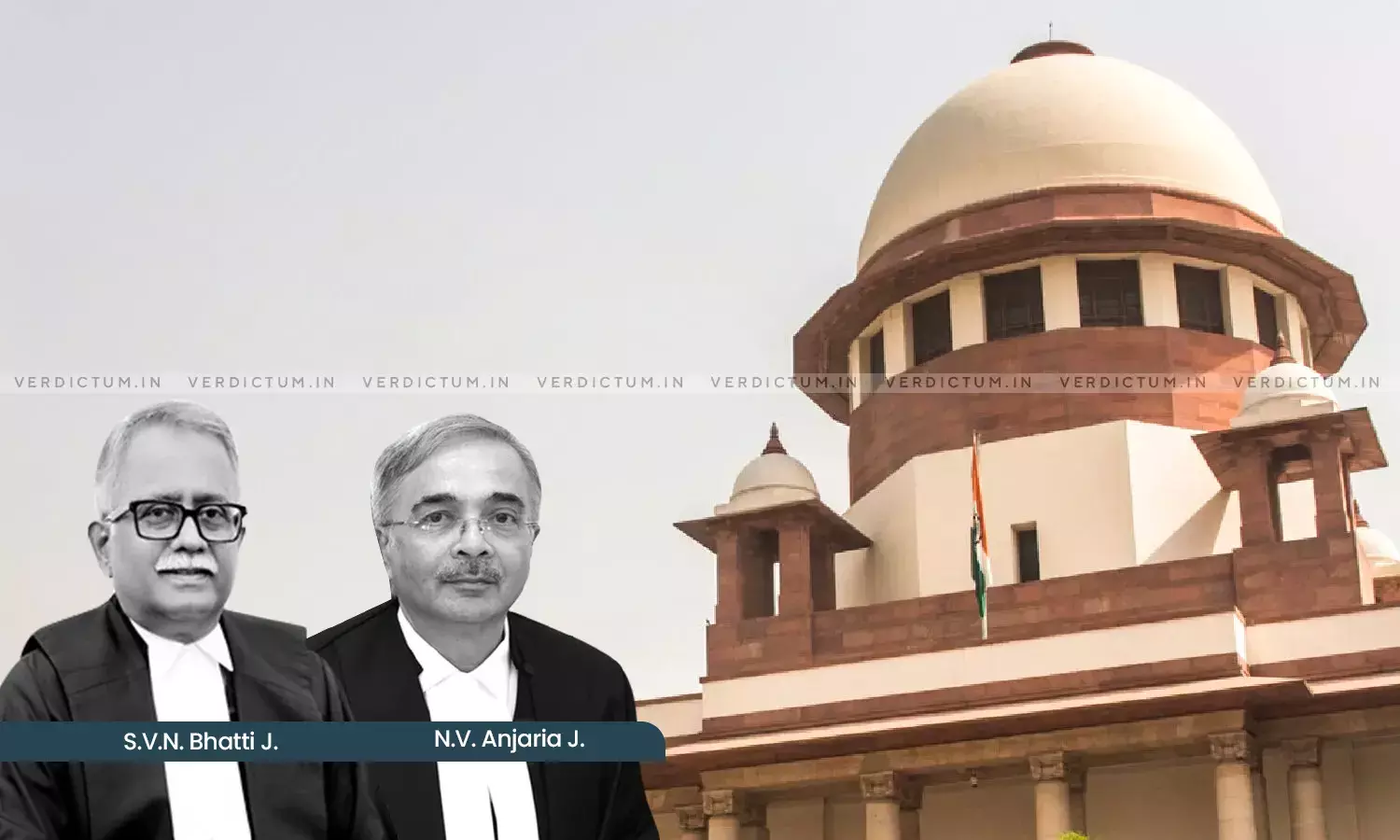
Justice S.V.N. Bhatti, Justice N.V. Anjaria, Supreme Court
The Supreme Court has held that an Executing Court considering a title objection under Order XXI Rule 97 of the CPC must conduct a full inquiry under Rule 101 into all questions concerning the parties’ right, title or interest, while remanding a Waqf Trust’s claim resisting the execution of a possession decree.
The Court was hearing an appeal against a Telangana High Court judgment affirming the rejection of the Waqf’s application resisting execution. The lower courts had found that its application under Order XXI Rule 58 was not maintainable because the execution petition sought possession rather than attachment and had also rejected its claim on merits.
A Bench of Justice S.V.N. Bhatti and Justice N.V. Anjaria observed: “Courts adjudicating an Application under Order XXI Rule 97 must do so in accordance with Rule 101 of the CPC and conduct a full-fledged inquiry into all questions, including those relating to the right, title, or interest in the property arising between the parties.”
Senior Advocate C. Aryama Sundaram appeared for the appellant-Waqf, while Senior Advocate Basava Prabhu S. Patil appeared for the first respondent.
Background
The first respondent obtained an ex parte decree in 2015 for specific performance of an alleged agreement of sale concerning 373 square yards of property comprising shops in Hyderabad. The decree also entitled him to possession.
When the decree-holder initiated execution proceedings, Alladin Charities and Zakat Wakf entered as a third-party objector and resisted delivery of possession. It claimed an independent title and possession based upon a Farman issued by the former Nizam of Hyderabad, a Muntakhab describing the endowed property, a 1976 Trust Deed and proceedings under the Waqf Act, 1995.
The Executing Court dismissed the application after finding that Order XXI Rule 58 dealt with objections to attachment rather than delivery of possession. It also held that the Waqf had not established that the property covered by the execution petition formed part of its notified property.
The Telangana High Court agreed that the application should have been filed under Order XXI Rule 97. It nevertheless dismissed the appeal on merits after finding insufficient material connecting the disputed municipal numbers with the Waqf property.
Before the Supreme Court, the Waqf contended that citing the wrong procedural provision could not justify rejecting its substantive objection. It argued that the identity and title of the property required a detailed inquiry under Rules 97 to 101.
The decree-holder defended the orders but, in response to the Court’s query concerning correlation between the property descriptions in the earlier sale deed, agreement and court-executed sale deed, suggested remanding the matter so that both parties could file additional pleas and evidence.
Court’s Observations
Rules 97-101 Extend To Strangers Claiming Independent Rights
Referring to Periyammal v. V. Rajamani (2025), the Court noted that the execution procedure is not confined to resistance offered by a judgment-debtor. A stranger claiming an independent right, title or interest may also invoke the adjudicatory mechanism.
Summarising the precedent, the Bench stated: “Order XXI Rule 35 of the CPC confers jurisdiction on the Executing Court to remove any person bound by the Decree who refuses to vacate the property. Rules 97 to 101 of Order XXI deal with situations where execution is obstructed or resisted by ‘any person’, including even a stranger to the Decree who is not bound by it or who claims an independent right, title or interest in the property.”
The Court further noted that Rule 97 operates before execution of a possession decree, while Rule 99 applies when a stranger claiming rights in the property has already been dispossessed and seeks restoration.
Resistance Must Be Adjudicated Before Possession Is Delivered
The Court observed that a decree-holder facing resistance from a purported stranger must seek adjudication under Rule 97 rather than bypassing the objection and repeatedly seeking a possession warrant under Rule 35.
The Bench stated: “If a purported stranger to the Decree resists execution, the DHR’s sole remedy lies under Order XXI Rule 97 of the CPC. The Holder cannot bypass such obstruction and insist on the reissuance of the warrant for possession under Order XXI Rule 35.”
The Court held that the resulting inquiry must comply with Rule 101 and encompass every question of right, title or interest arising between the parties. It found that some conclusions in the orders under challenge did not conform to these principles.
Fresh Pleas And Evidence Permitted
The Court did not finally determine whether the disputed property belonged to the Waqf or the decree-holder. It instead restored the dispute to the stage at which the rival title and property-identification claims could be examined through a complete inquiry.
The Bench directed: “The matter is remanded to the VII Senior Civil Judge, City Civil Court at Hyderabad, State of Telangana for disposal as indicated above.”
Both parties were permitted to raise further or fresh pleas and place their respective material before the Executing Court.
Conclusion
The Supreme Court allowed the appeal and set aside the orders of the Executing Court and the Telangana High Court.
It remanded the matter to the VII Senior Civil Judge, City Civil Court at Hyderabad, with directions to permit additional pleas from both sides, conduct a fresh inquiry under Order XXI Rules 97 to 101 CPC and decide the dispute afresh in accordance with law.
The Court made no order as to costs and disposed of the pending applications.
Cause Title: Alladin Charities and Zakat Wakf v. Mohammed Saleem Alias Mohd. Wajid Ali and Another (Neutral Citation: 2026 INSC 1122)
Appearances
Appellant: Senior Advocate C. Aryama Sundaram; Advocate-on-Record Pranab Kumar Mullick; Advocates Soma Mullick and Rishabh Agrawal
Respondents: Senior Advocate Basava Prabhu S. Patil; Advocate-on-Record Juristrust Law Offices