Competing Property Claims Requiring Evidence Should Be Decided By Civil Court, Not Under Article 226: Supreme Court
The Apex Court held that the disputed area's status required evidence and an examination of contemporaneous documents.
The Supreme Court has held that competing property claims requiring the appreciation of evidence and examination of contemporaneous documents should be decided by the competent Civil Court, rather than in proceedings under Article 226 of the Constitution.
The Court accordingly set aside the Bombay High Court’s findings concerning the disputed status of a residential building’s terrace.
The Court was hearing a civil appeal against a Bombay High Court judgment in a housing society's writ petition under Article 226 of the Constitution. The High Court had directed the Municipal Corporation of Greater Mumbai to implement an order requiring the removal of alleged unauthorised works, although the flat owner had challenged the municipal notice and order before the Bombay City Civil Court.
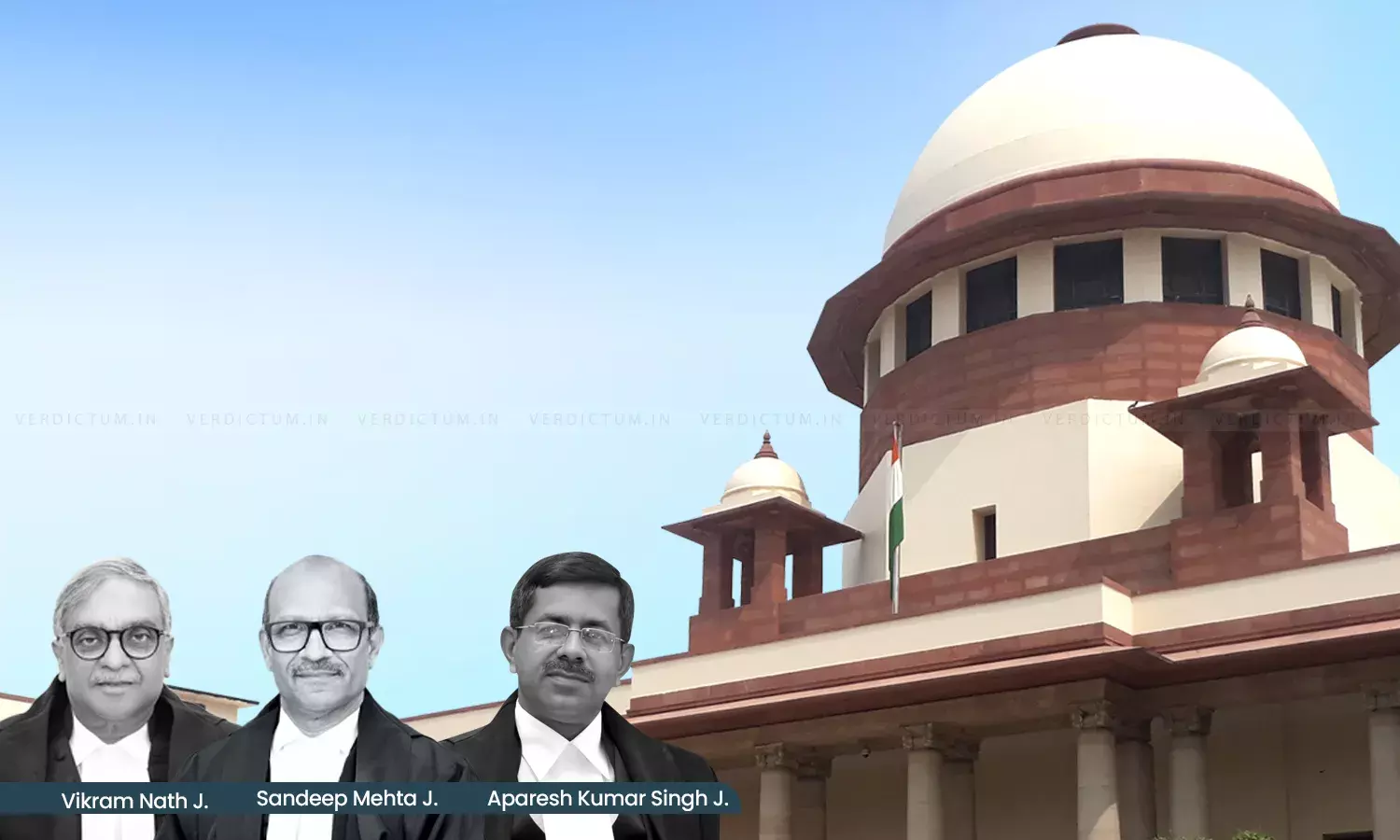
A Bench of Justice Vikram Nath, Justice Sandeep Mehta and Justice Aparesh Kumar Singh observed: “In view of the competing claims of the parties regarding the status of the said terrace area and the specific plea raised by the appellant that apart from the portion claimed by him, another portion of the terrace is open to the sky, intended for common use and accessible through both staircases, we are of the firm opinion that the High Court erred in exercising the extraordinary jurisdiction under Article 226 of the Constitution of India in the petition preferred by the respondents to adjudicate a lis which involves seriously disputed questions of fact. The findings in the impugned judgment being based on conjectures and surmises, cannot be affirmed.”
Advocate Mayank Kshirsagar (AOR) appeared for the appellant. Advocate Samit Dilip Shukla appeared for the respondents.
Background
The dispute concerned the terrace above four flats purchased by the appellant in a high-rise residential building. The original fire-safety approval treated the terrace floor as a refuge area. The flat owner, however, relied on the subsequent fire approval and sanctioned plans to contend that the portion claimed by him had not been retained as a refuge area in the final approved configuration.
The flat owner asserted that the terrace areas corresponding to his flats formed part of an integrated arrangement and that a separate portion remained open to the sky for common use, with access through two staircases. The housing society disputed his interpretation and maintained that the entire terrace formed part of the refuge area intended for the residents' safety.
Following the society's complaint, the municipal authorities inspected the premises. The Municipal Corporation later issued a notice under Section 53(1), read with Sections 52(1)(b) and 52(1)(d), of the Maharashtra Regional and Town Planning Act, 1966, alleging that unauthorised works had been carried out in the flat and terrace without permission. The Corporation subsequently directed the flat owner to remove those works within 15 days.
The flat owner challenged the notice and order before the Bombay City Civil Court. While the suit remained pending, the Bombay High Court allowed the society's writ petition and directed the Corporation to implement its order immediately. The High Court also issued directions concerning the internal staircase and required the common door providing access to the terrace to be opened.
Before the Supreme Court, the flat owner contended that the High Court had entered into seriously disputed factual issues and had prejudiced the adjudication pending before the Civil Court. The society continued to dispute his claim over the terrace and asserted that it had been earmarked as a common refuge area.
Court's Observations
Disputed Terrace Claims Required Evidence
The Supreme Court found that the parties had raised competing claims concerning the status of the terrace. It held that determining whether the portion claimed by the flat owner formed part of the refuge area required the appreciation and sifting of evidence and an examination of contemporaneous documents. Those questions were already under consideration in the pending civil suit.
The Court explained the limits of writ jurisdiction: “Law is well settled that a Court examining a lis under Article 226 of the Constitution of India is not obliged to entertain a challenge involving seriously disputed factual aspects. Such issues may more appropriately be examined by the competent Civil Court or the prescribed statutory authority, as the case may be.”
The Court found that the High Court's conclusions had the tenor of conjectures and surmises based on photographs produced during the writ proceedings. It held that the High Court should not have adjudicated the parties' competing factual claims through its extraordinary jurisdiction under Article 226 of the Constitution.
Immediate Implementation Prejudiced Pending Suit
The Supreme Court noted that the High Court had stated that it was not deciding the parties' entitlement, but had nevertheless mandated immediate implementation of the very municipal order challenged in the pending suit. It further noted that, in the absence of an injunction, the onus was on the Corporation to take the steps necessary to implement its order. A judicial mandate for immediate enforcement, however, would constrain the Civil Court's independent adjudication.
The Court observed: “By effect of the mandatory directions issued by the High Court supra for immediate implementation, the remedy before the Civil Court would be overshadowed, leaving hardly any scope for the Civil Court to take an independent view on the legality and validity of the order dated 10th August, 2025. In our opinion, the directions issued by the High Court have the effect of pre-empting adjudication of seriously disputed questions of fact which completely overlap with the issues pending before the Civil Court.”
The Court held that the High Court's direction would have an adverse bearing on the adjudication of the suit and would virtually make the civil remedy redundant. It therefore set aside the High Court's judgment to the extent indicated and permitted the flat owner to raise all available defences and contentions before the Civil Court. The housing society was also permitted to contest the suit.
Emergency Access Preserved; Civil Suit Expedited
The Supreme Court sustained the direction requiring the common terrace-access door to remain open. It held that the measure was justified because it preserved clear and unhindered access for all occupants during an emergency, without restricting the Civil Court's discretion in the pending suit.
The Court observed: “The said direction appears to be justified insofar as it would ensure clear and unhindered access to the terrace to all occupants of the building in case of an emergency situation. Thus, to that extent, the impugned order is sustained without prejudice to the judicial discretion of the trial Court in the pending civil suit filed by the appellant.”
Considering that the dispute concerned rival claims over an area meant for the residents' safety and security, the Court directed the Civil Court to expedite the proceedings and endeavour to conclude the suit within six months from the presentation of a copy of its decision.
The Court clarified: “Needless to say that the Civil Court shall decide the suit uninfluenced by the observations made in the impugned judgment and all parties shall cooperate in the expeditious disposal of the suit.”
Conclusion
The Supreme Court allowed the appeal and set aside the Bombay High Court's judgment to the extent that it directed immediate implementation of the municipal order and prejudiced the pending civil suit. It retained the direction requiring the common terrace-access door to remain open for emergencies. The Civil Court was directed to decide the suit independently and preferably within six months from the presentation of a copy of the Supreme Court's decision. All pending applications were disposed of.
Cause Title: Ajit Patel v. Evita Co-operative Housing Society Limited and Others (Neutral Citation: 2026 INSC 1269)
Appearances
Appellant: Mayank Kshirsagar (AOR); Darryl Pereira, Pankhuri, Anumita Verma, Shikhar Rai and Natasha Kasad, Advocates
Respondents: Mohit D. Ram and H.K. Chaturvedi (AOR); Abbas Zaidy, Nayan Gupta, Tejas Rai, Anjali Chaturvedi, Sagar Chaturvedi, Megha Chaturvedi, Samit Dilip Shukla and Protyusha Thanawala, Advocates; Trilegal Advocates On Record