

Demand For Bribe Is Sine Qua Non For Establishing Offence U/S 7 & 13 PC Act: Supreme Court Sets Aside Conviction Despite Sentence Already Undergone
The Court while clearing Education Office assistant of charges noted that no witness saw demand or handover of money; reiterated recovery of tainted notes alone cannot sustain conviction.

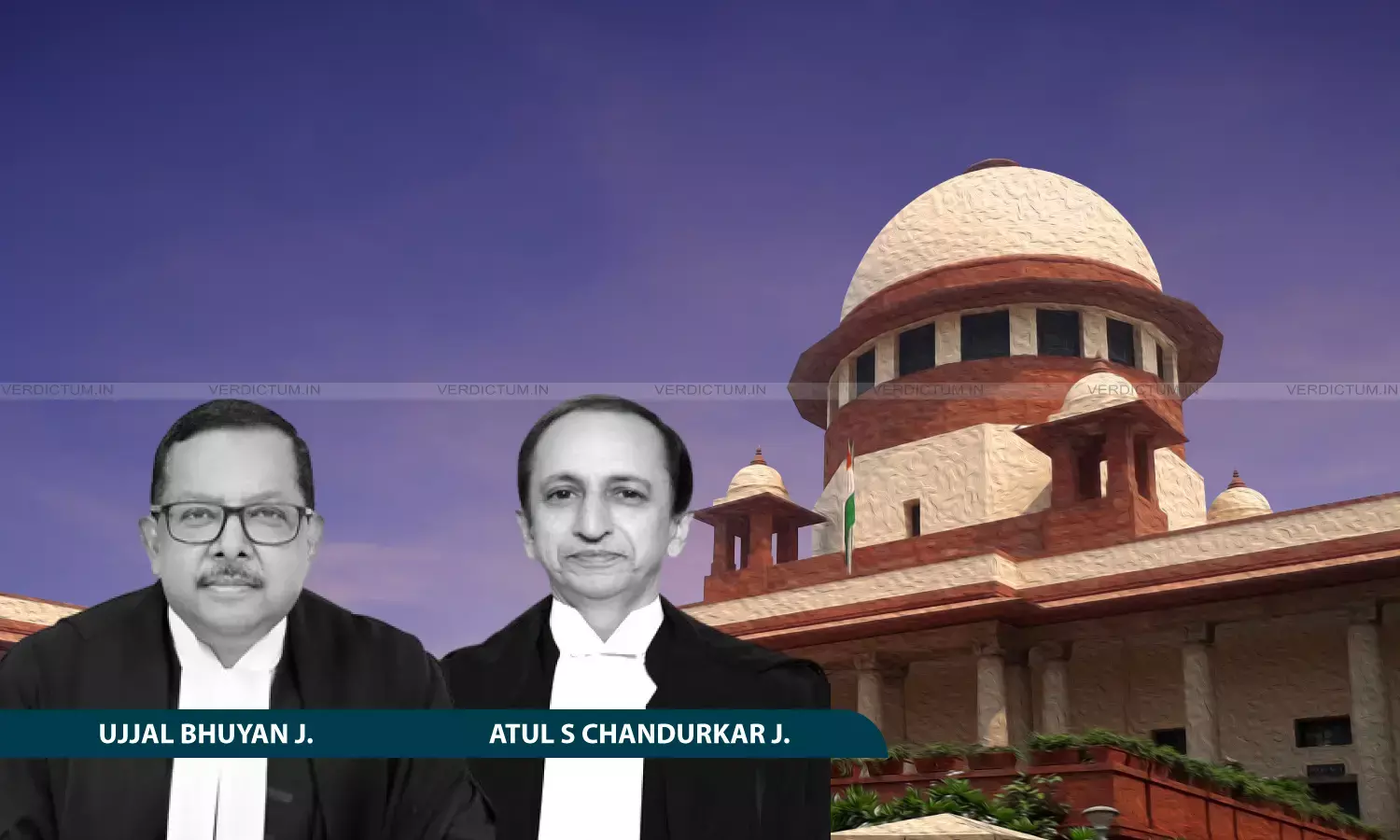
The Supreme Court has held that demand for a bribe is the sine qua non for establishing an offence under Sections 7 and 13 of the Prevention of Corruption Act, 1988. Setting aside the conviction of a District Education Office assistant, the Court cleared him of the charges even though he had already undergone his sentence and paid the fine, as he had pursued the appeal to clear his name.
The case rested on the uncorroborated testimony of the complainant. The Court declared the charge not proved and cleared the appellant, who had already undergone his sentence and sought to clear his name.
A Bench of Justice Ujjal Bhuyan and Justice Atul S. Chandurkar referring to Aman Bhatia v. State 2025 SCC OnLine SC 1013, noted, “…mere recovery of tainted money, by itself, is insufficient to establish the charge(s) against an accused under the PC Act. The Bench held that to sustain a conviction under Sections 7 and 13 of the PC Act, the prosecution must prove beyond reasonable doubt that the public servant voluntarily accepted the money, knowing it to be a bribe. 3 2025 SCC OnLine SC 1013 23 Thus, the demand for bribe is the sine qua non for establishing an offence under Sections 7 and 13 of the PC Act”.
Advocate Shambo Nandy, AOR appeared for the appellant and Advocate Anando Mukherjee, AOR for the respondent.
The complainant, appointed an orderly in a Government High School on February 1, 2010, alleged that the appellant demanded Rs. 5,000 as a bribe to release his unpaid salary. A trap was laid on May 20, 2010. The prosecution claimed the money was paid at the appellant's residence and recovered from under his pillow, and that his fingers turned a solution pink.
Thereafter, a Vigilance Case led to a conviction under Sections 7 and 13(2) by the Special Judge, Anti-Corruption Bureau, West Singhbhum, on February 27, 2021. The appellant received four years' rigorous imprisonment and a fine of Rs. 10,000 on each count, to run concurrently. The Jharkhand High Court dismissed his appeal on July 21, 2022. The Supreme Court issued notice on July 24, 2026, granted leave on September 23, 2026, and reserved judgment after hearing.
The Court found "inconsistencies galore" in the trap narrative, as witnesses differed on whether the appellant was apprehended at his residence or his office. Two office clerks said they signed the seizure papers at the vigilance officials' direction.
Crucially, no witness saw the demand or the payment. The Court relied on P. Satyanarayana Murthy v. State of A.P. (2015) 10 SCC 152, the Constitution Bench in Neeraj Dutta v. State (Government of NCT of Delhi) (2023) 4 SCC 731, and Jaswinder Singh v. State of Punjab 2026 SCC OnLine SC 1952 to hold that demand and acceptance must be proved as facts in issue, and that recovery alone is not enough.
The Court set aside the Special Judge's judgment and the High Court's judgment, declared that the charge under Sections 7 and 13 could not be proved, and allowed the appeal.
Cause Title: Ajit Kumar v. State of Jharkhand (Neutral Citation: 2026 INSC 1084)
Appearances:
Appellant: Shambo Nandy, AOR Daksh Sharma, Advocates.
Respondent: Anando Mukherjee, AOR, Shwetank Singh, Advocates.
Click here to read/download the Judgment