

RBI-IBA Caution List Cannot Be Used To Blacklist Advocates For Alleged Negligence: Supreme Court Directs BCI To Audit Disciplinary Mechanism
The Apex Court held that banks and the Indian Banks’ Association cannot use the RBI-backed Caution List mechanism, meant for fraudulent third-party entities, to brand an advocate as negligent or professionally incompetent, while directing the removal of an advocate’s name from the list.
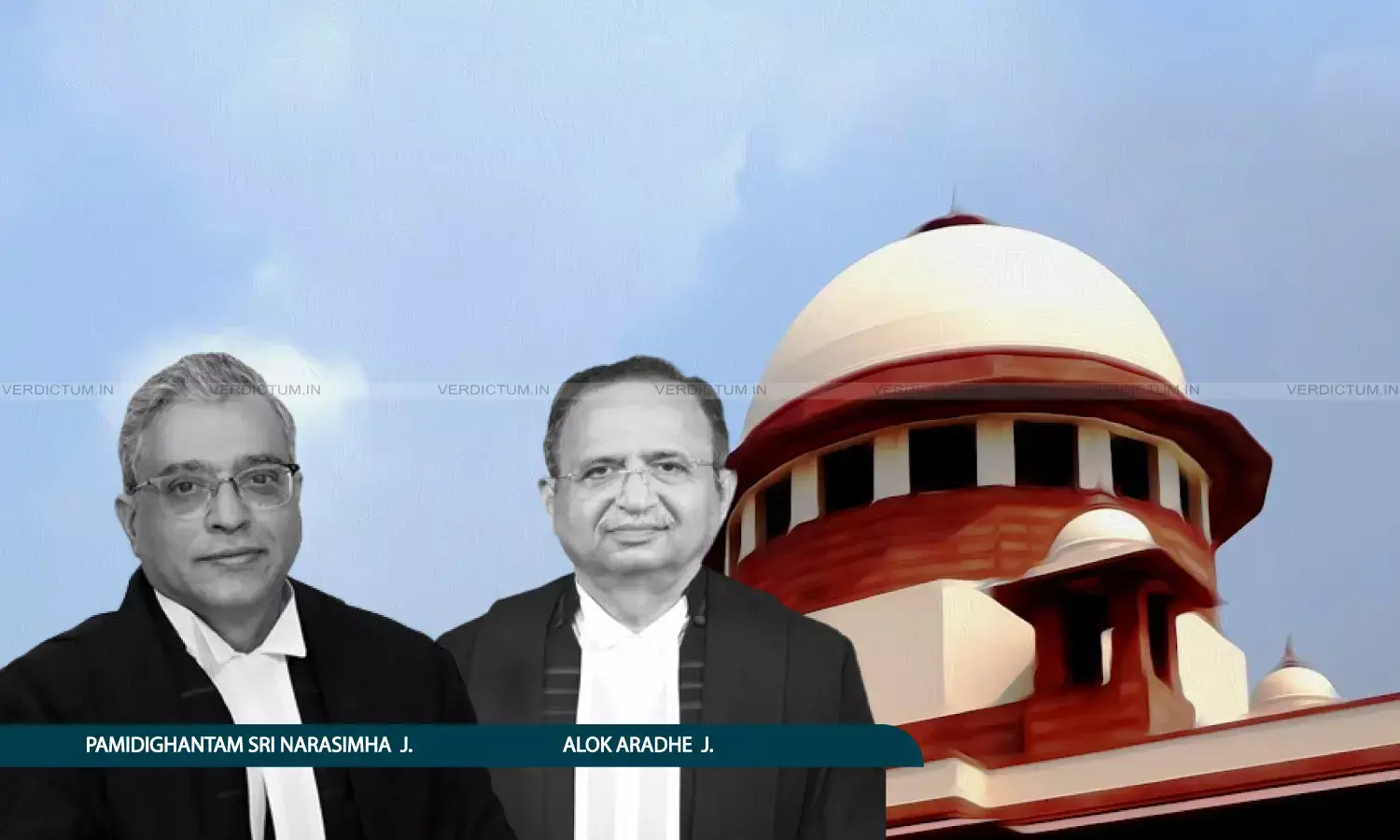
Justice Pamidighantam Sri Narasimha and Justice Alok Aradhe, Supreme Court
The Supreme Court has held that the RBI-IBA Caution List mechanism, meant to alert banks against fraudulent third-party entities, cannot be used to blacklist advocates for alleged negligence in rendering legal opinions, while directing the Bar Council of India to undertake a performance audit of its disciplinary mechanism to ensure that complaints of professional misconduct are dealt with promptly, fairly and effectively.
The Court was hearing an appeal filed by an advocate whose name had been included in the Indian Banks’ Association Caution List after a bank alleged that his title verification opinion exposed it to financial risk. The High Court had declined to entertain his writ petition on the ground that the IBA was not “State” under Article 12 of the Constitution.
A Bench of Justice Pamidighantam Sri Narasimha and Justice Alok Aradhe held that the writ petition was maintainable as the inclusion of the advocate’s name in the Caution List was illegal, and observed: “While the RBI may issue directions to ensure integrity in banking transactions, such power does not include declaring an advocate professionally negligent by including his name on a Caution List, which is meant to identify fraudulent entities. In the present case, where the allegation against the appellant pertains solely to negligence, the inclusion of his name in the Caution List is unsustainable. In view of the above discussion and analysis, we hold that the respondent Bank and IBA cannot include the name of the appellant in the Caution List. Consequently, we direct them to remove the appellant’s name from the Caution List with immediate effect.”
The Bench further held: “Permitting banks or banking associations to bypass the disciplinary process under the Advocates Act and unilaterally portray an advocate as professionally incompetent by including his name in a Caution List is illegal, unsustainable and impermissible. It would amount to circumventing the legal profession's freedom of self-regulation, which, in turn, is an inextricable feature of the independence of the judiciary. Consequently, we hold that the action of including appellant’s name in the Caution List and the consequent comment on his competency is illegal and is set aside.”
Advocate Pankaj Agarwal appeared for the appellant, while Advocate Rajesh Kumar Gautam appeared for the respondents. Senior Advocate Maninder Singh assisted the Court as Amicus Curiae.
Background
The appellant, an advocate enrolled in 1998, had been on the panel of several banks and financial institutions. The dispute arose from a legal opinion furnished by him in relation to immovable property offered as security for a credit facility. The bank alleged that the opinion was erroneous because it did not account for prior sale transactions concerning part of the property.
After considering his explanation, the bank removed him from its panel on the grounds of negligence in title verification. It then forwarded his name to the IBA for inclusion in the Caution List titled “Third Party Entities Involved in Fraud”, with a remark that he had given a wrong legal opinion and was negligent.
The advocate challenged the action, contending that the inclusion was made without notice, affected his professional engagements with other institutions, and damaged his reputation.
Court’s Observation
Writ Maintainable Against Sector-Wide Caution List
The Court began by examining whether the writ petition could have been rejected only because IBA was not “State” under Article 12. Referring to the wider sweep of Article 226 and decisions including Andi Mukta Sadguru Shree Muktajee Vandas Swami Suvarna Jayanti Mahotsav Smarak Trust v. V.R. Rudani (1989), Zee Telefilms Ltd. v. Union of India (2005), Kaushal Kishor v. State of U.P. (2023), and S. Shobha v. Muthoot Finance Ltd. (2025), the Court held that the nature of the function and its effect on legal rights were decisive.
The Court stated: “The appellant is not merely aggrieved by his de-empanelment by a Bank, which may well fall within the realm of a contractual relationship. His real grievance is against the inclusion of his name in the Caution List with remarks casting aspersions on his professional competence and integrity. Such action undoubtedly carries serious consequences as it has the potential to affect his standing as an advocate and his future professional engagements, particularly by financial institutions. The appellant, therefore, asserts infringement of his fundamental right to practise the profession of law under Article 19(1)(g) of the Constitution. Once such a grievance is raised, the High Court, exercising jurisdiction under Article 226, could not have declined examination of the matter solely on the ground that the body against whom relief was sought may not strictly fall within the definition of “State” under Article 12.”
The Court also distinguished a Bombay High Court decision concerning an IBA service dispute, noting that the present challenge concerned “maintenance and dissemination of a sector-wide Caution List” under RBI guidelines.
RBI Circulars Target Fraud, Not Professional Negligence
The Court then examined Section 35A of the Banking Regulation Act, 1949 and the RBI circulars on fraud risk management. It accepted that RBI could issue directions to preserve banking discipline and prevent fraud, but drew a clear line between fraud prevention and disciplining an advocate for alleged negligence.
The Court noted: “There can be no quarrel with the proposition that the RBI, as a sectoral regulator, is entitled to devise such regulatory measures aimed at maintaining the stability of the banking system. However, the issue before us is not whether the RBI possesses the authority to issue regulatory directions in matters concerning banking discipline and fraud prevention, but whether the measures contemplated in the circulars, when applied to advocates rendering professional services, amount to disciplinary action based on their professional conduct.”
The Bench highlighted that there was no allegation of fraud, collusion, criminal misconduct, or deliberate facilitation of fraudulent activity against the advocate. The allegation was confined to negligence in title verification.
The Court underscored: “Fraud, by its very nature, imports an element of mens rea and deliberate intention and design to defraud. An erroneous legal opinion or an omission in the course of due diligence, absent any allegation of dishonest intent or deliberate facilitation of illegality, cannot be elevated to the level of fraud.”
Banks May Discontinue Empanelment, But Cannot Blacklist Advocates As Fraudulent
The Court clarified that a bank may internally assess the quality of services rendered by a panel advocate and discontinue empanelment if dissatisfied. However, circulating an advocate’s name across banks under a fraud-related Caution List has wider consequences beyond the contractual relationship.
The Court observed that such inclusion “effectively amounted to professional blacklisting” and adversely affected the advocate’s standing and future professional engagements.
Advocates Act Preserves Professional Self-Regulation
The Court then turned to the Advocates Act, 1961 and held that allegations of professional conduct, competence or negligence must be addressed through the disciplinary machinery of the State Bar Councils and the Bar Council of India.
The Bench stated: “Independence of the legal profession is as important as independence of the judiciary. In fact, their independence from the executive and the legislature is the foundation of the rule of law and democracy. The independence of the legal profession is secured by the principle of self- regulation. This principle has had statutory recognition with the passing of the Advocates Act, 1961. Questions concerning the professional conduct, competence, or negligence of an advocate fall within the exclusive domain of the disciplinary mechanism contemplated under the said enactment and are to be examined by the statutory bodies constituted thereunder. Permitting external agencies or institutions to record adverse findings and opinions about the professional standing of advocates would not only transgress the legislative framework governing the legal profession but also undermine the independence of the Bar.”
The Court also referred to Supreme Court Bar Association v. Union of India (1998), Bar Council of Maharashtra v. M.V. Dabholkar (1975), and Bar of Indian Lawyers v. D.K. Gandhi PS National Institute of Communicable Diseases (2024) while discussing the sui generis nature of the legal profession and the statutory role of Bar Councils.
Accountability Must Be Strengthened Within The Bar Council Framework
The Court clarified that its judgment should not be understood as diluting the accountability of advocates, especially because legal opinions in banking transactions have serious financial implications. However, it said the remedy lies in strengthening statutory disciplinary mechanisms, not creating parallel processes.
The Court remarked: “The concerns expressed by banks and financial institutions regarding diligence, quality and reliability of legal opinions furnished by advocates cannot be ignored. Modern banking transactions require well- considered legal opinions, and they constitute an important part of institutional decision-making. Such opinions are critical as banking and financial transactions involve substantial financial exposure. Deficiencies in professional services will have immediate and substantial financial consequences. The solution for accountability lies not in the creation of parallel structures, like declarations in Caution Lists, as in the present case, but in strengthening the existing regulatory mechanisms contemplated under the Advocates Act, 1961 itself.”
The Bench directed the Bar Council of India to undertake a performance audit of its disciplinary mechanisms and those of the State Bar Councils.
The Court added: “In view of the above discussion and having regard to the importance of maintaining public confidence in the institution of lawyers, it is desirable that the Bar Council of India undertakes a comprehensive performance audit of the disciplinary mechanisms administered by it and the State Bar Councils under the Advocates Act, 1961. We direct the Bar Council of India to constitute a committee and seek an objective assessment of its duties of self-regulation of professional conduct and discipline, consider the report and file an affidavit of the action proposed/taken.”
Continuing Legal Education And National Legal Academy
The Court further addressed the need for Continuing Legal Education, noting that professional competence cannot be maintained merely by rules on misconduct.
The Bench stated: “In India, the statutory responsibility for maintaining standards of professional conduct and legal education rests with the Bar Council of India and the State Bar Councils under the Advocates Act, 1961. While considerable attention has been devoted to legal education at the entry level through law universities and professional examinations, there is a glaring dearth in institutionalised learning for advocates after enrolment.”
The Court, while stating that "to maintain the highest standards of professional competence, legal knowledge, advocacy skills, and ethical conduct expected from members of this noble profession, we have directed the Bar Council of India to initiate and institutionalise the discipline and culture of Continuing Legal Education (CLE)", emphasised that “continuing Legal Education should not be viewed as a mere regulatory requirement, but as a professional commitment to excellence and service".
Such programmes, the Bench added, "can also bridge the knowledge gap between urban and rural practitioners, ensuring that lawyers across the country have access to developments in law, technology, advocacy skills, and professional ethics.”
The Court further suggested that "the Bar Council of India may consider establishing a National Legal Academy (NLA) for members, like how the National Judicial Academy (NJA) was established for Judges", while adding that "there is both a need and a promise in a successful collaboration among these Academies".
The Court also called for a shared responsibility of the Bar and Bench in reducing pendency, and suggested serious consideration of a National Legal Academy for lawyers.
Conclusion
Allowing the appeal, the Supreme Court set aside the High Court judgment and directed the immediate removal of the advocate’s name from the Caution List.
The matter was directed to be listed for further consideration on issues relating to Continuing Legal Education and the proposal for establishing a National Legal Academy.
Cause Title: Ajay Vijh v. Indian Banks Association & Ors. (Neutral Citation: 2026 INSC 670)
Appearances
Appellant: Pankaj Agarwal, Sunil Murarka, Neha Agrawal, Siddhant Sahay, Advocates, with E.C. Agrawala, AOR
Respondents: Rajesh Kumar Gautam, AOR, with Advocates Anant Gautam, Vibhu Sharma, Likivi Jakhalu, Aman Gahlot, Isha Gaur, Rishi Chauhan, Azal Aekram; Radhika Gautam, AOR, with Advocates Radhika Gautam and Anjul Dwivedi; Gurmeet Singh Makker, AOR
Amicus Curiae: Senior Advocate Maninder Singh, assisted by Advocates Rajat Nair and Prabhas Bajaj
