Transitional Area Retains Rural Character Until Final Notification Declaring It A Municipality Under Article 243-Q Of Constitution: Supreme Court
The Apex Court also reiterated that a coordinate Bench could not bypass an earlier Division Bench view by relying on a judgment of another High Court and had to refer the matter to a larger Bench if it doubted the earlier ruling.
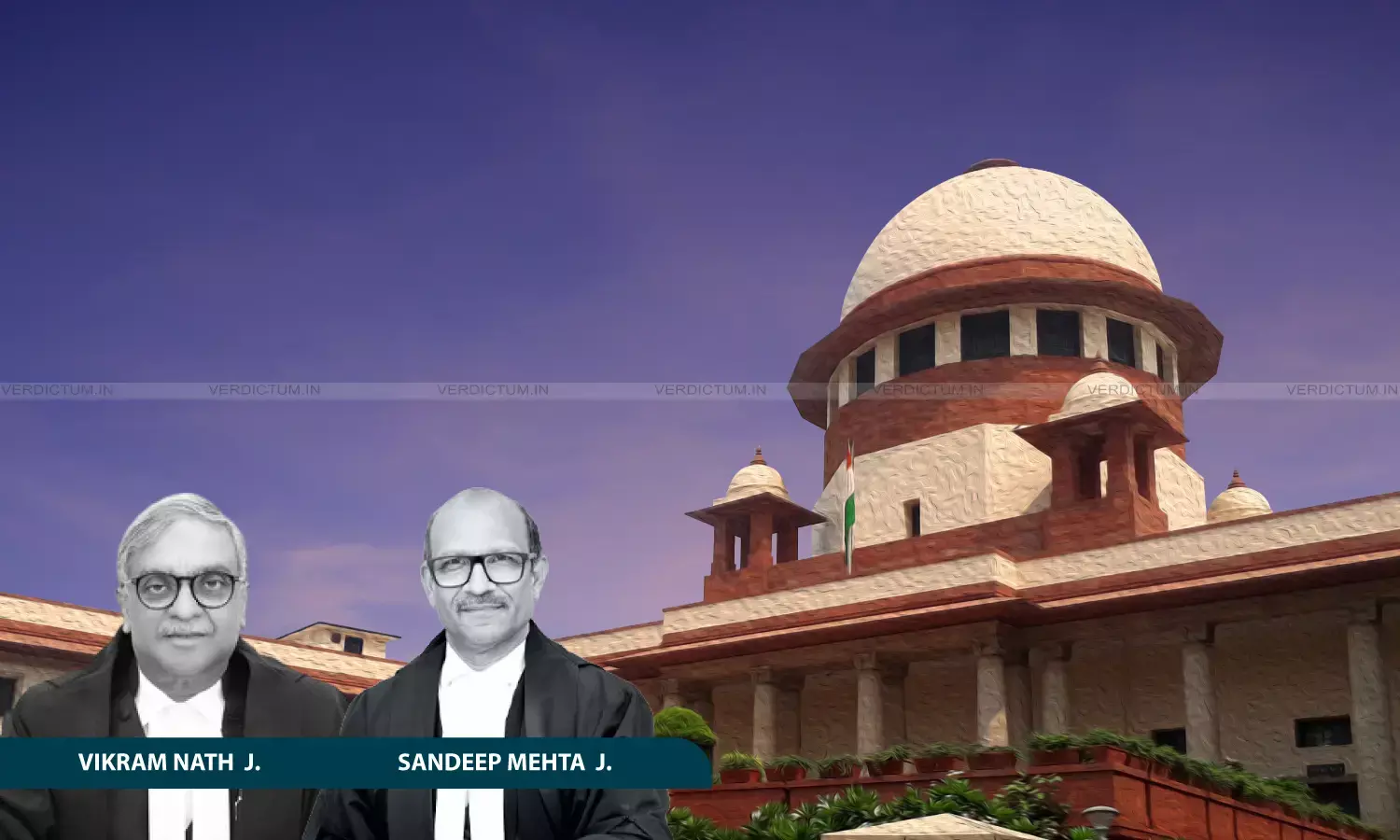
Justice Vikram Nath, Justice Sandeep Mehta, Supreme Court
The Supreme Court has held that a transitional area under Article 243-Q of the Constitution retains its rural character until a final notification is issued declaring it to be a municipality.
The Court was hearing appeals against the judgment of the Bombay High Court, Nagpur Bench, which had held that students whose schools were situated in Nagar Panchayat or transitional areas could not claim the benefit of 75% Rural Category reservation under the Jawahar Navodaya Vidyalaya Selection Test Scheme, 2026.
A Bench of Justice Vikram Nath and Justice Sandeep Mehta observed: “The presumption, in our opinion, would operate in favour of treating the area in question to be rural till the final transition takes place. It is our firm opinion that until and unless the final notification declaring the area under question to be a municipality as per the header of Article 243-Q of the Constitution of India is issued, the transitional area would definitely retain its character as a rural area.”
Chapalgaonkar Siddharth Sarang, AOR, appeared for the appellants, while S. Rajappa, AOR, and Aaditya Aniruddha Pande, AOR, appeared for the respondents.
Background
The dispute concerned admission to Class VI in Jawahar Navodaya Vidyalaya under JNVST-2026. The appellants had been provisionally selected from the rural quota, but were denied final admission on the ground that for a few months in Class III they had studied in schools situated in areas notified as Nagar Panchayat or transitional areas under the Maharashtra Municipal Councils, Nagar Panchayats and Industrial Townships Act, 1965.
The High Court held that once an area was declared transitional, it ceased to retain rural character and could not be treated as rural for JNV rural quota admission. It also held that areas not notified by the government as rural areas would be treated as urban areas for admission under the rural quota.
The appellants argued that a previous Division Bench of the same High Court had taken the contrary view in Jiya Jitendra Nagrale v. State of Maharashtra, and that a coordinate Bench could not ignore that decision by relying on another High Court ruling. They also argued that the subsequent UDISE Guidelines could not be applied after the selection process had concluded. The respondents submitted that declaration of an area as a Nagar Panchayat permanently ended its rural character, and that UDISE was only a verification mechanism.
Court’s Observations
The Supreme Court, at the outset, noted that the later Division Bench judgment of the High Court in Arpita Santosh More had taken a “diagonally opposite view” to the earlier Division Bench decision in Jiya Jitendra Nagrale.
The Court observed: “Having gone through the conclusions in the two conflicting views of the Benches of co-equal strength of the High Court, we find that the Division Bench in Arpita Santosh More (supra) has virtually overruled the ratio of the judgment in Jiya Jitendra Nagrale (supra) which ex facie runs contrary to the principle of per incurium.”
The Court reiterated that where a coordinate Bench disagrees with an earlier view of the same High Court, the permissible course is to refer the issue to a larger Bench.
The Court held: “In the present case, none of the circumstances which could justify a departure from the earlier view is shown to exist. More importantly, in para 40 of Arpita Santosh More (supra), the Division Bench has explicitly declared the law as laid down in Jiya Jitendra Nagrale (supra) to be incorrect without assigning any logical or rational reason behind such finding. On this ground alone, quite apart from the merits, the impugned judgment cannot be sustained.”
On merits, the Court held that Article 243-Q itself differentiates between a transitional area, a smaller urban area and a larger urban area.
The Court observed: “Clause (a) refers to “a transitional area, that is to say, an area in transition from a rural area to an urban area”, whereas clauses (b) and (c) employ the expressions “a smaller urban area” and “a larger urban area”, respectively. The Constitution has, therefore, specifically used different expressions in the three clauses.”
It added that if “transitional area” were treated as synonymous with “urban area”, the distinction maintained in Article 243-Q(1)(a) would lose its independent meaning.
The Court then examined the 1965 Act and found that its scheme also maintained a distinction between transitional areas and smaller urban areas.
The Court stated: “Section 341-A, on the other hand, empowers the State Government to declare an area to be “in transition from a rural area to an urban area”, leading to the constitution of a Nagar Panchayat. The Legislature has, thus, treated a transitional area as a category distinct from a smaller urban area.”
Referring to the absence of any notification under Section 341-D for the concerned areas, the Court held that they continued to be governed as transitional areas under the statutory framework. It observed that the statutory scheme “does not place a Nagar Panchayat on the same footing as a Municipal Council.”
The Court found that the High Court had wrongly relied upon Rakam Singh v. State of Uttar Pradesh (2015), since that case arose in the context of an industrial township under the proviso to Article 243-Q(1), and not a Nagar Panchayat under Article 243-Q(1)(a).
The Court observed: “The present case raises an entirely different question, namely, the legal status of a transitional area constituted under clause (a) of Article 243-Q(1) and its relevance for determining eligibility of the students residing in such area against the seats reserved for rural students under the Jawahar Navodaya Vidyalaya Scheme.”
It further held that Rakam Singh was not concerned with Clause 4.7 of the JNV Prospectus, the object of the JNV Scheme, or the question whether a transitional area should be treated as rural or urban for JNV eligibility.
The Court relied on Clause 4.7 of the JNVST-2026 Prospectus, which stated that urban areas are those defined by government notifications on the last date of submission of applications, and that all other areas would be considered rural.
The Court held: “For the purposes of the Prospectus, an area is to be treated as urban only where it has been so notified by the Government. In the absence of such a notification, it falls within the category of rural area be it transitional or residual. The clause does not envisage any further sub-classification.”
The Court added that the respondent-Samiti was bound to apply the Prospectus as framed and could not introduce an additional eligibility criterion not found in it.
The Court noted that the UDISE Guidelines were issued after the selection process had concluded and that the Prospectus did not refer to the UDISE portal or entries in that database.
The Court observed: “Candidates who applied pursuant to the Prospectus were, therefore, not put to notice that their eligibility under the Rural Category would be determined with reference to entries in the UDISE database.”
It further held that the appellants had applied, appeared in the examination and were provisionally selected under the Prospectus as it stood. The Court therefore concluded that the subsequent UDISE Guidelines could not furnish a basis to revisit their eligibility for JNVST-2026.
The Court clarified: “However, a criterion introduced in the midst of or after the completion of the selection process cannot be applied retrospectively to govern admissions already under process.”
The Court made it clear that the respondent-Samiti was not barred from adopting UDISE or any other uniform verification mechanism for future admissions, provided the criterion was notified before the relevant admission process began.
The Court observed: “If the respondent-Samiti considers it appropriate to rely upon the UDISE classification for determining the rural or urban status of schools, it is at liberty to incorporate such a criterion in the Prospectus or other governing documents applicable to future admission cycles. Once such a requirement is notified in advance, all candidates would have clear notice of the basis on which their eligibility is to be assessed.”
Conclusion
The Supreme Court set aside the impugned judgments of the High Court and directed that the appellants who had qualified and succeeded on merit be admitted to Class VI of Jawahar Navodaya Vidyalaya against seats reserved for the Rural Category forthwith.
If the academic session had already commenced, the respondents were directed to provide bridge classes or other academic support necessary to ensure that the appellants could cover the missed academic exercises and continue their studies without disadvantage.
The Court clarified that the judgment was confined to the JNVST-2026 admission process. It further held that the respondent-Samiti may revise the criteria or verification mechanism, including use of UDISE guidelines, for future admission cycles, but any such revision must be notified before commencement of the relevant admission process and must operate prospectively. The appeals were allowed with no order as to costs.
Cause Title: Adarsh Dinkar Sontakke (Minor) & Ors. Etc. v. Navodaya Vidyalaya Samiti & Ors. Etc. (Neutral Citation: 2026 INSC 865)
Appearances
Appellants: Chapalgaonkar Siddharth Sarang, AOR, with Advocates Sneha Sanjay Botwe, Deepak Chatap, Pranav Deshmukh, Bodhi Ramteke and Akash Tripathi
Respondents: S. Rajappa, AOR, with Advocates R. Gowrishankar, G. Dhivyasri, Samrat Krishnarao Shinde and Siddharth Dharmadhikari; Aaditya Aniruddha Pande, AOR, with Advocate Shrirang B. Varma