

Reluctance Of Independent Witness To Testify In Violent Crimes Fearing Retaliation Cannot Be Held Fatal To Prosecution: Supreme Court
The Court held that non-examination of independent witnesses does not weaken the prosecution's case, particularly in circumstances where fear and societal realities deter public participation.
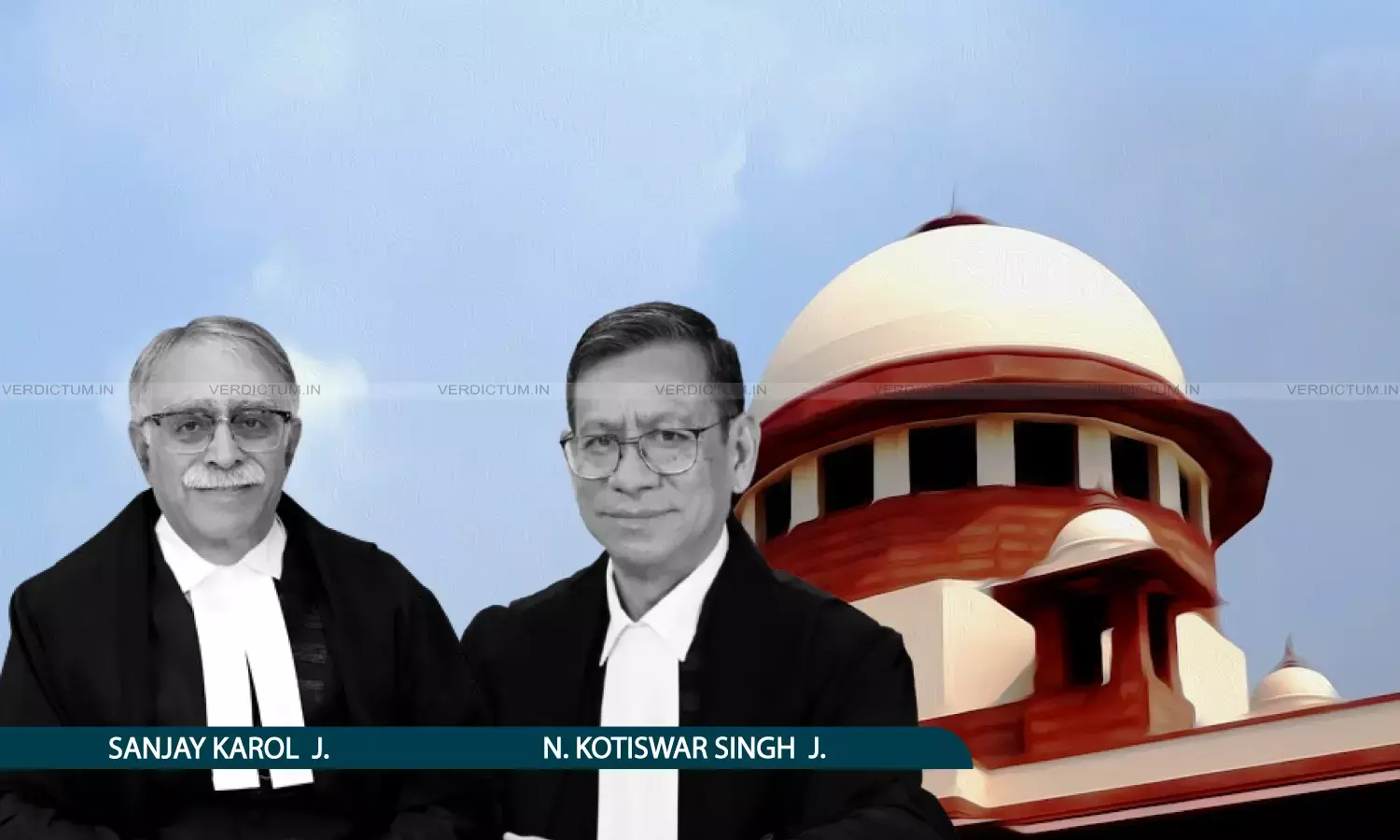
Justice Sanjay Karol, Justice N. Kotiswar Singh, Supreme Court
The Supreme Court has held that the reluctance of independent witnesses to come forward and testify in violent crimes, owing to fear of retaliation, cannot be held fatal to the prosecution's case, particularly where the evidence on record is otherwise credible and reliable.
The Court was hearing criminal appeals challenging the conviction of the appellants under Sections 302, 307, 149 and 120B of the Indian Penal Code, 1860, arising out of a fatal shooting incident.
A Bench of Justice Sanjay Karol and Justice Nongmeikapam Kotiswar Singh observed: “One additional point raised was the absence of any of the villagers to give statements about the incident, i.e., the lack of independent witnesses. It is well settled that the same does not compromise the case of the prosecution. In this case particularly the Court cannot lose sight of societal realities where, allegedly at the command of an ill-reputed person, witness in his trial had been gunned down. Hesitation on the part of the common person is but natural, not wanting to be entangled, in what was clearly unpleasant and thorny business”.
Advocate Chandra Bhushan Prasad appeared for the appellants; Advocate Azmat Hayat Amanullah appeared for the State.
Background
The case arose out of an incident wherein the deceased was shot dead while returning home from court along with the complainant. The prosecution's case was that the appellants, along with other accused persons, surrounded the deceased and opened fire, resulting in his death.
Upon completion of the investigation, charge sheets were filed, and the Trial Court convicted the appellants, sentencing them to life imprisonment under Section 302 IPC, along with other sentences under allied provisions.
The High Court, while doubting the testimony of certain prosecution witnesses, upheld the conviction primarily based on the testimony of the complainant, who was also an injured eyewitness.
The appellants challenged the conviction before the Supreme Court, raising several grounds, including delay in lodging the FIR, inconsistencies in the medical and ocular evidence, non-examination of material witnesses, and absence of independent witnesses.
Court’s Observation
The Court reiterated that a conviction can be based on the testimony of a single witness, provided the same is of reliable and credible quality. It emphasised that evidence is to be weighed and not counted, and that testimony of a “sterling witness” can form the sole basis of conviction.
On the facts, the Court found that the testimony of the complainant (PW-5), who was also an injured eyewitness, was reliable and had withstood cross-examination.
Addressing the contention of delay in lodging the FIR, the Court held that mere delay is not sufficient to discard the prosecution case.
It was observed that delay must be examined in the context of surrounding circumstances and that if satisfactorily explained, it does not adversely affect the prosecution. On the facts, the Court found no ground to disbelieve the prosecution's version on account of delay.
The Court also rejected the contention regarding the inconsistency between medical and ocular evidence. It held that both the eyewitness account and medical evidence consistently indicated that the deceased was shot on the head, and any minor variation in description did not affect the core prosecution case.
The Court further reiterated that credible eyewitness testimony carries greater evidentiary value than expert medical opinion.
On the issue of non-examination of independent village witnesses, the Court held that such absence does not undermine the prosecution's case.
The Court further noted the surrounding circumstances, observing that hesitation on the part of the common person is but natural, not wanting to be entangled in what was clearly unpleasant and thorny business.
The Court emphasised that fear and societal pressures often deter individuals from coming forward as witnesses, particularly in cases involving violence and intimidation.
The Court considered the cumulative effect of all objections raised by the appellants, including alleged contradictions, non-examination of certain witnesses, and discrepancies in the place of occurrence.
It held that none of these factors, either individually or collectively, was sufficient to discredit the prosecution's case, particularly in light of the credible testimony of the injured eyewitness.
Conclusion
The Supreme Court held that the prosecution had successfully established the guilt of the appellants and that the conviction recorded by the courts below did not suffer from any infirmity.
The appeals were accordingly dismissed, and the conviction and sentence of the appellants were upheld.
Cause Title: Adalat Yadav & Ors. v. State of Bihar (Neutral Citation: 2026 INSC 403)
Appearances
Appellants: Advocate Chandra Bhushan Prasad, AOR
Respondents: Advocate Azmat Hayat Amanullah, AOR; Advocates Rebecca Mishra, Vanshita Gupta, Sagar Chauhan
