

Central Govt. Has Last Word On VRS Of All India Services Officers: Supreme Court Directs Reconsideration Of IPS Officer Abdur Rahman’s VRS Plea
A series of complaints were filed against the officer including allegations of domestic cruelty, contracting a second marriage during the subsistence of his first marriage, and a speech delivered at the launch of his book Denial and Deprivation.

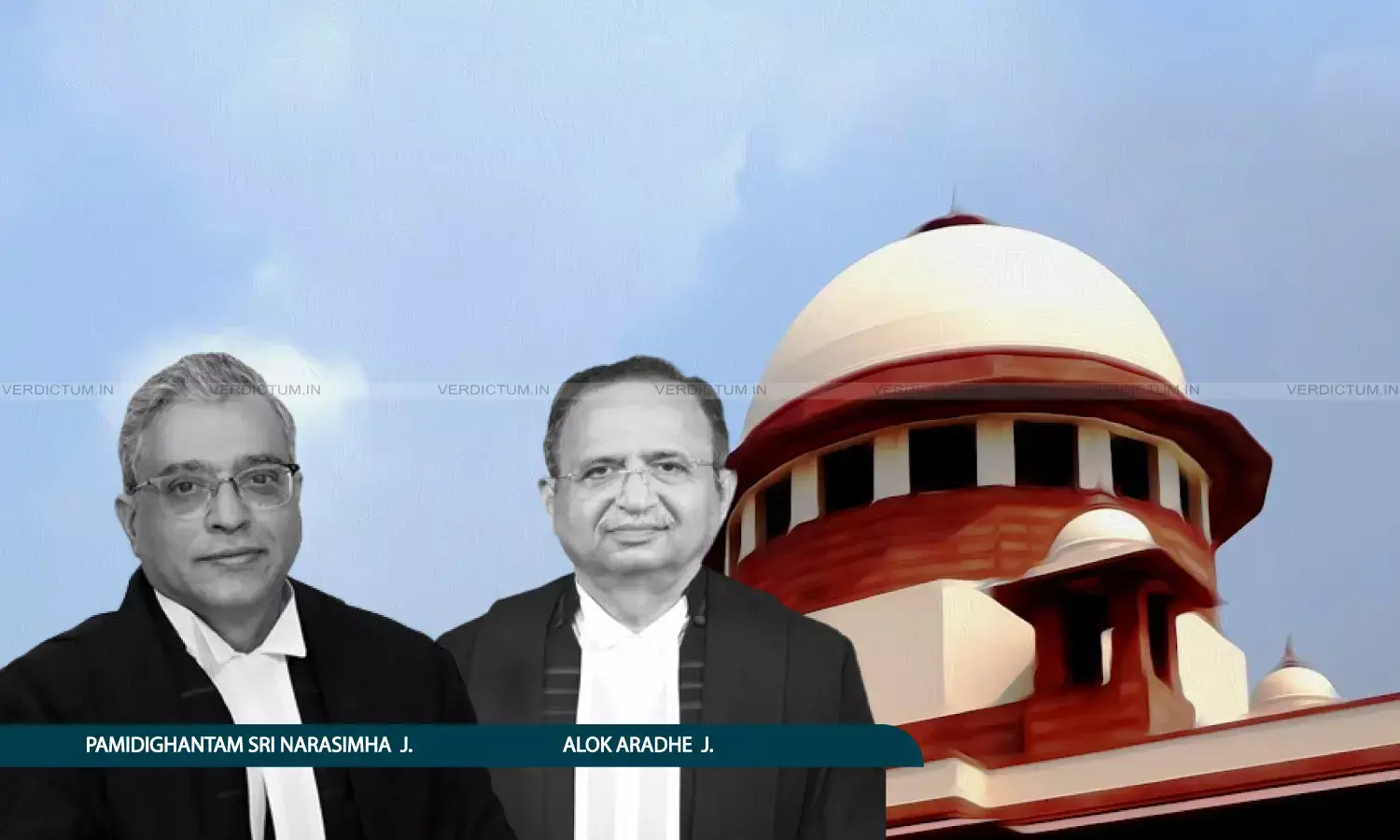
Justice Pamidighantam Sri Narasimha and Justice Alok Aradhe, Supreme Court
The Supreme Court has set aside the Central Government’s decision rejecting IPS officer Abdur Rahman’s request for voluntary retirement and directed the Ministry of Home Affairs to reconsider his application afresh within three months. The matter arose against the backdrop of multiple disciplinary proceedings against the officer, including charges linked to his public opposition to the Citizenship (Amendment) Act, 2019 and participation in protests against the law.
Examining Rule 16(2A) of the All India Service (Death-cum-Retirement Benefits) Rules, 1958 and the Department of Personnel and Training’s 1980 guidelines governing acceptance of voluntary retirement notices, the Court held that the Central Government indeed has the “last word” in deciding such requests.
A series of complaints were filed against Abdur Rahman, a 1997-batch IPS officer of the Maharashtra cadre, including allegations of domestic cruelty, contracting a second marriage during the subsistence of his first marriage, and a speech delivered at the launch of his book Denial and Deprivation. These later culminated in departmental chargesheets, including one relating to his social media posts and participation in protests against the Citizenship (Amendment) Act, 2019, after which he sought voluntary retirement in August 2019.
A Bench of Justice Pamidighantam Sri Narasimha and Justice Alok Aradhe observed “…the voluntary severance of employee-employer relationship pursuant to a VRS notice requires Central Government’s acceptance and it would also require a considered decision of the Central Government. It would be incongruous to suggest that this VRS could take effect without any genuine and a well considered exercise of discretion by the Central Government. The scheme of the extant rules governing the All-India Services consistently treats the Central Government as the repository of ultimate authority over career-terminating decisions concerning IPS officers, and ‘acceptance’ of VRS must be consistently read with that scheme…”.
“…To this extent, we hold that the Central Government has the last word when deciding a request for VRS under Rule 16(2A) of the 1958 Rules and in doing so, it is not bound by the recommendation of the State Government. We also make it clear that this power is not unconstrained and is qualified. Exercise of discretion by the Central Government under proviso to Rule 16(2A) is guided by Guideline 3(ii) of the DoPT Guidelines…”, the Bench further observed.
Senior Advocate Huzefa Aziz Ahmadi appeared for the appellant and Aishwarya Bhati, A.S.G., Senior Advocate Ruchi Kohli appeared for the respondent.
The appeal arose from the Union Government’s October 2019 decision refusing voluntary retirement to Abdur Rahman, a 1997-batch IPS officer of the Maharashtra cadre, on the ground that disciplinary proceedings were “pending or contemplated” against him and that he was therefore not clear from the vigilance angle. The rejection was later upheld by the Central Administrative Tribunal and the Bombay High Court.
Before the Supreme Court, the appellant argued that the State Government had already recommended acceptance of his voluntary retirement after concluding that the complaints pending against him were unlikely to culminate in any major penalty. The Union Government, however, maintained that it was not bound by the State’s assessment and retained independent authority to determine whether the circumstances warranted refusal of voluntary retirement.
On the facts of the case, the Court found that the Union Government’s October 25, 2019 order suffered from non-application of mind. It noted that as on the date of rejection no formal chargesheet had been served on the appellant and therefore no disciplinary proceedings were technically “pending.” The Court further held that the mere existence of complaints does not automatically amount to proceedings being “contemplated”; there must be material indicating a deliberate decision to initiate formal departmental action.
“…Incorporation of discretion in the rule is deliberate and intended to guide exercise of power. When disciplinary proceedings are pending or contemplated against a member of the service for imposition of a major penalty, the request for VRS ‘may not ordinarily be accepted’. Phrasing of the guideline accords the Central Government the vital discretion to apply its mind on case to case basis and in a given case it may accept the notice of the officer for VRS despite the possibility of imposition of a major penalty”, it noted.
“The Central Government cannot form an opinion which is not supported by material on record. Though not bound by the recommendation of the State Government, its opinion does carry weight and persuasive value owing to the fact that it is the authority with direct supervisory knowledge of the officer serving in connection with affairs of that State and under whose authority any disciplinary proceedings are to be conducted. 6 Even Ashok Kumar Sahu (supra) notes that such order passed by the competent authority needs application of mind. Thus, exercise of discretionary power in accepting or rejecting a request for VRS cannot be without engagement with views expressed by the State Government”, it noted further.
The Bench found that of the complaints cited against the officer, only one could arguably be said to be under contemplation at the relevant time, and even in that regard the State Government had assessed that a major penalty was unlikely. The Union Government, the Court held, failed to meaningfully engage with that assessment before refusing voluntary retirement.
The Court also took note of the substantial delay in disciplinary proceedings that followed, including those concerning the officer’s alleged participation in protests against the Citizenship (Amendment) Act. It noted that chargesheets were issued years after the original complaints, inquiry officers were appointed belatedly, and several proceedings remained inconclusive for prolonged periods. The Bench observed that unexplained delay in disciplinary action can itself prejudice an officer and undermine administrative fairness.
Allowing the appeal, the Court set aside the Ministry of Home Affairs’ order dated October 25, 2019 and directed the Ministry to reconsider Abdur Rahman’s request for voluntary retirement under Rule 16(2A), taking into account both the position existing at the time of the original request and subsequent developments, including the prolonged pendency of disciplinary proceedings.
Cause Title: Abdur Rahman v. Union Of India & Ors. (Neutral Citation: 2026 INSC 550)
Appearances:
Appellant: Huzefa Aziz Ahmadi, Sr. Adv., Rohit Kumar Singh, AOR, Ashray Chopra, Rohan Sharma, Paras Sharma, Shubhanginee Singh, Advocates.
Respondent: Aishwarya Bhati, A.S.G., Ruchi Kohli, Sr. Adv., Anupriya Srivastava, Shreya Jain, Srishti Mishra, Nitin Pavuluri, Digvijay Dam, Astha Singh, Arvind Kumar Sharma, AOR, Shrirang B. Varma, Siddharth Dharmadhikari, Aaditya Aniruddha Pande, AOR, Advocates.
Click here to read/download the Judgment