

Demand Of Dowry Not Needed To Attract Offence U/S 498A IPC; Any Unlawful Demand Made By Husband Or His Family Sufficient: Supreme Court
The Supreme Court was considering a matter where the husband and the in-laws were charged with continuous torture and harassment on the demands of dowry.

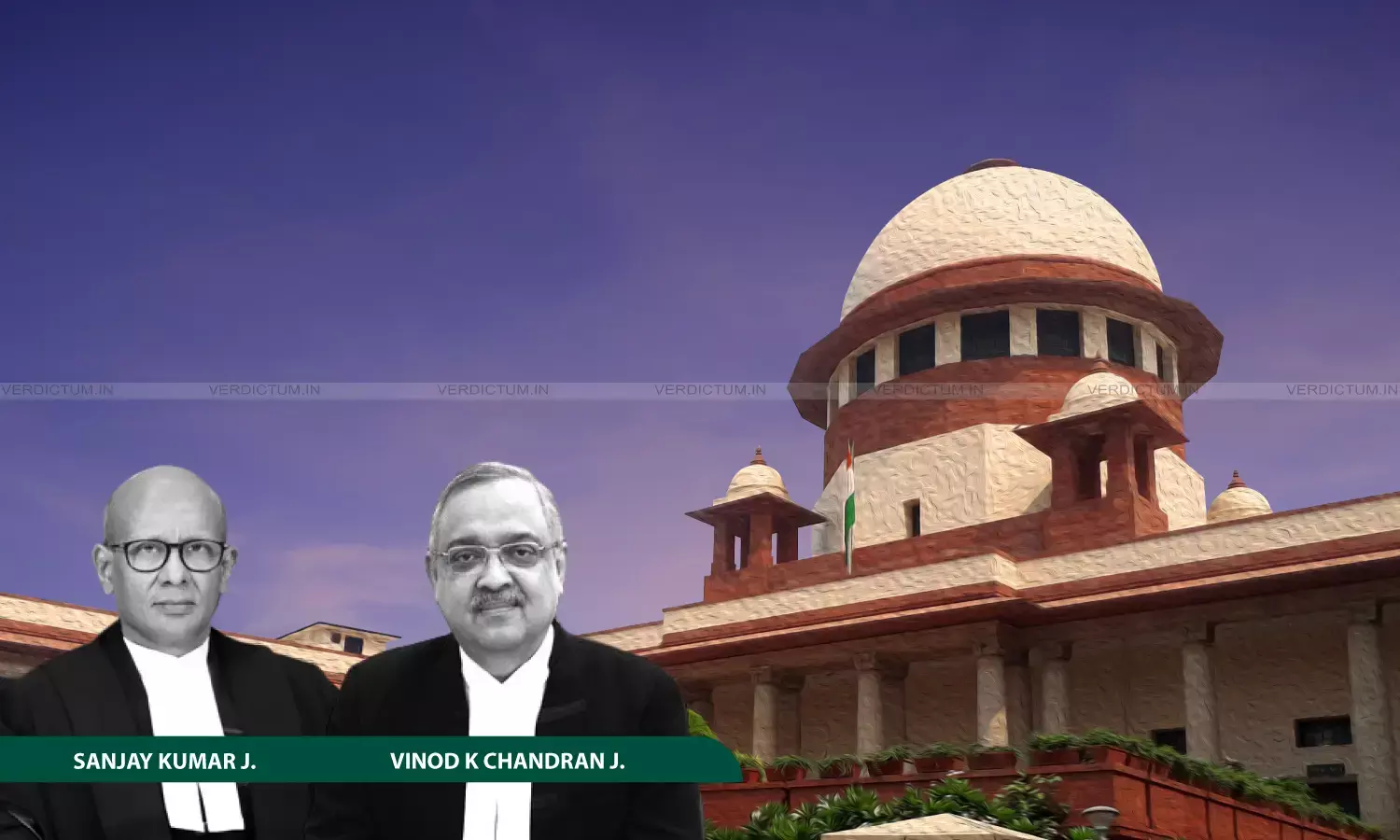
The Supreme Court has observed that to attract Section 498-A of the Indian Penal Code, there need not be a demand of dowry, since any unlawful demand made by the husband or his family is covered under Explanation (b). The Apex Court also stated that Explanation (a) of Section 498-A also brings in any mindless action, willful in nature, driving the wife to commit suicide under ‘cruelty’.
The Apex Court was considering a matter where the husband and the in-laws were the accused charged with continuous torture and harassment on the demands of dowry.
The Division Bench of Justice Sanjay Kumar and Justice K. Vinod Chandran stated, “We are conscious of the fact that to attract Section 498-A, there need not be a demand of dowry, since any unlawful demand made by the husband or his family is covered under Explanation (b). Explanation (a) of Section 498-A also brings in any mindless action, willful in nature, driving the wife to commit suicide under ‘cruelty’. But the evidence led by way of oral testimony, here, does not put forth any unlawful demand or such mindless acts of physical or mental torture as rightly found by the High Court. Why then the conviction, is the vexing question.”
Senior Advocate Kailash Vasdev represented the Appellant while AOR Ankita Chaudhary represented the Respondent.
Factual Background
Suicide, whether on volition or driven to it by the husband and in-laws, was the question posed before the Trial Court. The Trial Court acquitted the accused of the charges under Section 304-B of the Indian Penal Code, 1860 (IPC) finding that there was no evidence on the aspect of demand of dowry and that the letter produced, alleged to be a demand made by the father-in-law, was not proved. Relying on the oral testimony of certain witnesses and the letters written by the deceased to her brother and her father, torture was found to have been meted out to the deceased by the accused for non-fulfilment of unlawful demands. The Trial Court convicted the accused and sentenced the accused to three years rigorous imprisonment (RI) and a fine of Rs 5,000 with default sentence of three months RI under Section 498-A read with Section 34 of the IPC and also under Section 4 of the Dowry Prohibition Act, 1961 (DP Act), with no separate sentence passed under the DP Act.
Reasoning
The Bench found the conviction under the DP Act to be inconsistent with the finding of the Trial Court that there was no demand of dowry established. “It is also bewildering that the trial court entered a conviction under Section 498-A of the IPC on general and omnibus allegations raised, without specific substantiation”, it added.
As per the Bench, the High Court rightly found that in the totality of the circumstances, the conviction under Section 4 of the DP Act could not be sustained. The Bench noticed that the High Court also found that though there were no specific instances pointed out, which alone would bring the case under the mischief of Section 498-A of the IPC, it still convicted the accused on the ground of “certain particulars regarding the cruelty meted out to her having come out in the evidence”.
The Bench found that the fact that the death occurred by suicide was clear from the evidence of the Doctor and a neighbour. The neighbour deposed that she was holding the child of the deceased while standing near her when suddenly she consumed something from a bottle. She snatched away the bottle when the liquid splashed on her, which she realised was a pesticide. The doctor had spoken of the frothy discharge from the mouth and nose and cyanosis of the nails and lips found in the postmortem, stated to be clear symptoms of poisoning.
Reference was also made to the letter written by the deceased to her father and brother, where she spoke about the demands of dowry, instances when their sister returned to her family and then, after mediation in which the village elders participated, having returned to her marital home on the assurance of the husband to ensure that the acts complained of would never be repeated. It was specifically noticed by the Trial Court that there was no date seen from the letters. The Bench held that no reliance could be placed on the alleged letters in the totality of the circumstances, especially the proof of the handwriting having not been established as that of the deceased.
“As was noticed by the trial court and the High Court, we too find that the testimony regarding demand of dowry was general and omnibus”, it added. As per the Bench, the evidence led, both the oral testimony and the documents, fell short of establishing the crime under Section 498-A.
Thus, allowing the appeal, the Bench reversed the impugned judgments of both the Trial Court and the High Court and acquitted the appellant/accused.
Cause Title: A v. State of Odisha & Ors. (Neutral Citation: 2026 INSC 544)
Appearance
Appellant: Senior Advocate Kailash Vasdev, AOR Kiran Kumar Patra, Advocates Umrao Singh Rawat, Padamnav Chaudhary, Sanjay Kumar, Preetish Sahu, Abhilasa Pathak
Respondent: AOR Ankita Chaudhary, Advocates Chand Kapoor, Shreyas Balaji, Vishakha Raghuram