

Some Disputes Or Discord In Matrimonial Life Not Sufficient In Itself To Attract Offence Of Abetment Of Suicide: Supreme Court
The Supreme Court was considering an appeal filed against the order overturning acquittal of the appellant in a case registered under Sections 498-A and 306 of the Indian Penal Code.

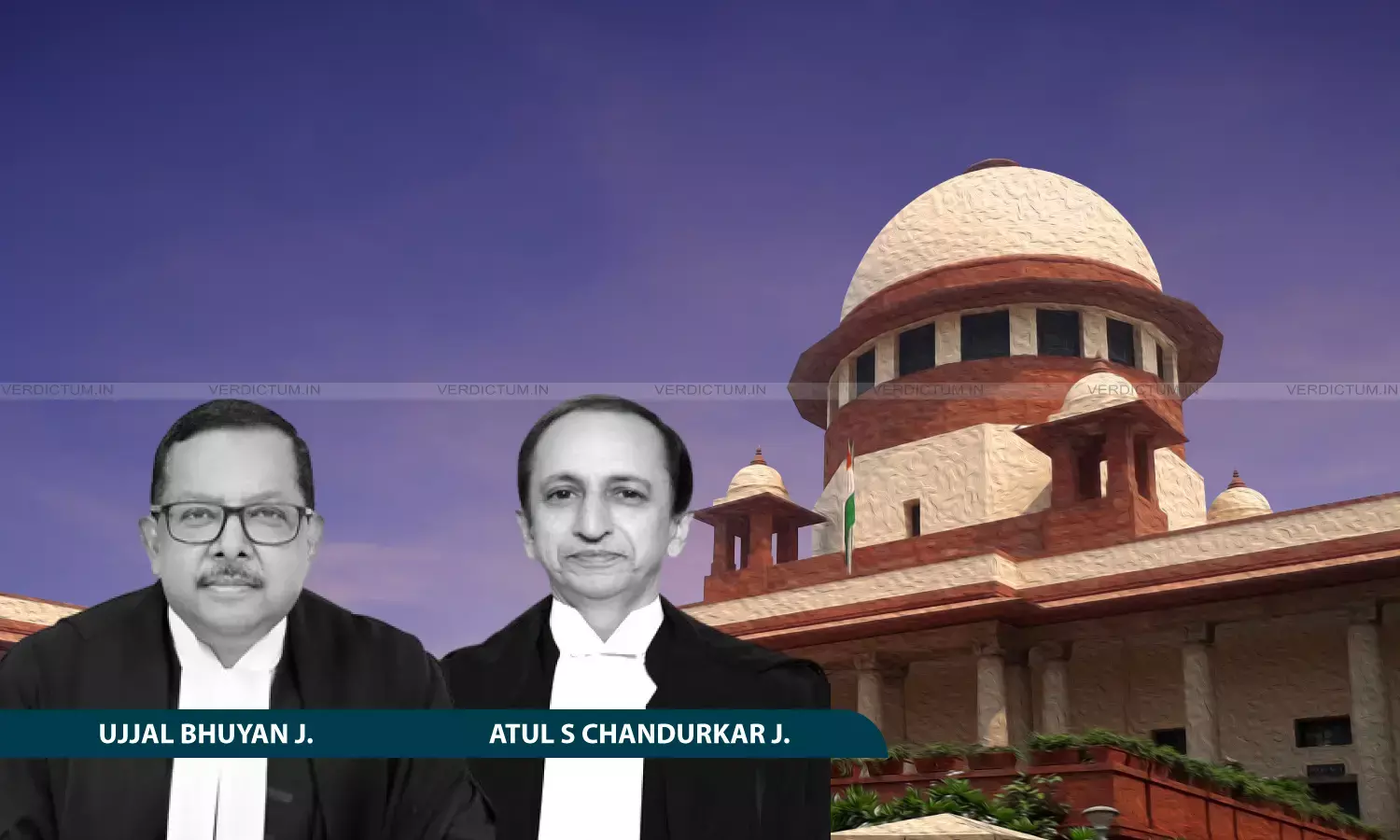
While granting acquittal to a husband in a case of cruelty and suicide abetment, the Supreme Court has held that some disputes or discord in the matrimonial life of the accused and the victim would not be sufficient in itself to attract the provisions of Section 306 read with Section 107 of the Indian Penal Code.
The Apex Court was considering an appeal filed against the acquittal of the appellant in a case registered under Sections 498-A and 306 of the Indian Penal Code, 1860 having been overturned by the Himachal Pradesh High Court.
The Division Bench of Justice Atul S. Chandurkar and Justice Ujjal Bhuyan held, “It is likely that there may have been some disputes or discord in the matrimonial life of the appellant and the victim. That, however, would not be sufficient in itself to attract the provisions of Section 306 read with Section 107 of the Penal Code. In fact, there is no evidence, whatsoever, to indicate any act of abetment by the appellant. On the contrary, it has been brought on record that the appellant, on realising that the victim had ingested some liquid thinking it to be a medicine, had immediately sought medical aid from PW10. He also shifted the victim immediately to the hospital.”
Senior Advocate D.N. Goburdhun represented the Appellant while AOR Vikrant Narayan Vasudeva represented the Respondent.
Factual Background
The case dates back to the year 2008, when the appellant (A13) got married to the victim. On the same day, the younger sister of the victim, was also married. Sometime after their marriage, it was alleged that the mother of the appellant as well as his sisters used to harass the victim on one pretext or the other. It was alleged that on the day of the death anniversary of the victim’s father, there were arguments between the appellant and the victim, which required the intervention of some of the family members. Sometime in July 2009, the victim gave birth to a daughter and, hence, the victim’s sister joined her at the matrimonial home. It was alleged that acts of torturing the victim continued and she was not being given proper food.
On the fateful day, the family of the victim allegedly received a phone call by which they were informed that the victim had consumed poison, as a result of which she was taken to hospital. She died during the course of treatment. A report was, accordingly, lodged with the police authorities and an investigation was undertaken. The Judge of the Sessions Court acquitted all the accused persons. The State of Himachal Pradesh, being aggrieved, challenged the acquittal by preferring an appeal. The High Court was of the view that though the prosecution had failed to bring home the charges against A2 to A4, the said charges had been proved beyond reasonable doubt against the appellant. Aggrieved thereby, the appellant approached the Apex Court.
Reasoning
Considering the facts of the case, the Bench found that the Sessions Court noted that the allegations of demand of money or asking the victim to take a loan were afterthought allegations. It noted that no witness had deposed that the victim was ever threatened with any consequences whatsoever. “There was no evidence at all of any unlawful demand. Mere harassment by itself could not be treated to be cruelty. In fact, it was noted that the victim was treated affectionately by the accused when she was pregnant and also after delivering a child. On that basis, the Sessions Court proceeded to acquit all the accused from the aforesaid charges”, it added.
The Bench also noticed that the Judge had the occasion to note the demeanour of all the witnesses while recording their evidence. Taking note of the fact that the acquittal of the appellant was reversed by the High Court by holding that the prosecution had proved beyond reasonable doubt that the victim had been harassed mentally and physically by the appellant, the Bench stated, “In our view, it was necessary for the High Court, as an appellate Court, while considering an appeal against acquittal, to record a finding that the Sessions Court had either misread the entire evidence to arrive at a perverse conclusion or that its conclusion could not be supported by the evidence on record. However, no such finding has been recorded in the impugned judgment.”
On a perusal of the evidence of the record, the Bench held that the Sessions Court was justified in arriving at the correct conclusion that the prosecution had failed to prove the charge against the appellant beyond reasonable doubt. Thus, allowing the appeal and setting aside the impugned judgment, the Bench acquitted the appellant of the charges framed against him.
Cause Title: A v. State of Himachal Pradesh (Neutral Citation: 2026 INSC 948)
Appearance
Appellant: Senior Advocate D.N. Goburdhun, Advocates Sumit Singh Somria, Anjali Sharma, Priyanshi Singh, Pahul Preet Kaur, AOR P. D. Sharma
Respondent: AOR Vikrant Narayan Vasudeva, Advocate Arindam Gupta