

Officer In-Charge Of Women Police Station Not Public Servant To Whom Allegedly False Statements Were Made: Supreme Court Quashes Section 182 IPC Proceedings
The Supreme Court was considering an appeal filed against an order refusing to quash a complaint registered under Section 182 of the Indian Penal Code.

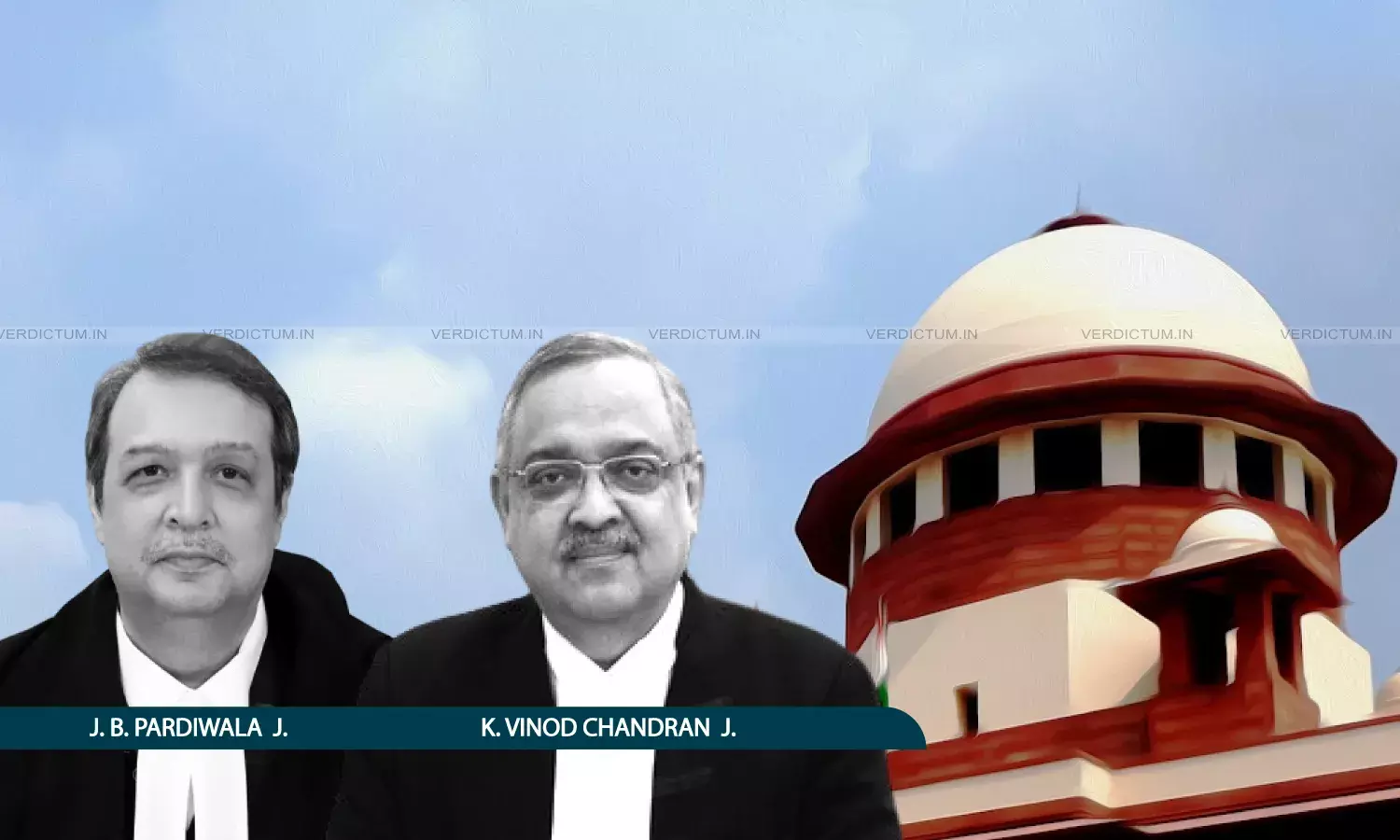
Justice J. B. Pardiwala, Justice K. Vinod Chandran, Supreme Court
The Supreme Court has quashed the proceedings registered under Section 182 of the Indian Penal Code in a case of marital discord while observing that the Officer in-charge of the Women Police Station was neither the public servant to whom allegedly false and frivolous statements were made nor was the said officer administratively superior to the public servant mentioned in the complaint of the wife.
The Apex Court was considering an appeal filed against an order refusing to quash a complaint registered under Section 182 of the Indian Penal Code.
The Division Bench of Justice J. B. Pardiwala and Justice K. Vinod Chandran held, “The Officer in-charge of the Women Police Station is neither the public servant to whom allegedly false and frivolous statements were made nor is the said officer administratively superior to the public servant made mention of in the complaint of the second respondent.”
“The complaint is ill-motivated and in any event no cognizance could have been taken based on Annexure P2 filed by a police officer before whom the second respondent complained of false and frivolous complaints made by the appellant against the second respondent and her family members”, it added.
Factual Background
The appeal was filed by the sister of the deceased husband of the second respondent. The second respondent’s marriage was plagued with marital discord. When the husband was alive, the sister-in-law and his wife were at loggerheads due to the marital discord. Criminal proceedings were also initiated against each other, which came to be settled after the husband of the second respondent died. There was a compromise entered into between the second respondent and the family of the appellant. A solitary complaint filed under Section 182 of the Indian Penal Code (IPC) remained, which became the bone of contention between the parties.
The appellant, by the application under Section 482 of the Code of Criminal Procedure, 1973 (CrPC) sought quashing of the complaint. The High Court found that the offence under Section 182 of the IPC read with the provisions of Section 195 of the Cr.P.C is a matter between the ‘public servant and the ‘offender’. The settlement between the appellant and the second respondent wife did not put an end to that, since the offence was against the public servant. Aggrieved thereby, the appellant approached the Apex Court.
Reasoning
On a perusal of the facts of the case, the Bench noted that the rejection was without looking at the complaint itself. The Bench noted that the complaint was made by the wife, when the fight between the two families was raging, and the allegation was that the appellant (husband’s sister) made complaints to various departments, which were false and misleading statements intended at harassing the second respondent and pressurizing her to withdraw the various complaints.
It was further noticed that the allegation was also that the complaints were made in the various Government Departments, not only against the second respondent but also her family members.
The Bench explained that Section 182 if committed is between the offender and the public servant and Section 195 stipulates that, for offences punishable under Sections 172 to 188, no cognizance shall be taken unless the complaint in writing is of the public servant or of some other public servant to whom he is administratively sub-ordinate.
The Bench noted that there was no complaint filed by any of the officers in the various departments where the allegations were raised by the appellant. It was noticed that the Officer in-charge of the Women Police Station was neither the public servant to whom allegedly false and frivolous statements were made nor was the said officer administratively superior to the public servant made mention of in the complaint of the second respondent.
Thus, allowing the appeal, the Bench quashed the proceedings.
Cause Title: A v. State of Himachal Pradesh (Neutral Citation: 2026 INSC 856)