

Can’t Force Husband-Wife Relationship By Judicial Proceedings: Supreme Court Grants Divorce Under Article 142 Of Constitution
The appellant husband had moved the Supreme Court against the order upholding the dismissal of the divorce petition.

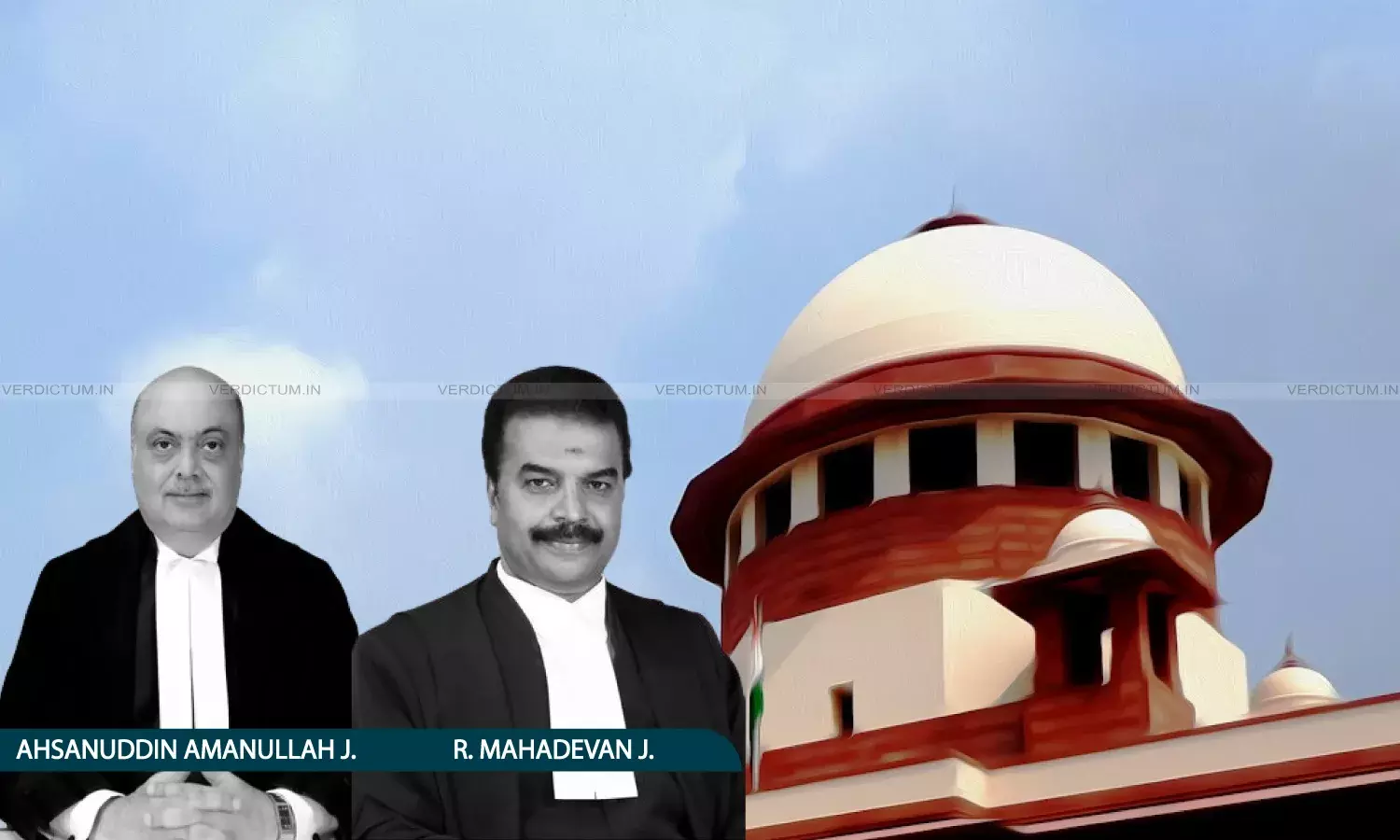
While exercising its power under Article 142 of the Constitution and granting a divorce decree subject to the husband paying Rs 60 lakh in favour of the wife, the Supreme Court has held that forcing a relationship of husband and wife cannot be done by judicial proceedings.
The appellant husband had moved the Apex Court against the order impugned by which the High Court had upheld the dismissal of the petition filed by the appellant before the Family Court seeking divorce from the respondent-wife.
The Division Bench of Justice Ahsanuddin Amanullah and Justice R. Mahadevan held, “The Court may indicate here that in such matters and at a juncture where the stance of the parties are absolutely hard and totally inflexible, the Court has to take a hard decision which may not be acceptable to both the parties. However, the Court has to look at the matter objectively, more so, for the reason that both the parties have a life ahead which it is for them to choose how they want to spend and forcing a relationship, that too of husband and wife, cannot be done by judicial proceedings.”
AOR Balaji Srinivasan represented the Appellant, while the Respondent appeared in person.
Arguments
It was the case of the parties that they were living separately since the year 2003, and despite his efforts, they could not be reunited. It was submitted that due to the constant harassment faced, the family had moved to Andhra Pradesh, after selling the Hyderabad residence. The appellant claimed that he had no future with the respondent-wife and did not want his peace to be disturbed at this juncture in life.
The respondent wife, on the contrary, opposed the prayer seeking divorce and contended that the issues raised by the appellant were frivolous and fictitious.
Reasoning
The Bench at the outset highlighted that it was left in a peculiar situation where it had to take a call as to whether interference was required. Noting that the stance of the parties was absolutely inflexible, the Bench held that it had to take a hard decision which might not be acceptable to both parties.
“The Court thus has taken a very realistic view in the matter and going by what has been stated above, has come to the conclusion that the marriage between the parties being dead for all practical purposes has to be nullified”, it added.
Thus, exercising its power/jurisdiction under Article 142 of the Constitution, the Bench granted a decree of divorce to the parties on the ground of irretrievable breakdown of marriage. “However, the said grant of divorce is subject to the appellant paying/transferring an amount of Rs. 60,00,000/- (Rupees Sixty Lakhs) in favour of the respondent-wife within two months from today, as has been undertaken before the Court and proof thereof be filed before this Court. The amount lying with the Registry of Rs. 68,00,000/- (Rupees Sixty Eight Lakhs) along with whatever interest may have accrued in the interregnum be paid to the respondent by the Registry upon completion of the required formalities within two weeks from today”, it ordered.
Allowing the appeal, the Bench also took note of the fact that the appellant had agreed that he would also contribute his share to the marriage of his daughter.
Cause Title: A v. B (Neutral Citation: 2026 INSC 623)
Appearance
Appellant: AOR Balaji Srinivasan, Advocate Kanishka Singh
Respondent: Respondent-in-person