

Readiness & Willingness Of Plaintiff In Specific Performance Suit Can Be Gathered From Prior & Subsequent Conduct Of Parties: Supreme Court
The Supreme Court was considering an appeal arising out of the impugned judgment and decree passed by the Madras High Court.

While restoring an order of the Trial Court decreeing the suit for specific performance, the Supreme Court has held that the readiness and willingness of the plaintiff is to be gathered from the entirety of facts and circumstances of the case, including the overall conduct of the parties prior to and subsequent to the filing of the suit.
The Apex Court was considering an appeal arising out of the impugned judgment and decree passed by the Madras High Court, whereby the High Court partly allowed the Second Appeal preferred by the Plaintiff-Appellant, dismissed the suit qua the relief of specific performance but directed the Defendants/Respondents to return a sum of Rs 9,30,000 along with interest.
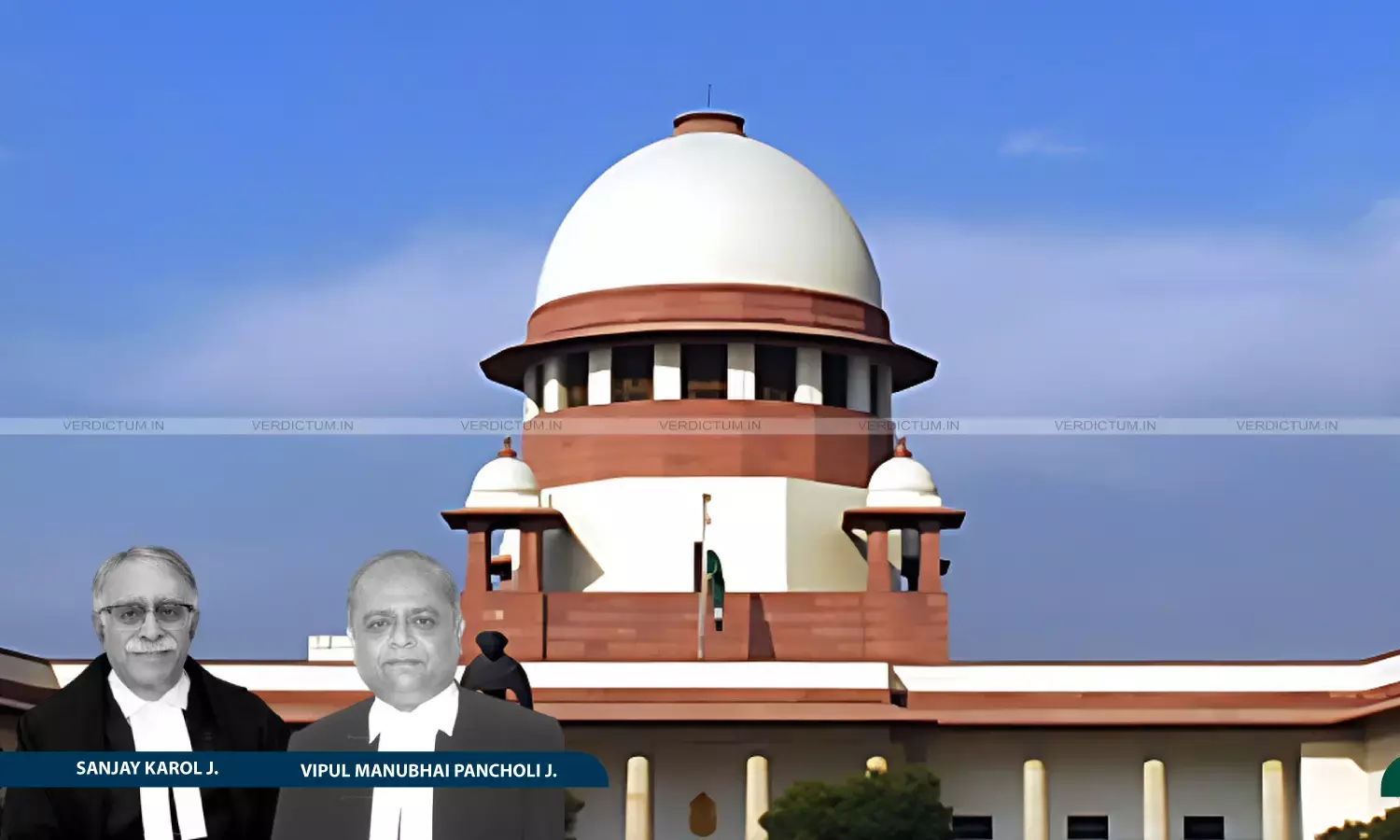
The Division Bench of Justice Sanjay Karol and Justice Vipul M. Pancholi held, “Insofar as the second issue regarding readiness and willingness under Section 16(c) SPA 1963 is concerned, we find it difficult to sustain the findings returned by the First Appellate Court and as affirmed by the High Court vide the impugned judgment. It is trite law that in order to obtain a decree for specific performance, the plaintiff must aver and prove that he was always ‘ready and willing’ to perform the terms of the contract which are to be performed by him. Such readiness and willingness of the plaintiff is to be gathered from the entirety of facts and circumstances of the case, including the overall conduct of the parties prior and subsequent to the filing of the suit.”
Reference was made to the judgments in Syed Dastagir v. T.R. Gopalakrishna Setty (1999), Sughar Singh v. Hari Singh (2021) and Janardan Das v. Durga Prasad Agarwalla (2024).
AOR Aljo K. Joseph represented the Appellant, while Advocate Prabha Swami represented the Respondent.
Factual Background
The plaintiff-appellant (purchaser) entered into a sale agreement with the defendant-respondent (vendors) for the purchase of a property for a total sale consideration of Rs.9,30,000, out of which a sum of Rs.9,00,000 was paid as earnest money. The balance amount of Rs.30,000 was agreed to be paid at the time of execution of the sale deed, within four months. According to the plaintiff, he was always ready and willing to perform his part of the contract and, in July 2010, approached the defendants to complete the sale transaction. However, they sought further time. In December 2010, when the plaintiff again insisted on the execution of the subject sale agreement, the defendants allegedly became evasive and demanded more money, and when the plaintiff refused, they threatened to alienate the property to a third party. As a result, the plaintiff issued a legal notice calling upon the defendants to receive the balance consideration and execute the sale deed in accordance with the agreement.
The plaintiff instituted a Suit when no reply was furnished. The Trial Court decreed the suit for specific performance in favour of the plaintiff and directed the plaintiff to deposit the balance sale consideration and the defendants to execute the sale deed within two months. In appeal, the First Appellate Court partly modified the order of the Trial Court. While concurring with the finding returned by the Trial Court, the Court observed that since the plaintiff did not issue the legal notice within the time period stipulated in the subject sale agreement, i.e., immediately after the expiry of four months, he had failed to prove that he was ready and willing to perform the contract. Accordingly, the First Appellate Court directed the defendants to refund the advance amount. In Second Appeal, the High Court, vide the impugned judgment, partly allowed the second appeal preferred by the plaintiff and modified the judgment by affirming the denial of the relief of specific performance and directing the defendants to pay a sum of Rs 9,30,000 along with interest per annum. Aggrieved thereby, the appellant approached the Apex Court.
Reasoning
Reiterating the principles of law governing the power of the High Court under Section 100 CPC, the Bench explained, “It is a well settled legal position that Section 100 confers jurisdiction on High Court to entertain a second appeal, only when it is satisfied that the case involves a substantial question of law. Re-appreciation of evidence and interference with concurrent findings of fact is impermissible unless such findings are shown to be perverse, based on no evidence, or suffering from material illegality or misreading of evidence. Merely because another possible view may arise from the same material on record would not justify interference under Section 100 CPC.”
On a perusal of the facts of the case, the Bench noted that the Trial Court and the First Appellate Court had drawn their conclusion after appreciating the evidence available on record. The High Court, while interfering with the said finding, failed to demonstrate that the conclusions arrived at by the Courts below suffered from any perversity, material illegality or were in ignorance of relevant evidence.
Considering that the High Court reappreciated the evidence to come to a different conclusion, which was impermissible within the limited scope of Section 100 CPC, the Bench stated, “Therefore, drawing from the conspectus of the aforesaid facts and circumstances, we are of the considered view that the High Court, while exercising the power under Section 100 CPC, erred in interfering with the concurrent findings of fact returned by the Courts below regarding the validity and genuineness of the subject sale agreement.”
As per the Bench, it was difficult to sustain the findings returned by the First Appellate Court and as affirmed by the High Court, insofar as the second issue regarding readiness and willingness under Section 16(c) SPA 1963 was concerned. The Bench noted that only a nominal amount of Rs 30,000 was left, which was payable at the time of execution of the sale deed, and if the plaintiff was unwilling to perform the contract, he would not have paid nearly 93% of the sale consideration.
“Merely because the legal notice came to be issued after expiry of four months from the stipulated period mentioned in the agreement, the same by itself cannot lead to an inference that the plaintiff was not ready and willing to perform the contract, especially when the suit itself was instituted well within the prescribed period of limitation. The readiness and willingness of the plaintiff must be assessed in light of the overall conduct of the parties and the attending circumstances of the particular case”, it added.
Thus, holding that the plaintiff had sufficiently established continuous readiness and willingness within the meaning of Section 16(c) SPA 1963, the Supreme Court allowed the appeal while restoring the Trial Court order decreeing the suit for specific performance.
Cause Title: A. Shahul Hameed v. N. Malligarjuna (Neutral Citation: 2026 INSC 573)
Appearance
Appellant: AOR Aljo K. Joseph, Advocates Rajnish Kumar, Rajesh Kumar, N Leela Vara Prasad, Ishtha Singh, Surit Chaubey
Respondent: Advocates Prabha Swami, Divya Swami, AOR Nikhil Swami