

Similarity In Modus Operandi Alone Doesn't Make Distinct Cyber Frauds Part Of Same Transaction: Supreme Court
The Court also observed that composite probes into complex multi-state cyber frauds at an early stage can impede thorough forensic audits and prejudice vulnerable victims.

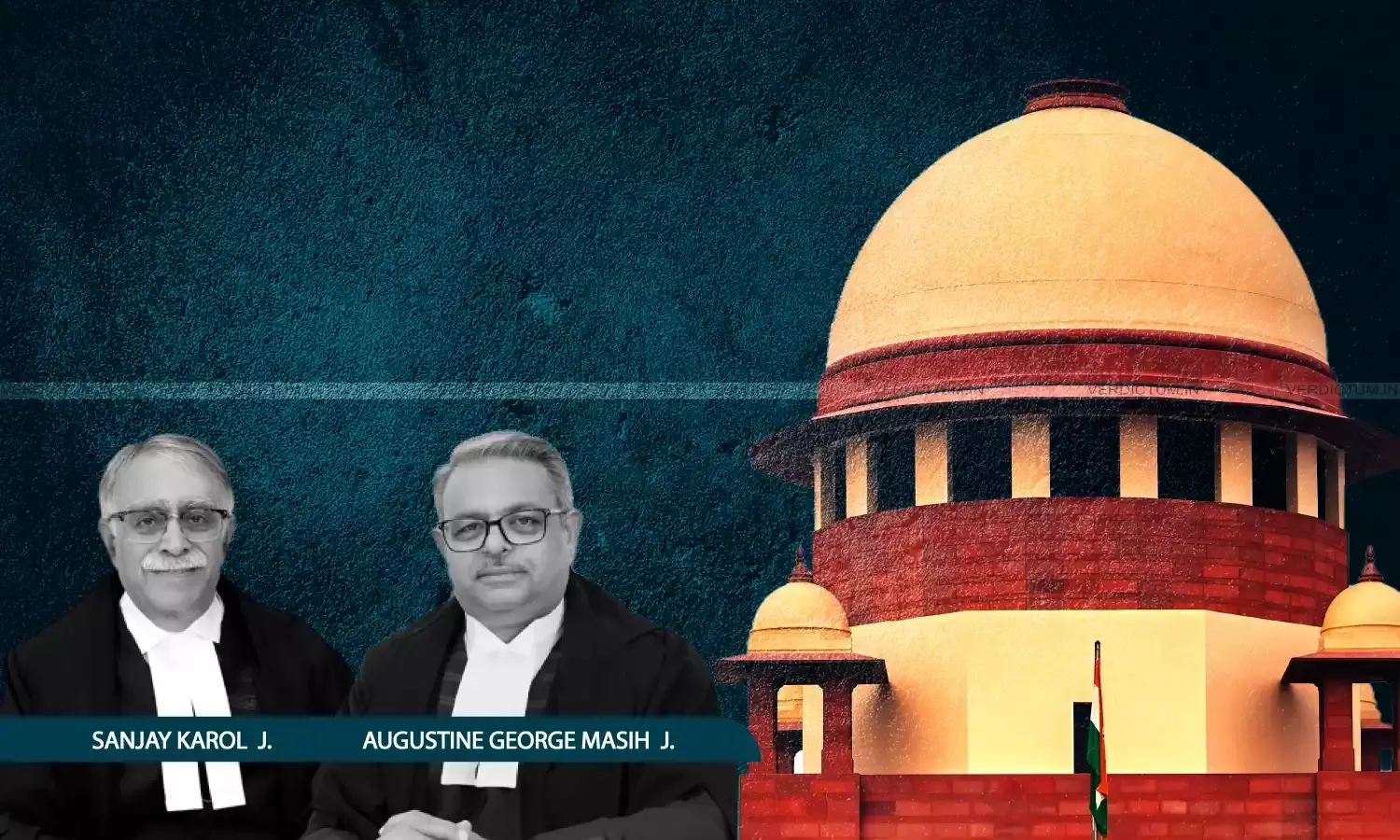
Refusing to consolidate multiple First Information Reports (FIRs) registered across different States, the Supreme Court held that distinct instances of cyber fraud involving different victims, separate money transfers, and varied losses cannot be treated as part of the "same transaction."
It was observed that the mere routing of defrauded funds into a single bank account or a common pattern of deception does not establish a live link between independent offences.
Emphasizing that each victim suffered a distinct injury through a separate occurrence, the apex court ruled that such complaints constitute independent offences requiring separate investigations, thereby declining the petitioner's plea for clubbing or composite investigation.
The Bench of Justice Sanjay Karol and Justice Augustine George Masih held, "In the present case, each of the subject FIRs has been lodged by a different complainant who was allegedly induced to part with money on different occasions but with no live link or connectivity of transactions inter se different set of persons. The mere fact that a part of the defrauded amounts is alleged to have been transferred in the bank account of petitioner’s proprietary concern does not, by itself, establish that all the incidents form part of the same transaction. Though the alleged modus operandi appears to be similar, the victims, the amounts involved, the transactions complained of and the consequences suffered are distinct. Prima facie, therefore, the subject FIRs relate to separate transactions disclosing distinct offences and cannot be said to arise out of the same transaction."
Advocate Kaustubh Somnath Pawar appeared for the Petitioner, while AOR Aaditya Aniruddha Pande appeared on behalf of the Respondents.
Brief Facts
The petitioner instituted the present writ petition under Article 32 of the Constitution, principally seeking the quashing of multiple First Information Reports (FIRs) registered against him across different States, namely Maharashtra, Karnataka, and Odisha. In the alternative, he prayed for the clubbing and consolidation of all such FIRs and sought directions for a single composite investigation by a single agency to avoid multiplicity of proceedings and conflicting judicial opinions.
The allegations in the subject FIRs pertained to a series of cyber frauds, wherein unknown fraudsters contacted distinct victims posing as police officials, falsely threatened them regarding alleged money laundering activities, and induced them to transfer large sums of money into various bank accounts. A portion of the defrauded funds was allegedly credited to a bank account held in the name of a proprietary concern owned by the petitioner. Although the petitioner was not named as an accused in the initial FIRs, his proprietary concern's bank account featured in the investigation. The petitioner maintained that he was innocent, had served abroad on a merchant ship, and had merely permitted third parties to operate his account, which was subsequently misused without his knowledge.
Contentions of the Parties
The petitioner contended that he had no role or involvement in the alleged offences. He asserted that he was working abroad and had allowed a friend to use the bank account for an online gaming business, which was thereafter misused by third parties. Upon discovering the misuse of his proprietary account, the petitioner lodged a cyber crime complaint against the individuals who unlawfully used his account. He argued that since all FIRs alleged a similar modus operandi and involved the same bank account, forcing him to face multiple investigations across different States would cause immense hardship, especially given his severe cardiac and diabetic health conditions.
The State authorities contended that an extraordinary writ petition under Article 32 of the Constitution was not maintainable for quashing FIRs when alternative statutory remedies under Section 482 of the Code of Criminal Procedure, 1973 (CrPC) or Article 226 of the Constitution were readily available. The respondents argued that each FIR was lodged by a distinct victim regarding an independent incident of cheating, involving separate monetary transactions executed on different occasions. Therefore, the offences did not form part of the "same transaction."
The States submitted that cyber fraud networks operated through intricate digital channels, complex money trails, and fictitious identities. A composite investigation at a preliminary stage would derail fair and effective probing by the respective jurisdictional police forces. It was urged that clubbing the matters would cause grave prejudice and hardship to individual complainants who would be forced to litigate in foreign jurisdictions.
Observations and Findings of the Court
The Court observed that while the power under Article 32 of the Constitution to protect fundamental rights and quash criminal proceedings was exceptionally wide, it remained an extraordinary remedy to be exercised sparingly.
It reaffirmed that, as a matter of judicial discipline and orderly procedure, an aggrieved person must ordinarily approach the concerned High Court under Section 482 CrPC or Article 226 of the Constitution, unless a clear infringement of fundamental rights or extraordinary exigent circumstances were established.
The Court held that the petitioner failed to demonstrate any palpable violation of fundamental rights or exceptional grounds to bypass the statutory remedies available under the ordinary criminal procedure. Consequently, the prayer for quashing the FIRs was declined.
It was also noted that a second FIR was impermissible only if it related to the same incident or formed part of the exact same transaction. Where subsequent complaints pertained to distinct incidents, different victims, and separate acts of crime, independent FIRs were legally maintainable.
Applying the tests of unity of purpose, proximity of time, and continuity of action, the Court observed that mere similarity in the modus operandi or the involvement of a common bank account did not weave distinct instances of fraud into a single transaction.
The Court highlighted that each victim suffered an independent financial loss through a separate transaction without any inter-se link among the victims. Therefore, the FIRs constituted distinct offences.
The Court acknowledged the medical ailments of the petitioner but held that personal health difficulties could not override established criminal jurisprudence to justify clubbing distinct offences. On the contrary, consolidating the FIRs would impose severe hardship on naive victims who were lured and defrauded.
It was observed, "Cyber frauds of the present nature are often executed through complex technological means involving multiple bank accounts, fictitious identities and digital networks operating across different jurisdictions. Investigation into such offences, as rightly contended by the learned counsel(s) for the respondent States, necessarily requires detailed forensic examination of electronic evidence, analysis of banking transactions and tracing of money trails so as to identify the people involved. Given that the investigating agencies are yet to ascertain the complete flow of funds and unravel the entire chain of events, a direction for a composite investigation may impede a fair and effective investigation. Several cyber frauds are now on the rise and the offence, considering its gravity and implications cannot be taken lightly. More so, when the victims of crime largely hailing from the rural areas, unaware and ignorant of the process and the mechanism adopted by the criminals are allured to overcome their poverty."
Accordingly, the Court dismissed the writ petition, declining both the primary relief of quashing and the alternative relief of clubbing the FIRs. However, the Court granted liberty to the petitioner to approach the appropriate legal forums under the CrPC or Article 226 of the Constitution to seek remedies in accordance with the law.
Cause Title: Rutvij Bhagat Singh Wakhare v. The State of Maharashtra & Ors. [Neutral Citation: 2026 INSC 740]
Appearances:
Petitioner: Advocate Kaustubh Somnath Pawar, Advocate Shreyas P Barsawade, Advocate Nring Chamwibo Zeliang, Advocate on Record Siddhartha Sinha
Respondents: Advocate on Record Aaditya Aniruddha Pande, Advocate Siddharth Dharmadhikari, Advocate Shrirang B. Varma, Advocate Sourav Singh, Advocate Chitransha Singh Sikarwar
Click here to read/download the Judgment