

Profit Or Loss To Investors Is Immaterial In Case Of Regulatory Infraction: Supreme Court Affirms SEBI Penalties On Kotak AMC Over Unauthorized Extension Of Scheme Maturity
The Court ruled that market integrity is paramount and regulatory breaches cannot be condoned by commercial expediency, investor profits, or the absence of an intention to cause financial loss.

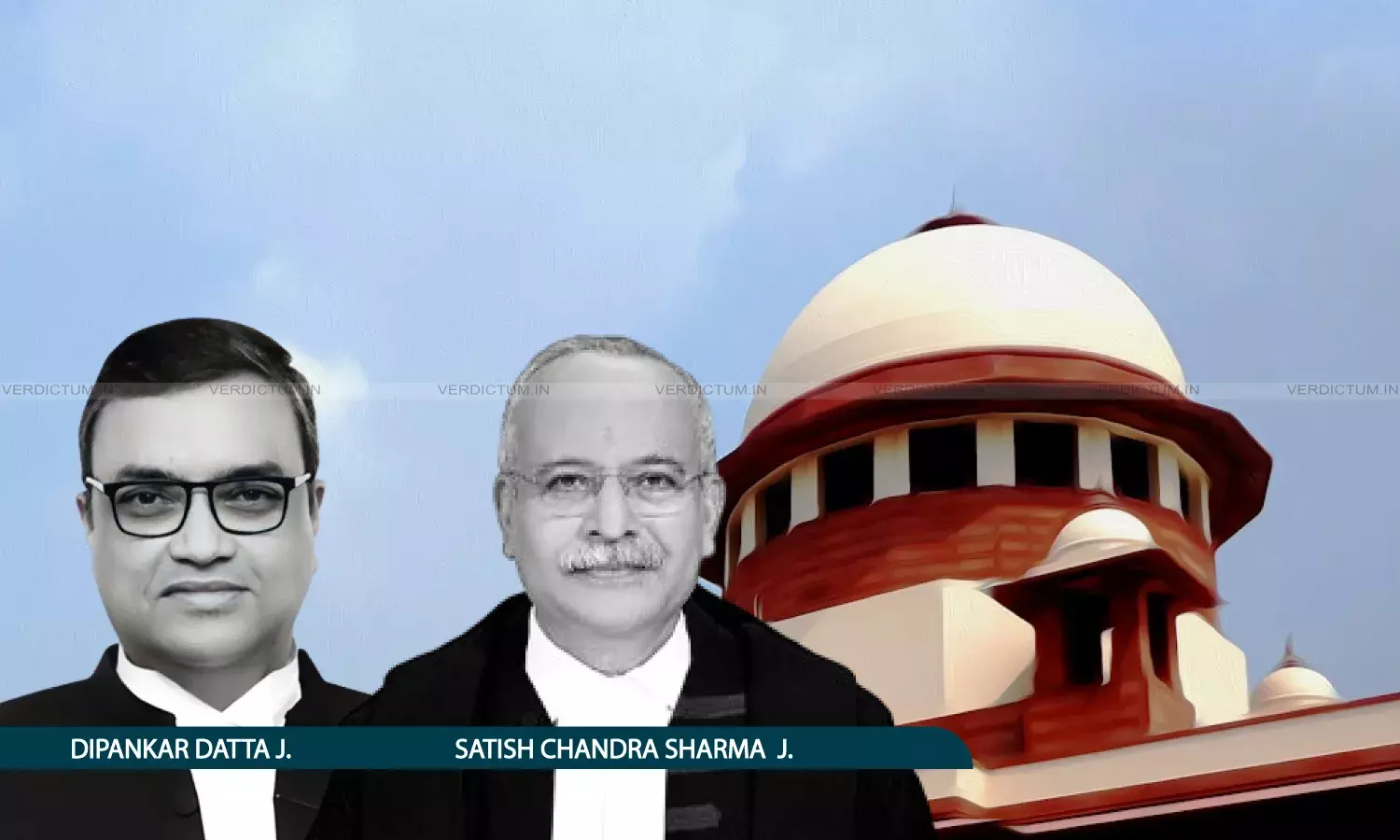
Justice Dipankar Datta, Justice Satish Chandra Sharma, Supreme Court
The Supreme Court dismissed the appeals preferred by Kotak Mahindra Asset Management Company, Kotak Mahindra Trustee Company, and its senior executives, thereby upholding the monetary penalties imposed by the Securities and Exchange Board of India (SEBI).
Firmly establishing that profit or loss to investors is immaterial in case of regulatory infraction, the Apex Court affirmed the SEBI penalties on Kotak AMC over the unauthorized extension of scheme maturity.
The Court held that the regulatory framework governing close-ended mutual fund schemes is consequence-neutral and strictly mandates full redemption on the scheduled maturity date.
Strongly deprecating the unauthorized standstill agreement and maturity extensions of underlying debt instruments, the Bench observed that a civil obligation's breach automatically attracts penalty once contravention is established, rendering investor gains or the lack of mens rea entirely irrelevant to corporate and fiduciary liability.
The Bench of Justice Dipankar Datta and Justice Satish Chandra Sharma held, "Breaches of the regulatory framework, fortuitously, could ultimately result in gain but excusing a breach which led to profit is likely to incentivize the next breach. Progression from profit to greed, from greed to regulatory breach and from breach to systemic failure is not too unfamiliar. Market integrity being the paramount consideration, profit or loss to investors is immaterial to determine whether a regulatory infraction has occurred. A wrongdoer cannot be allowed to use the plea of the investors having gained, notwithstanding the violation, as a shield for evading penalty. The 1996 Regulations operate in a specific field: to ensure compliance. Variable scenarios of violation is not contemplated."
Senior Advocate Mukul Rohatgi and Senior Advocate Shyam Divan appeared for the Appellants, while Advocate Amarjit Singh Bedi appeared for the Respondents.
The Court also held, "As the trustee company holding the funds of unitholders in a fiduciary capacity, KOTAK TRUSTEE was bound to independently assess whether the course was, first, in adherence with the extant regulations, and secondly, whether the course was in the interest of the unitholders. As held by the AO and upheld by the TRIBUNAL, all three parties, viz. KOTAK AMC, KOTAK TRUSTEE and the Senior Executives failed to ensure compliance with the 1996 Regulations. They adopted a course unknown to law. No case for interference is, thus, set up by any of the appellants."
Brief Facts
The genesis of the dispute arose from certain close-ended Fixed Maturity Plan (FMP) schemes launched by a Kotak Mahindra Mutual Fund. The asset management company/KOTAK AMC invested a substantial portion of the corpus collected from investors into Zero Coupon Non-Convertible Debentures (ZCNCD) issued by companies belonging to a prominent infrastructure group. These debt investments were secured by a pledge of shares of a media entertainment company, with a stipulation to maintain a specific security cover.
During the subsistence of the schemes, the share value of the pledged security plummeted sharply due to corporate disclosures and the invocation of pledges by other lenders. Consequently, the security cover fell below the mandated threshold. The debenture trustee called upon the issuers and pledgors to furnish additional security or deposit funds, which they failed to do. In a subsequent meeting between the promoters and lenders, the borrowers expressed their inability to provide additional collateral and sought a moratorium.
Confronted with the choice of selling the pledged shares or restructuring the debt, the asset management company chose to enter into a standstill agreement with the borrowers to prevent a further crash in the share price. The trustee company concurred with this approach. Upon the maturity of the schemes, the asset management company failed to pay the full maturity proceeds to the unitholders, withholding a significant percentage owing to the delayed redemption of the debentures.
The market regulator issued show-cause notices to the asset management company, the trustee company, and their senior executives for violating mutual fund regulations. Although the entire outstanding amount was subsequently paid to the unitholders, the Whole Time Member of the regulator levied monetary penalties, directed the refund of management fees with interest, and restrained the company from launching new schemes. The Adjudicating Officer also penalised the trustee company and its officials. On appeal, the Securities Appellate Tribunal set aside the direction regarding the refund of management fees but upheld the rest of the order, against which the appellants preferred the present appeals.
Contentions of the Parties
The appellants contended that their decision to enter into a standstill agreement instead of aggressively offloading the pledged shares was taken in good faith to prevent a catastrophic collapse in the share price, which would have severely depleted the realization value for the unitholders. It was submitted that the entire investment amount, along with appropriate returns, was eventually recovered and paid back to the unitholders, ensuring that no actual financial loss was caused to the investors.
The appellants argued that the decision fell within the realm of commercial prudence and asset management strategies, aimed at mitigating systemic market risks rather than committing regulatory infractions.
The respondent-SEBI argued that close-ended schemes have a fixed maturity mandate, and the regulations strictly cast an obligation on the asset management company to wind up the schemes and distribute the proceeds on the designated maturity date.
It was urged that the failure to pay the unitholders upon maturity constituted a serious violation of the regulatory framework governining mutual funds, which cannot be condoned under the guise of commercial expediency.
The respondent contended that both the asset management company and the trustee company failed to exercise proper due diligence and breached their fiduciary duties by locking up investor funds beyond the scheduled tenure of the schemes without prior consent.
Observations of the Court
The Court said that there were three primary allegations of SEBI against KOTAK AMC, KOTAK TRUSTEE and its Senior Executives:
A. Lack of due diligence while investing in ESSEL Group Companies;
B. Extension of maturity dates of the ZCNCDs; and
C. Inadequate disclosures to the investors and to SEBI.
The Apex Court observed that its statutory role as an appellate court under the special enactment was strictly confined to the adjudication of substantial questions of law. It was noted that the Court could not examine the economic wisdom or commercial prudence behind financial decisions, as the regulatory framework designed by the market regulator was entirely consequence-neutral.
The Court emphasized that a civil obligation's breach attracts regulatory penalties automatically once the contravention is established, rendering the presence or absence of a guilty mind (mens rea) or intention completely irrelevant to the determination of liability.
In evaluating the investments made by the asset management company, the Court observed a manifest lack of due diligence and proper care. It was noted that the financial health of the issuer companies was alarmingly poor and marked by consistent losses, which should have deterred any prudent investor.
The Court affirmed the regulatory findings that the investment committee had curiously approved the funds without adequate analysis of credit, liquidity, or interest rate risks, relying blindly on the reputation of the parent group and the pledged security cover rather than executing standard professional diligence.
The Court strongly deprecated the unauthorized extension of the maturity dates of the debt instruments, noting that close-ended schemes are bound by an absolute statutory mandate to be wound up and fully redeemed on their scheduled maturity dates. It was observed that the only lawful mechanism to extend such a timeline was a regulatory roll-over, which legally required the prior written consent of the unitholders and full disclosure to the regulator.
The Court rejected the defense of commercial expediency, noting that a regulatory infraction cannot be sanitized or condoned merely because it fortuitously resulted in financial gains for the investors or because no unitholder registered a formal complaint.
Furthermore, the Court took serious exception to the total absence of timely disclosures, observing that both the unitholders and the market regulator were kept entirely in the dark while the appellants presented them with a completed transaction. It was noted that the trustee company signally failed to execute its fiduciary duties by failing to independently evaluate whether the standstill arrangement conformed to the regulations.
"...the conduct of the Senior Executives becomes material. They are supposed to be individuals who are domain experts, being well-versed in the field of securities law. It is unimaginable that they were not aware of the consequences of infraction of the regulatory framework. Future of the unitholders was put to immense risk by them. In matters such as this, where the margin for error is virtually non-existent, the conduct of the Senior Executives treads beyond condonable limits and, consequently, disentitles them even to any interference with the penalty imposed", the Court observed.
Finally, the Court expressed its stern disapproval of the appellants' litigation conduct, pointing out the selective non-disclosure of crucial internal documents and the presentation of a truncated, misleading summary of statutory provisions during oral arguments, thereby upholding the penalties and dismissing the appeals with exemplary costs.
Cause Title: Mr Nilesh Shah & Ors. v. SEBI & Anr. [Neutral Citaion:2026 INSC 681]
Appearances:
Appellants: Senior Advocate Mukul Rohatgi, Senior Advocate Shyam Divan, Advocate Mahesh Agarwal, Advocate Ankur Saigal, Advocate Ashwath Rau, Advocate S. Lakshmi Iyer, Advocate Deepsikha Mishra, Advocate Kashish Bhatia, Advocate Anushree Kapooria, Advocate Aditi Shukla, Advocate Ritish Desai, Advocate Dishti Kaji, Advocate Ankur Singhal, Advocate on Record E. C. Agrawala, Advocate Anshula L Bakhru
Respondents: Advocate Amarjit Singh Bedi, Advocate Surekha Raman, Advocate Shreyash Kumar, Advocate Sidharth Nair, Advocate Harshit Singh, Advocate Yashwant Sanjenbam, Advocate on Record M/S. K. J. John And Co.
Click here to read/download the Judgment