

Rule 23(1) Of Haryana Civil Services Rules Applies To Compassionate Financial Assistance & Not Compassionate Appointment: Supreme Court
The Bench upheld the constitutional validity of Rule 23(1) of the Haryana Civil Services Rules, but clarified that authorities cannot impose their restrictive conditions to deny public employment requests.

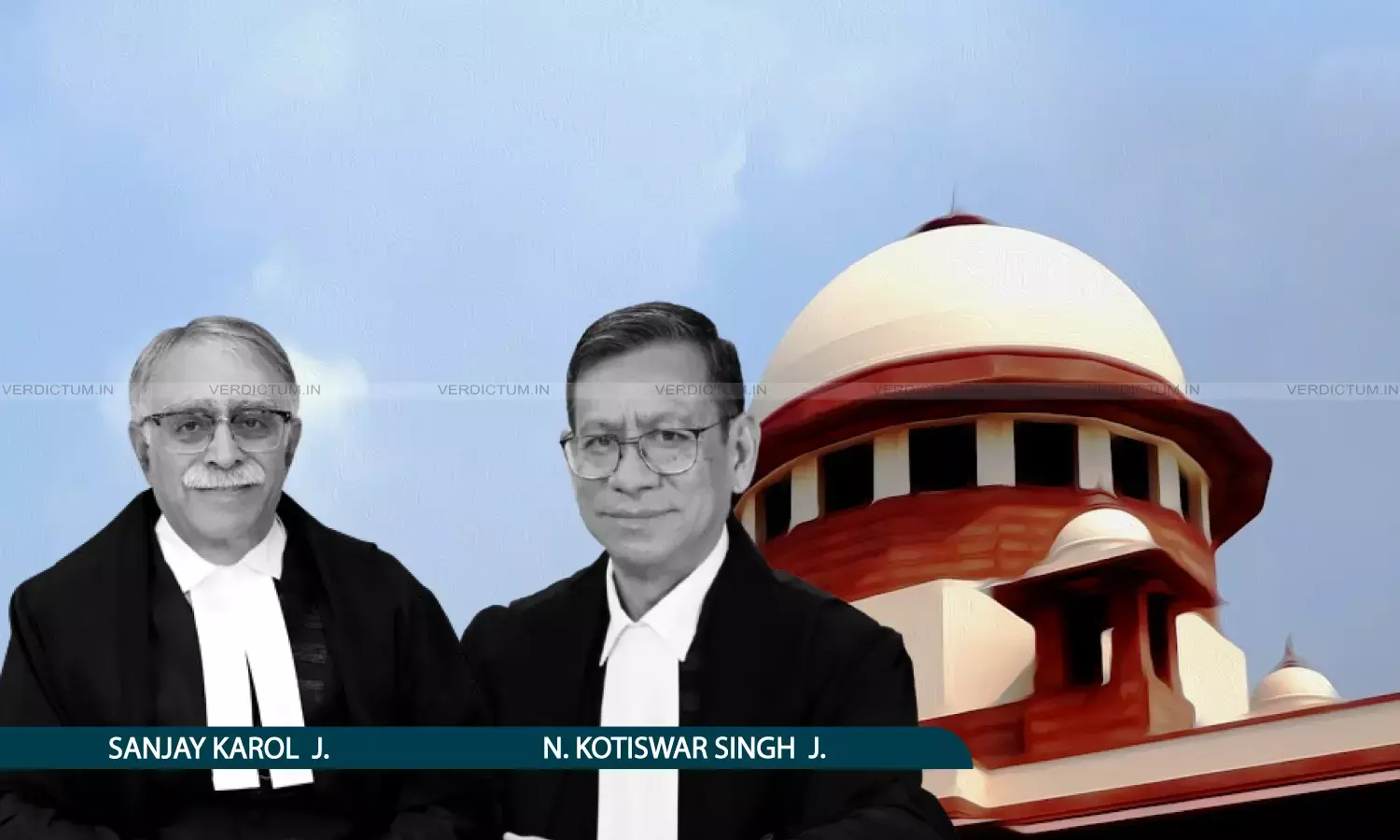
Justice Sanjay Karol, Justice N. Kotiswar Singh, Supreme Court
The Supreme Court has observed that Rule 23(1) of the Haryana Civil Services (Compassionate Financial Assistance or Appointment) Rules, 2019 applies only to claims for ‘compassionate financial assistance’ and does not extend to a claim for ‘compassionate appointment’.
The Court has set aside a Punjab and Haryana High Court judgment, directing the State of Haryana to consider the claim of an applicant for compassionate appointment on its own merits within three months, entirely uninfluenced by an ongoing criminal appeal against his mother.
The apex court observed that while the statutory rule constitutionally bars "compassionate financial assistance" during pending criminal trials to prevent wrongdoers from getting state funds, its explicit text lacks any corresponding provision to block a "compassionate appointment."
Highlighting a stark statutory anomaly where a family member under a criminal cloud cannot receive minor monthly financial aid but remains technically eligible for a permanent lifetime government job, the Bench emphasized that courts cannot engage in judicial legislation to fix legislative gaps and must apply the law exactly as drafted.
The Bench of Justice Sanjay Karol and Justice Nongmeikapam Kotiswar Singh observed, "Rule 23(1) of the Rules of 2019, by its express language and its marginal heading, applies only to claims for ‘compassionate financial assistance’. It does not, by its text or by any permissible process of interpretation, extend to a claim for ‘compassionate appointment’. The Respondent-State erred as a matter of law in invoking Rule 23(1) to defer the Appellant’s claim for compassionate appointment. The High Court equally erred in upholding that application."
AOR Shubham Bhalla appeared for the Appellant, while AAG Hemant Gupta appeared for the Respondents.
Brief Facts of the Case
The Appellant’s father, a Junior Basic Teacher in the Government Primary School under the State of Haryana, died in a road accident under suspicious circumstances. Consequently, a criminal case was registered against the Appellant’s mother (the wife of the deceased employee), on the allegation that she had conspired with other individuals to murder her husband under Section 302 of the Indian Penal Code.
During the pendency of the criminal trial, the mother executed an affidavit expressing no objection to the service and policy-related benefits being extended to her sons, including the Appellant, and undertaking not to assert any independent claim. The Appellant and his family approached the school authorities seeking clarification regarding the disbursement of these compassionate benefits. The Director of Elementary Education inicialmente informed the subordinate officers that under the Haryana Civil Services (Compassionate Financial Assistance or Appointment) Rules, 2019, the accused wife was not entitled to benefits, and directed the submission of documents for the major children.
The Appellant originally approached the High Court through a writ petition owing to departmental inaction, which was disposed of with a direction to the authorities to decide his representation. Subsequently, the Trial Court acquitted the Appellant’s mother of the murder charge, but on the basis of a "benefit of doubt" rather than an honorable acquittal. Following this, the brother of the deceased employee preferred a criminal appeal against the said acquittal before the High Court, rendering the criminal proceedings sub judice.
In view of the pending criminal appeal, the Director of Elementary Education declined the Appellant’s claim for compassionate appointment, keeping it in abeyance. Aggrieved by the rejection, the Appellant filed a second writ petition challenging the constitutional validity of Rule 23(1) of the Rules of 2019 and seeking a direction for the consideration of his appointment. The High Court dismissed the writ petition, upholding the validity of the rule and observing that the suspension of benefits during pending criminal proceedings was justified, the pending appeal was a continuation of the trial, and the mother held the primary right to the benefits. The present Civil Appeal was preferred against the said impugned order.
Contentions of the Appellant
It was contended that Rule 23(1) of the Rules of 2019, by its express and unambiguous language, applied exclusively to claims for "compassionate financial assistance" and could not be extended to a claim for "compassionate appointment."
It was submitted that the Rules of 2019 maintained a deliberate legislative distinction between financial assistance and public appointment, each governed by different procedures, definitions of family, and competent authorities. Therefore, the High Court and the authorities committed a manifest error of law by importing a restrictive condition into Rule 7, which governs compassionate appointments.
It was further argued that the Appellant's mother and brother had explicitly renounced their respective claims by way of affidavits in favor of the Appellant, thereby leaving no legal impediment for the consideration of his individual claim.
Contentions of the Respondents
It was countered that the Rules of 2019 constituted a single, integrated welfare mechanism where financial assistance and compassionate appointment were merely two options within the same consolidated benevolent scheme, rather than independent remedies.
It was submitted that a harmonious interpretation of Rule 23(1) was necessary to prevent an absurd anomaly wherein a family under criminal suspicion for murdering a government employee could secure public employment while being barred from financial aid.
It was argued that compassionate appointment is not a vested right but a discretionary concession. Under the statutory hierarchy, the widow holds the primary right, and until her entitlement or disqualification is conclusively determined by the final outcome of the criminal appeal, no derivative right could accrue in favor of the Appellant.
Observations of the Court
The Court restated the foundational position of law that compassionate appointment is not a vested or heritable right, nor is it a condition of service that can be claimed without scrutiny or a selection process. It was observed that such relief is extended by the State in the public interest as a structured, humane response to bail out a bereaved family facing sudden pecuniary crisis due to the death of its sole bread earner. However, the Court emphasized that this principle cuts both ways; while a claimant must strictly satisfy all conditions, the State must equally justify any refusal or deferment by grounding its decision within the explicit provisions of the applicable rules, tested on the anvil of non-arbitrariness under Article 14 of the Constitution.
The Court held that Rule 23(1) of the Haryana Civil Services (Compassionate Financial Assistance or Appointment) Rules, 2019, applies exclusively to claims for compassionate financial assistance and cannot be extended to claims for compassionate appointment. It was observed that the plain and unambiguous language of the provision, including its marginal heading, refers solely to financial assistance, and importing appointment into its text would amount to judicial legislation rather than statutory interpretation.
The Court noted that purposive construction is an instrument to resolve genuine ambiguity, not a license to override clear text or to introduce a restriction that the Rule-making authority chose not to explicitly include under its Article 309 powers.
"We must, however, be clear that this Court cannot remedy the anomaly by reading into the Rules a provision which the legislature/State has not formulated. The judicial function is to apply the law as it is. It is for the Rule-making authority/State and the executive, in exercise of the rule-making power under Article 309, to clarify and rectify the legislative lacunae", it observed.
The Court found that the High Court committed a manifest error in law by conflating the priority structures of the two reliefs. It was observed that while Rule 5(1)(f) creates a strict, cascading sequential bar for financial assistance by explicitly using the word "failing" across multiple sub-clauses, Rule 5(1)(g) contains no such conditional language for compassionate appointments.
"The sequential bar applicable to claims for compassionate financial assistance under Rule 5(1)(f), expressed through the cascading “failing” formulation in each sub-clause thereof, has no counterpart in Rule 5(1)(g), which governs compassionate appointment. Rule 5(1)(g) contains no “failing” language. The High Court erred in importing the sequential bar from Rule 5(1)(f) into the domain of Rule 5(1)(g). No absolute statutory bar prevents the consideration of the Appellant’s claim for appointment on the sole ground that the widow’s prior claim under Rule 5(1)(g) has not been conclusively determined", it said.
The Court observed that Rule 5(1)(g) merely provides a plain list of eligible family members without prioritizing one class over another. Consequently, the children’s claim is not automatically barred by the existence of a living widow, especially when the widow has executed an express declaration relinquishing her claim.
The Court held, "Rule 23(1) of the Rules of 2019 is constitutionally valid and does not offend Article 14 of the Constitution of India. It is preventive and regulatory in character, and the classification it creates has a rational and proximate nexus with the object of the provision. However, Rule 23(1) has no application to the facts of the present case, as the Appellant’s claim is for compassionate appointment and not for financial assistance."
upheld the constitutional validity of Rule 23(1) within its proper domain of financial assistance, observing that it does not offend Article 14 of the Constitution. The rule was characterized as preventive and regulatory rather than penal, creating a rational classification to prevent a person criminally culpable for an employee's death from accessing the welfare scheme.
However, the Court highlighted a significant anomaly in the statutory framework where the lesser relief of monthly financial assistance is suspended during criminal proceedings, but the substantially greater relief of lifelong government employment carries no such safeguard. While terming this legislative gap incongruous and highly desirable for the State Government to rectify via appropriate amendments, the Court clarified that the judiciary cannot remedy such a lacuna by reading unimposed restrictions into the law.
Concluding that the State had no legal foundation to keep the matter in abeyance, the Court observed that there was no legal impediment to considering the Appellant's case since his eligibility on merits had not been disputed by the respondents.
The Court allowed the Civil Appeal, set aside the impugned judgment of the High Court, and directed the competent authorities to decide the Appellant's claim for compassionate appointment strictly on its own merits in accordance with the rules within a specified period of three months, uninfluenced by the ongoing criminal appeal.
Cause Title: Atul Chauhan v. State of Haryana and Ors. [Neutral Citation:2026 INSC 640]
Appearances:
Appellant:AOR Shubham Bhalla
Respondents:Additional Advocate General Hemant Gupta, Advocate on Record Akshay Amritanshu, Advocate Harsh Rekha, Advocate Payal Gupta, Advocate Rony John, Advocate Saurabh Gupta, Advocate Akash Aggarwal, Advocate Sarthak Srivastava, Advocate Vineeta Tiwari.
Click here to read/download the Judgment