

Tree Branch Falling On Vehicle Not Ground & Injuring Passenger For MACT Claim: Supreme Court Grants ₹25L Relief To Claimant On Humane Grounds
The Bench observed that leaving a completely paralyzed victim in the lurch without immediate financial support does not appeal to the conscience of justice, thereby overriding legal technicalities to secure complete justice.

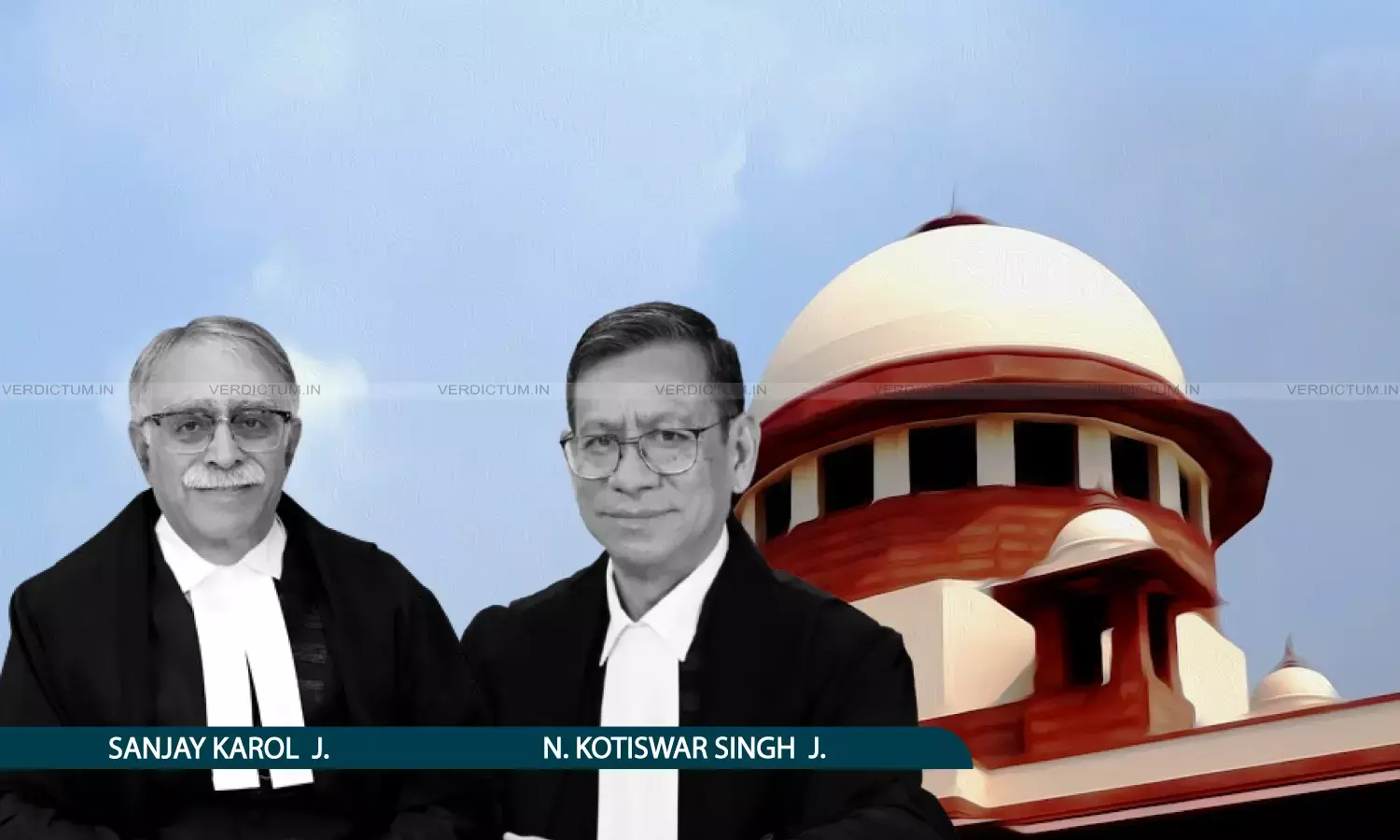
Justice Sanjay Karol, Justice N. Kotiswar Singh, Supreme Court
The Supreme Court directed the Commissioner of Bruhat Bangalore Mahanagara Palike, the Insurance Company, and the State Horticulture Department to pay an enhanced compensation of Rs 25,00,000 to an autorickshaw passenger who suffered permanent paraplegia after a roadside tree branch collapsed onto the vehicle.
While settling the question of law in favor of the civic body by holding that the stationary vehicle played no proximate role in the accident under Section 166 of the Motor Vehicles Act, the Division Bench invoked its extraordinary plenary powers under Article 142 of the Constitution of India.
The Court emphasized that a mechanical dismissal based strictly on the lack of a statutory nexus to the motor vehicle would be inhumane, choosing instead to sustain the prior apportionment of liability to ensure the victim received meaningful and immediate financial succour.
The Bench of Justice Sanjay Karol and Justice Nongmeikapam Kotiswar Singh observed, "In view of the stated liberal interpretation of this term, will the presence of the respondent in the auto rickshaw suffice as ‘use’. In ordinary circumstances, it probably would have. But take for instance a scenario where the respondent was a pedestrian and stood near or under the tree in an attempt to take shelter from the heavy rain and now the branch falls on him. This is an entirely likely scenario. In other words, the motor vehicle itself does not play an active role in the accident. It is not part of the proximate cause of the accident. For that reason, a claim under Section 166 specifically may not be appropriate."
Senior Advocate Anand Sanjay M. Nuli appeared for the Appellant, while DAG Ashish Gopal Garg appeared for the Respondents.
The Court added, "A question however refuses to leave us. Will the respondent be forced to contend for compensation in another round of litigation? Is this conclusion in the interest of justice? Should we have to decide only the question of law then actual money reaching the hands of the respondent would be delayed. It appears to us, to be not so. A person who has suffered such life altering grievous injuries, being left in lurch, without any money to sustain himself, does not appeal to the conscience of justice."
Brief Facts of the Case
The respondent was traveling in an autorickshaw when an unexpected heavy downpour prompted him to request the driver to pull over to the side of the road. While the vehicle was stationary underneath an old roadside tree waiting for the rain to subside, a branch suddenly detached from the tree and crashed onto the vehicle. The impact caused grievous bodily injuries to the respondent, resulting in total paraplegia of both lower limbs along with bowel and bladder incontinence.
Seeking compensation for his life-altering injuries, the respondent moved a claim petition before the Motor Accidents Claims Tribunal. The Claims Tribunal dismissed the petition on the ground that the incident was a natural calamity. The High Court initially dismissed the matter on the point of delay, but following a remand order from the Apex Court, it entertained the appeal on merits. In the second round, the High Court awarded compensation and apportioned the liability, directing the Insurance Company of the autorickshaw to pay half the amount, while the appellant and the State Horticulture Department were ordered to pay one-fourth each. Aggrieved by this apportionment of liability, the appellant approached the Supreme Court.
Contentions of the Parties
The appellant, alongside the State Horticulture Department, contended that they bore no liability or responsibility for the unfortunate accident. It was argued that the falling of the branch was a natural occurrence and a pure 'Act of God' (vis major) over which the state and municipal authorities had absolutely no control. They further placed reliance on judicial precedents to assert that statutory bodies could not be held liable for tortious negligence when the hazard was not reasonably foreseeable.
Conversely, the respondent sought confirmation of the compensation, highlighting the severity of the permanent disability suffered. It was argued on behalf of the claimant that municipal bodies owed a statutory duty of care to the public to maintain and monitor old trees within city limits to prevent such hazardous occurrences.
Observations of the Court
The Supreme Court observed that while municipal corporations did have a fundamental duty to look after city trees and undertake periodic maintenance, it was logistically unrealistic to expect them to maintain a constant vigil over every single tree and shrub across ever-expanding urban boundaries. The Court further noted that pruning or slashing all older branches could not be deemed a prudent solution.
Analysing the provisions of the Motor Vehicles Act, the Court observed that for a claim to be maintainable under Section 166, the accident must arise out of the "use" of a motor vehicle. While the term "use" enjoyed a wide and liberal statutory interpretation encompassing stationary vehicles, the Court observed that the vehicle in question played no active or proximate role in the accident. Since the injury was caused strictly by the falling branch—a situation identical to what a pedestrian taking shelter might have faced—the Court held that fastening liability upon the appellant under the Motor Vehicles Act was improper and unfair.
"It is within our domain, as the final Court of the country to ensure the law, as implemented, specially in cases like these, is humane and in accordance with the salutary principles of the Constitution. That apart, we may observe that the compensation as determined by the High Court in itself, is insufficient as per the settled principles of law, owing to a somewhat technical approach adopted by the High Court. In that view of the matter, we enhance the total compensation to Rs.25,00,000/- along with interest as determined by the High Court, to be calculated from the date of filing of the claim petition. The apportionment of liability shall remain undisturbed. This we do under the exercise of Article 142 of the Constitution", the Court observed.
However, moving beyond the strict technicalities of the law to prevent the claimant from being left in the lurch, the Court invoked its extraordinary plenary powers under Article 142 of the Constitution of India. It was observed that a mechanical dismissal would deny immediate succour to a victim suffering from permanent paralysis, which would fail the conscience of justice.
Consequently, while settling the question of law in favour of the appellant, the Court enhanced the total compensation to a more humane standard and ordered all the apportioned parties, including the appellant, to deposit the respective amounts directly into the respondent's bank account to secure complete justice.
Cause Title: The Commissioner, Bruhat Bangalore Mahanagara Palike v. K.K. Umesh Kumar & Ors.[Neutral Citation: 2026 INSC 637]
Appearances:
Appellant: Senior Advocate Anand Sanjay M. Nuli, Advocate on Record M/S. Nuli & Nuli, Advocate Suraj Kaushik, Advocate Nanda Kumar K. B., Advocate Dharm Singh, Advocate Akhila Wali, Advocate Abhishek Kanyalur, Advocate Divya Sinha, Advocate Ashritsai Torgal, Advocate Tanya Chillar.
Respondents: Advocate on Record Shweta Garg, Advocate on Record Manjeet Chawla, Advocate on Record Patil Rekha Chandra Gouda, Deputy Advocate General Ashish Gopal Garg, Advocate Rakesh Garg, Advocate Pankaj Seth, Advocate Jyoti, Advocate Shruti Jain, Advocate Jadhav Vishal.