

Supreme Court Holds Caretaker Guilty Of Contempt For Exploiting Kerala's Tallest Elephant 'Raman', Directs State To Seize Temporary Custody
The Court imposed a fine on a private caretaker for willfully breaching a judicial undertaking by deploying the captive elephant in a temple festival, emphasizing that the judiciary cannot remain a mute spectator to the exploitation of voiceless animals.

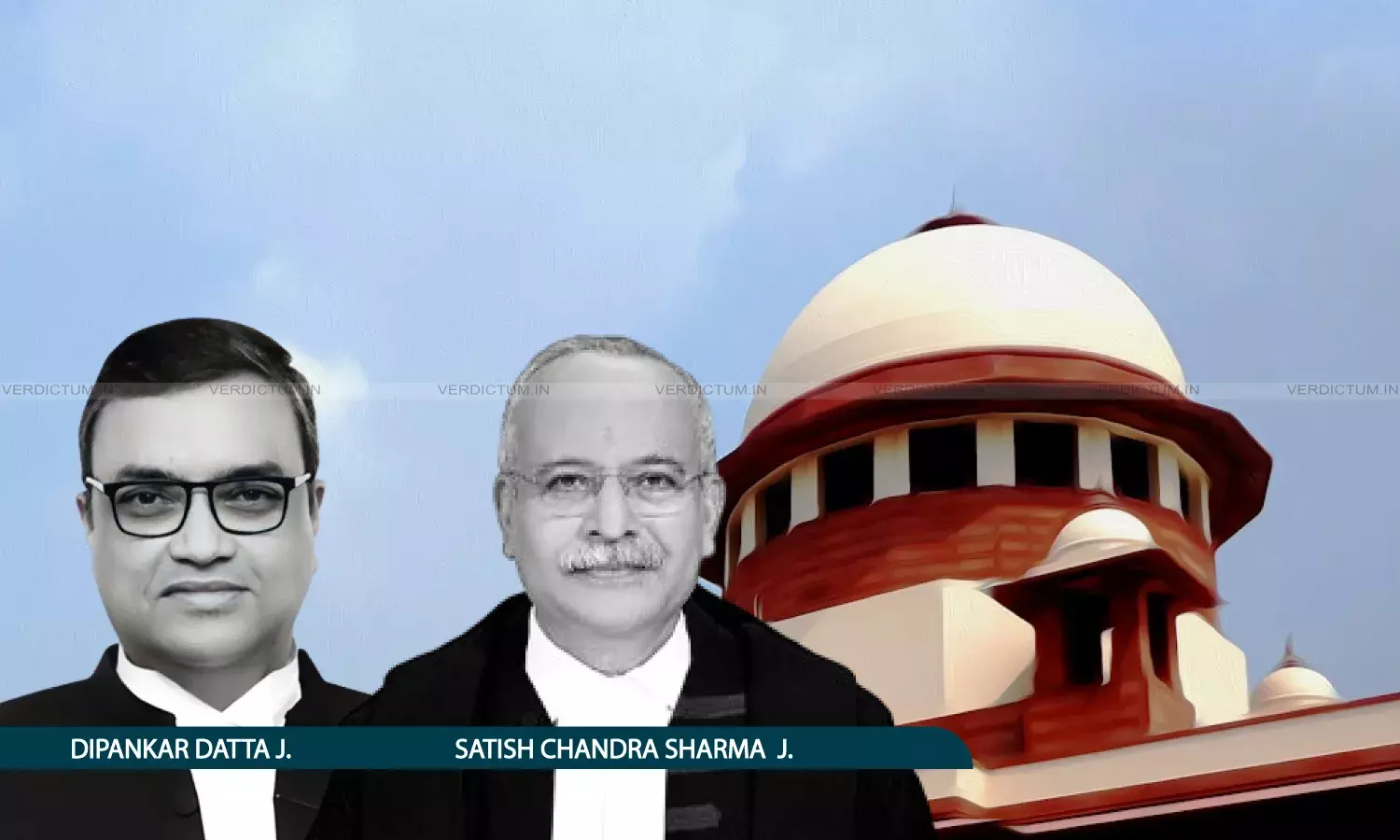
Justice Dipankar Datta, Justice Satish Chandra Sharma, Supreme Court
The Supreme Court held a private caretaker guilty of civil contempt and ordered the State of Kerala to take immediate, temporary custody of 'Raman'—reputed to be the tallest captive elephant in Kerala—to house it at a rehabilitation center.
The Court passed the order after the petitioner/caretaker violated a solemn court undertaking against using the elephant for commercial or temple activities. While the Bench fined the caretaker a amount of INR 2,000 for flagrant defiance, it discharged the state wildlife officials from the contempt proceedings, noting that their initial delay in conducting a mandatory medical inspection was caused by the elephant being in an aggressive state of musth.
The Bench of Justice Diapankar Datta and Justice Satish Chandra Sharma observed, "It is truly unfortunate that the elephant in question i.e.,Raman, who also happens to be the tallest elephant in the State of Kerala has been subjected to commercial exploitation despite an order restraining such exploitation, that too on the strength of an undertaking made before this Court. We would be failing in our duty towards the voiceless, if we turn a blind eye towards such defiance. We cannot be a mute spectator, more so in matters pertaining to voiceless animals, whose wellbeing is also of paramount importance."
Advocate on Record A. Karthik appeared for the Petitioners, while Advocate on Record Krishnamohan K. appeared for the Respondents.
Brief Facts of the Case
The petitioner instituted the present contempt petitions alleging willful disobedience of the interim directions passed by the Court in the underlying criminal appeals. The core controversy between the petitioner and the prime respondent centered around competing claims regarding the ownership and custody of a captive elephant named ‘Raman’.
The petitioner asserted that the elephant belonged to a religious mutt and was merely entrusted to the respondent for temporary upkeep, whereas the respondent claimed absolute ownership over the animal on the strength of purported gift deeds. Following allegations of illegal retention and maltreatment of the elephant, criminal proceedings were initiated against the respondent in the State of Kerala. In the interim, the petitioner moved an application seeking interim custody of the animal, and the litigation sequentially traveled through the Trial Court and the High Court of Kerala before reaching the Hon’ble Court.
During the pendency of the primary appeals, the Court directed the preservation of status quo regarding the custody of the elephant. Subsequently, the petitioner preferred an application seeking vacation of the interim protection, raising serious concerns regarding the deteriorating physical health and commercial exploitation of the animal in festive processions.
The Court ordered the wildlife authorities of the State to conduct a comprehensive medical inspection of the elephant. Concurrently, the counsel appearing for the respondent gave a categorical undertaking before the Court that the elephant would not be deployed for any commercial or temple activities during the interregnum.
The petitioner filed the instant contempt action on the ground that the respondent flagrantly violated the judicial undertaking by continuously exploiting the animal in public festivals, and further alleged that the State authorities failed to timeously inspect the elephant.
Contentions of the Parties
The petitioner contended that the respondent deliberately breached the undertaking recorded by the Court. In support of the allegations, the petitioner placed on record substantial photographic evidence, posters, and social media publicity materials demonstrating the active commercial exploitation and advertisement of the elephant in public events. It was further argued that the State authorities committed contempt by failing to execute a close-quarter medical examination of the animal as directed, especially after the elephant emerged from its period of aggressiveness.
Per contra, the respondent stoutly denied the allegations of non-compliance and maintained that the elephant was not commercially exploited after the judicial restraint. It was contended that the promotional materials relied upon by the petitioner pre-dated the court orders or were independently circulated by temple committees without the respondent's participation. However, the respondent acceded to a single isolated instance where the elephant was brought to a temple ceremony. It was argued that the animal was taken out solely on veterinary advice for physical exercise and to honor deep-rooted religious sentiments after a scheduled elephant suddenly fell ill. The respondent asserted that there was no intentional defiance and tendered an unconditional apology for the technical contravention.
Observations of the Court
The Court observed that the captive elephant, noted to be the tallest in the State of Kerala, was undeniably used in a ceremonial temple procession in direct defiance of the explicit undertaking given to the Court.
The Court noted with regret that the animal was subjected to commercial exploitation despite subsisting judicial restraints, and emphasized that the judiciary could not remain a mute spectator to the defiance of its orders, particularly in matters concerning the welfare of voiceless animals. It was held that protecting the well-being and health of the animal was of paramount consideration.
Consequently, the Court found the respondent guilty of civil contempt for willful breach of the undertaking. In the interest of justice, the Court deemed it appropriate to sentence the contemnor to pay a nominal fine.
Furthermore, to prioritize the health and overall care of the animal while the main custody dispute remained pending, the Court directed the State of Kerala to temporarily take over the immediate custody of the elephant and house it at an appropriate rescue and rehabilitation centre at state expense.
"Therefore in the given circumstances, where the issue pertaining to the custody of the elephant in question is yet to be decided finally; and with a view to prioritise the health and overall well-being of the elephant in question, this Court deems it appropriate to direct the State of Kerala to take over the custody of the elephant in question i.e., Raman; and house it an appropriate rescue / rehabilitation centre. It is clarified that the aforesaid arrangement is only temporary; and will be subject to the final orders passed by this Court in respect of the issue of interim custody pending adjudication in the Underlying Appeals", the Court said.
Lastly, regarding the state officials, the Court observed that the authorities had made bona fide endeavors to inspect the animal but were initially restricted due to its aggressive medical state. Since a detailed medical report was subsequently placed on record, the Court concluded that the state machinery did not willfully disobey the judicial mandates and accordingly discharged them from the contempt proceedings.
Accordingly, the Court disposed of the contempt petition.
Cause Title: Jayakrishna Menon v. Krishnankutty & Ors. [Neutral Citation:2026 INSC 631]
Appearances:
Petitioners: Advocate on Record A. Karthik, Advocate C. Unnikrishnan, Advocate Smrithi Suresh, Advocate Sugam Agrawal, Advocate Veera Mahuli, Advocate Nanditha S.
Respondents: Advocate on Record Krishnamohan K., Advocate on Record Nishe Rajen Shonker, Advocate Prerna Jain Kala, Advocate Jeevlin Jiji, Advocate Dania Nayyar, Advocate Anu K. Joy, Advocate Alim Anvar, Advocate Santhosh K, Advocate Devika A. L.