

"Bail Is The Rule And Jail Is An Exception" Is Not Absolute Rule, Statutory Restrictions Must Be Kept In Mind: Supreme Court
It was observed that the cardinal principle of bail jurisprudence must be balanced against statutory restrictions, the gravity of the offence, and the risk of witness tampering while considering regular bail applications for heinous crimes.

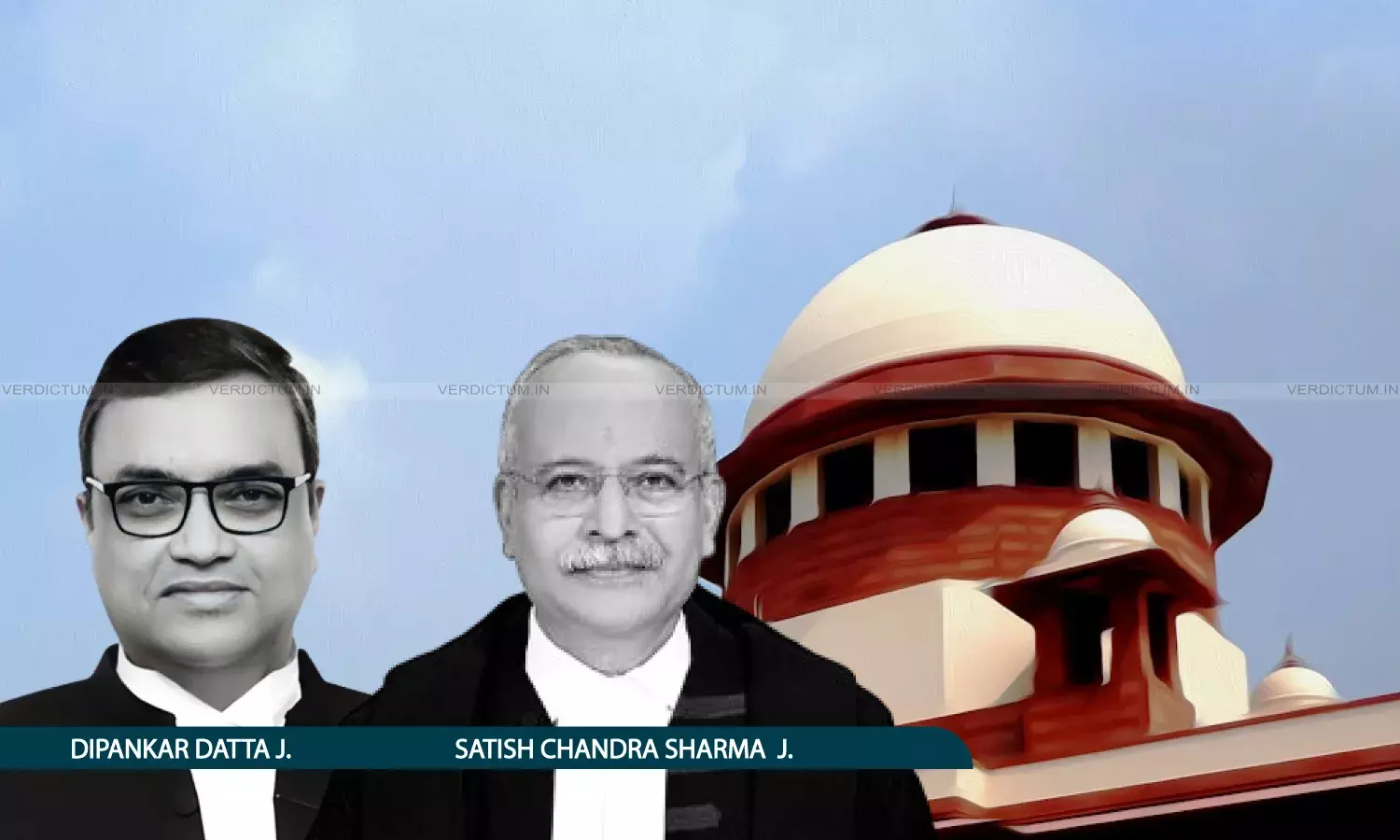
Justice Dipankar Datta, Justice Satish Chandra Sharma, Supreme Court
The Supreme Court has observed that the settled principle of "bail is the rule and jail is an exception" is a guiding metric rather than an absolute mandate.
The Bench observed that this primary rule of bail jurisprudence must invariably be balanced against crucial parameters, including statutory bars under Section 437(1) of the Code of Criminal Procedure (CrPC) for offenses punishable by death or life imprisonment, the gravity of the offense, and the prima facie nature of the evidence.
The Bench of Justice Dipankar Datta and Justice Satish Chnadra Sharma observed, "Bail is the rule and jail is an exception”, although is a cardinal principle of bail jurisprudence in India, it is not an absolute rule. The rule is sort of a guiding principle that should be kept in mind along with the facts of each case and statutory restrictions, if any, while considering a prayer for bail. In relation to offences such as the one under consideration, murder and conspiracy are serious offences. Section 437(1) of the CrPC bars grant of bail if reasonable grounds exist that the accused has committed an offence which is punishable with either death or life imprisonment."
Senior Advocates Abhishek Manu Singhvi, Sakal Bhushan, Sidharth Luthra appeared for the Appellants, while AOR Pashupathi Nath Razdan appeared for the Respondents.
"The cardinal rule has to be balanced with factors like prima facie case, gravity of offence, nature of evidence, antecedents, differentiation of roles, parity, delay in conclusion of trial, age of the accused, medical grounds, etc. However, bail could be declined if the offence is heinous and premeditated, there is grave apprehension of the witnesses being influenced or the evidence being tampered, a possibility of the accused absconding should he be granted bail and thereby evading trial, etc.", the Court added.
Brief Facts of the Case
The present matter arose out of a criminal dispute involving an alleged attempt to forcibly dispossess a landowner from his property in Jammu. The complainant filed a First Information Report (FIR) alleging that several named accused persons, along with their accomplices, unlawfully entered the land, threatened the occupants, and launched a violent assault upon his brother and nephew.
The nephew subsequently succumbed to the grievous injuries sustained during the assault, prompting the investigating agency to alter the offences in the FIR to include charges of murder, criminal intimidation, and criminal conspiracy under the Indian Penal Code. Following the completion of the investigation, the police filed a comprehensive chargesheet relying upon closed-circuit television (CCTV) footage, call detail records (CDRs) showing frequent communication among the co-accused, and testimonies of multiple eyewitnesses.
The appellants moved bail applications before the High Court of Jammu & Kashmir and Ladakh. The High Court rejected their prayers for the grant of regular bail, against which the appellants preferred the present special leave petitions (now converted into criminal appeals) before the Supreme Court. During the pendency of these appeals, the trial court recorded the evidence of the prosecution’s eyewitnesses.
Contentions of the Appellants
It was contended that the appellant (Sheikh Mehmood) was an elderly person of advanced age suffering from a chronic ailment requiring specialized medical attention. It was submitted that he was not present at the scene of the crime, no specific overt role was attributed to him by any eyewitness during their deposition before the trial court, and the allegations against him were confined to a vague claim of criminal conspiracy.
It was argued that the material testimony of the prime eyewitness had undergone progressive and contradictory improvements to deliberately implicate the appellant. It was pointed out that the eyewitness admitted during cross-examination that neither the appellant nor his son entered the disputed plot or appeared in the video recordings. Furthermore, it was clarified that the majority of his past criminal antecedents had already resulted in acquittals, discharges, or closures.
Contentions of the Respondents
The State argued that there was a prima facie case against all the appellants, establishing their direct or indirect complicity in a heinous crime that resulted in the loss of a human life. It was submitted that although the examination of the eyewitnesses stood completed, several other material witnesses of fact were yet to be deposed before the trial court.
Observations of the Court
The Court observed that while the cardinal principle of bail jurisprudence in India dictated that "bail is the rule and jail is an exception," it was not an absolute rule. It was noted that this rule served as a guiding principle which must be balanced against the specific facts of each case, statutory restrictions, and the gravity of the offences.
The Court highlighted that offences like murder and criminal conspiracy were exceptionally serious, and noted that Section 437(1) of the Code of Criminal Procedure created a statutory bar against the grant of bail if reasonable grounds existed to show that the accused committed an offense punishable with death or imprisonment for life.
The Bench observed that the primary rule of bail must be balanced against vital factors such as the existence of a prima facie case, the gravity of the offence, the nature of evidence, criminal antecedents, differentiation of roles, parity, advanced age, and medical grounds.
Conversely, the Court remarked that bail could be safely declined if the offence was heinous and premeditated, or if there existed a grave apprehension of witnesses being influenced, evidence being tampered with, or the accused absconding to evade trial.
Upon a prima facie evaluation of the evidence on record, the Court formed the opinion that the present case did not suffer from an absence of an overt act of homicidal death, a lack of records linking the death to the conspiracy, or a lack of shared common intention among the accused. Consequently, the Court observed that the rejection of the bail applications for the principal accused persons should follow as a matter of course.
The Court, however, adopted a differentiated approach toward two of the appellants, namely Sheikh Mehmood and Ravinder Kumar Gupta, on account of them being septuagenarians. It observed that one of them was in poor health requiring regular medical care, while the ocular evidence against the other was, to a certain extent, prevaricating and inconsistent.
In view of their advanced age and specific circumstances, the Court directed their release on regular bail, subject to furnishing bail bonds to the satisfaction of the trial court and complying with strict conditions to ensure an unhindered trial.
Cause Title: Sheikh Mehmood v. Union Territory of Jammu & Kashmir and other connected matters. [Neutral Citation: 2026 INSC 611]
Appearances:
Appellants:Senior Advocate Abhishek Manu Singhvi, Senior Advocate Sakal Bhushan, Senior Advocate Sidharth Luthra, Senior Advocate Sunil Sethi, Advocate on Record Jatin Bhardwaj, Advocate on Record Nupur Kumar, Advocate on Record P. D. Sharma, Advocate Harsh Tikoo, Advocate Misbahul Haque, Advocate Ramkishan Saraswat, Advocate Rahul Rai, Advocate Siddharth Seem, Advocate Kamal Kishore, Advocate Vasu Bhushan, Advocate Nipun Bhushan, Advocate Sumit Singh Somria, Advocate Parimoksh Seth, Advocate Shivangi Gumber, Advocate Anjali Sharma, Advocate Priyanshi Singh.
Respondents:Advocate on Record Pashupathi Nath Razdan, Advocate on Record Mahesh Thakur, Advocate Parth Awasthi, Advocate Pradeep Baisoya, Advocate Karman Singh Johal, Advocate Siddhartha Sati, Advocate Narveer Yadav, Advocate Ruchi Kumari, Advocate Anthony Raju, Advocate Dushyant Pratap Singh.
Click here to read/download the Order