

Writ Court Cannot Adjudicate Issues Concerning Title Or Ownership Of Property Under PIL Jurisdiction: Supreme Court
The Court set aside a High Court order for the demolition of shops in Madhya Pradesh, holding that disputed questions of title cannot be decided under writ jurisdiction and that necessary parties must be heard to uphold natural justice.

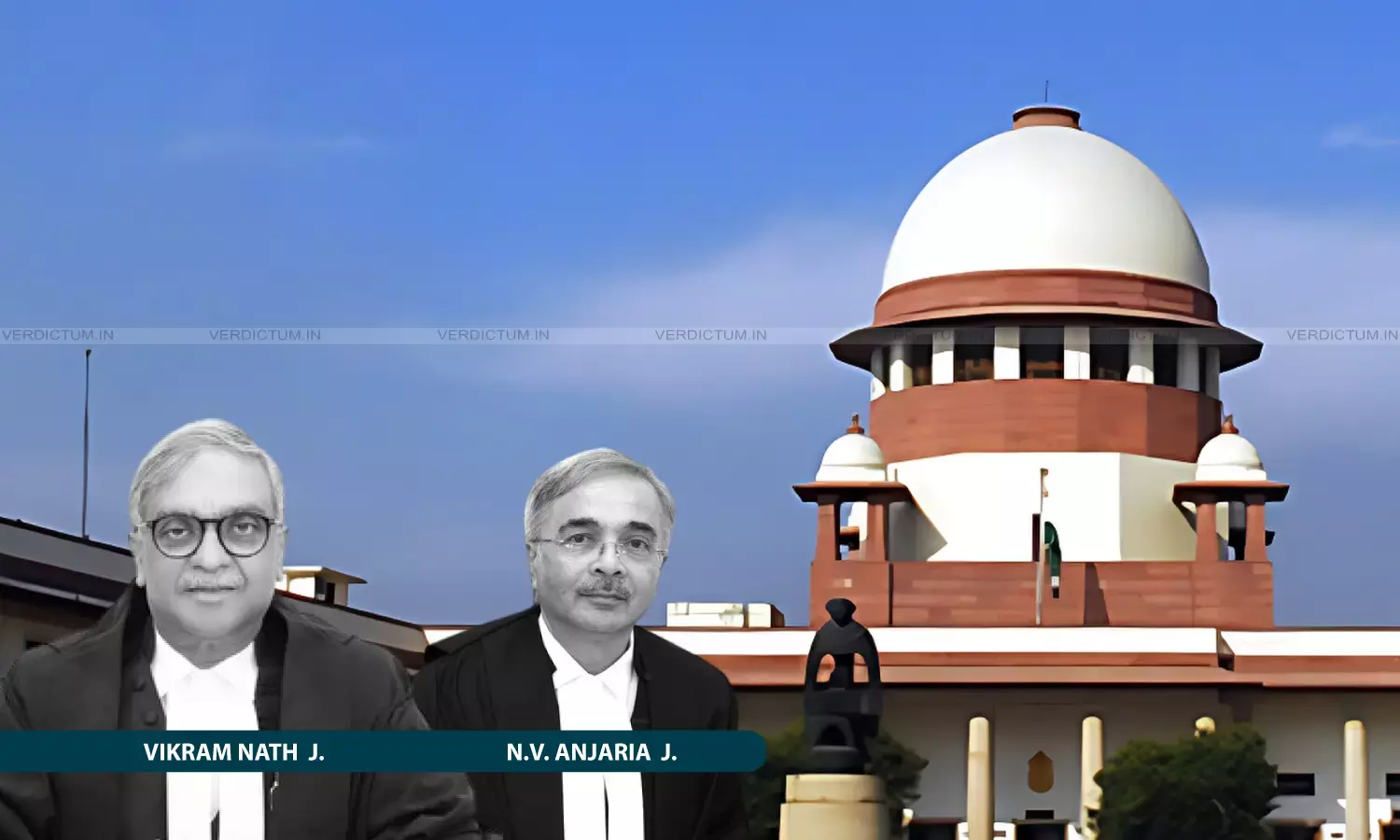
The Supreme Court has observed that a writ court, under PIL jurisdiction, should not adjudicate, directly or indirectly, on the aspects and issues concerning the title or ownership of the property.
The Court noted that the High Court erred by ordering the demolition of 54 shops without impleading the allottees and by attempting to resolve a property dispute between the Municipal Council and the State Government within the narrow scope of a Public Interest Litigation (PIL).
The Bench of Justice Vikram Nath and Justice NV Anjaria observed, “Given this well settled law, it is to be observed that a writ court would not be justified in granting the relief in a writ petition where grant of such relief is to be considered by necessarily touching upon and forming an opinion, directly or indirectly, on the aspects and issues concerning the title or ownership of the property. The public interest jurisdiction of the Constitutional Courts stems from plenary jurisdiction under Article 226 of the Constitution, and a public interest petition, for its substance, procedure and purpose, is a petition under Article 226 of the Constitution. Therefore, travelling into the area to adjudicate the titular issues would be a wrongful exercise of public interest jurisdiction.”
Additional Solicitor General Brijender Chahar appeared for the Petitioners, while Additional Advocate General Manisha T. Karia appeared for the Respondents.
Factual Background & Contention of the Parties
The private Appellants and the Nagar Palika, Khachrod (the Municipal Council) preferred four separate appeals against the judgment and subsequent review orders passed by the High Court of Madhya Pradesh.
Respondent No. 1 filed a Public Interest Litigation (PIL) contending that the Municipal Council unauthorisedly constructed shops on government land known as ‘Dussehra Maidan’, which the authorities reserved exclusively for cultural events. The High Court allowed the PIL and directed the demolition of the said shops. The private appellants, who were the allottees and occupants of the subject shops, were not impleaded as parties to the PIL. Consequently, they filed review petitions, which the High Court dismissed.
Prior to the final judgment, the PIL petitioner complained to the Tehsildar. A revenue inspection report revealed that the Municipal Council built several shops, a school, and a hostel on the subject land. Acting on the High Court's interim directions, the Tehsildar proceeded ex-parte against the Municipal Council and ordered the immediate demolition of the shops, terming the construction illegal. The High Court ultimately accepted the PIL petitioner's contentions and ordered the removal of the structures.
In its defence, the Municipal Council asserted absolute ownership over the subject land, arguing that the land vested in the Municipality by virtue of the Madhya Pradesh Municipalities Act and erstwhile official gazettes. The Municipal Council firmly contended that the construction was lawful, served the public interest, and did not obstruct any cultural activities. It categorically denied that the land belonged to the Najul Department.
Conversely, the State Government claimed ownership of the subject land, relying on Khasra entries to establish its status as a ‘Dussehra Maidan’. The State contended that the Municipal Council failed to obtain the requisite prior approval for the construction. The State averred that the construction was unauthorised, which necessitated the initiation of eviction and penal proceedings against both the private occupants and the Municipal Council.
Observations of the Court
The Supreme Court identified several jurisdictional and factual errors in the High Court's decision.
Firstly, the Court held that the High Court committed a manifest error by rejecting the review petitions. The appellants were allottees-cum-occupants who had been in possession for a significant period, yet the High Court ordered the demolition of their shops without impleading or hearing them. This omission constituted an "error apparent on the face of record."
The Court reiterated that while review jurisdiction is limited, it becomes imperative when a patent mistake—one detectable without elaborate reasoning—is discovered. By passing orders that resulted in serious civil consequences and infringed upon the appellants' Fundamental Right to trade without giving them an opportunity to be heard, the High Court breached the principles of natural justice.
Secondly, the Court observed that both the Municipal Council and the State Government asserted rival claims of ownership over the subject land. It is a well-settled principle of law that disputed questions of title or ownership cannot be adjudicated in a writ petition under Article 226 of the Constitution.
By declaring the shops "unauthorised," the High Court indirectly decided a titular dispute between the Municipality and the State. The Supreme Court clarified that a Public Interest Litigation (PIL) cannot be used as a forum to determine property titles; such issues must be addressed before a competent Civil Court.
Thirdly, upon examining a certified map authenticated by municipal authorities, the Court found that the High Court misjudged the physical location of the shops.
Fourthly, the Court emphasized that a PIL should promote the public good without damaging legitimate private interests. The appellants were not encroachers; they entered the premises through a lawful auction and paid the requisite premium and rent.
Lastly, the Court noted that the PIL appeared to have been filed with oblique motives by a disgruntled individual. The Court cautioned that judicial discipline must be maintained to ensure that the PIL mechanism does not become an instrument of injustice against third parties.
It said, “Any public interest litigation in its outcome aims at promoting a larger public interest. The public interest petition is a medium to achieve and preserve public good. An order passed or directions issued in a public interest petition should not operate to derecognise or to damage legitimate private interest or the lawful rights enjoyed by the citizens or those third persons who may not be party to the proceedings. An order in the public interest petition should not become antithetic to the very idea and object underlying the public interest jurisdiction.”
Accordingly, the Supreme Court allowed all four appeals and set aside the impugned judgment and review orders.
The PIL filed before the High Court was dismissed. However, the Court left it open for the State Government to take lawful action against the Municipality regarding the legality of the construction, without expressing any opinion on the merits of that specific dispute.
Cause Title: Prem Porwal And Ors. v. Jagdeesh Chandra Prajapati And Ors. [Neutral Citation: 2026 INSC 435]
Appearances:
Petitioners: Additional Solicitor General Brijender Chahar, Advocate on Record Divyakant Lahoti, Advocate on Record Ishit Saharia, Advocate K Vinayakam Gupta, Advocate Maqbool Mansuri, Advocate Kuldeep Pathak, Advocate Shashi Bhushan, Advocate Pooja Chahar.
Respondents: Additional Advocate General Manisha T. Karia, Advocate on Record Arjun Garg, Advocate on Record Harmeet Singh Ruprah, Advocate on Record Ishit Saharia, Advocate Amruta Arjun Garg, Advocate Arushi Kulshrestha, Advocate Saaransh Shukla, Advocate Sarthak Raizada Ga, Advocate Aarushi Singh.