

Total Ban Seems Ideal But We Lack Adequate Data: Supreme Court Permits Green Crackers In Delhi-NCR For Two Days During Diwali
The Court allowed permission to burst firecrackers only between 6:00 A.M. and 7:00 A.M. and between 8:00 P.M. and 10:00 P.M. on 7th and 8th November, 2026.

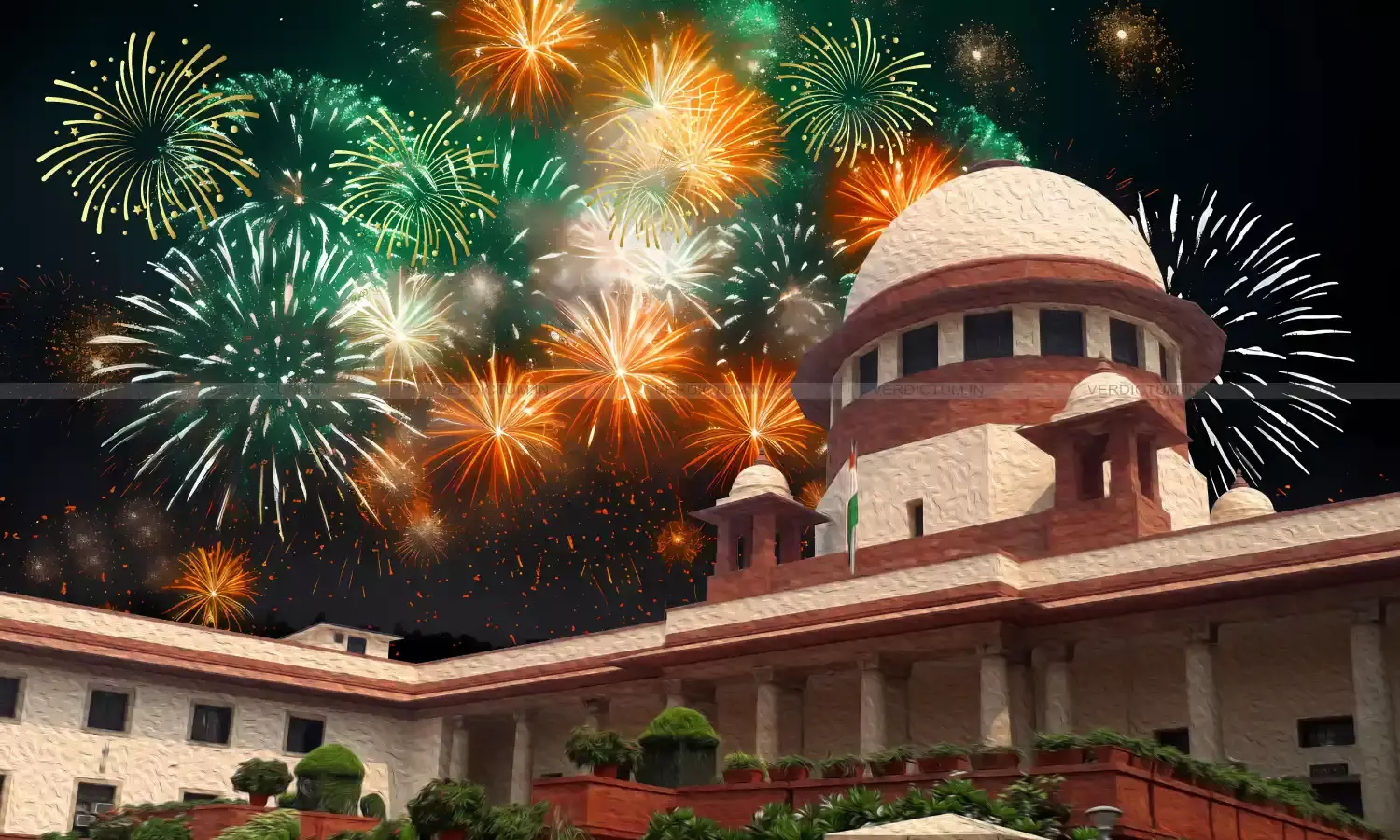
The Supreme Court, while declining to impose a complete ban on firecrackers in Delhi-NCR for the upcoming Deepawali festival, granted permission to burst firecrackers in Delhi-NCR on the same lines as its earlier order, directing the authorities to ensure that bursting of firecrackers was allowed only between 6:00 A.M. and 7:00 A.M. and between 8:00 P.M. and 10:00 P.M. on 7th and 8th November, 2026, on the occasion of Deepawali.
The Court observed that, though a blanket ban appeared to be the ideal solution, it was short of adequate data to conclude whether such a ban would solve the problem, and that the complete ban was facilitating the illegal sale of conventional firecrackers under the guise of Green Crackers.
While hearing the matter, the Court orally observed that it was not inclined to impose a complete ban on firecrackers in Delhi-NCR as it could have a spiralling effect, but cautioned the authorities not to push it to take a harsh stand. The Bench stressed that its orders would become a “mockery” if the implementing mechanism was not put into operation on the ground, and directed the Union of India to file an affidavit on the enforcement measures taken.
The Bench of Justice MM Sundresh and Justice PB Varale directed, "The permission to burst firecrackers is granted on the same lines, as passed by this Court vide order dated 15.10.2025. Accordingly, the authorities shall ensure that bursting of firecrackers is allowed only between 6:00 A.M. – 7:00 A.M. and 8:00 P.M. – 10:00 P.M. on 7th and 8th November, 2026."
It was also observed, "Though imposition of a blanket ban seems to be the ideal solution, we are of the opinion that this Court, at this point in time, is short of adequate data to decide whether or not a complete ban would be the best solution to solve the problem of environmental pollution, caused by bursting firecrackers. At the cost of repetition, this Court has not been furnished with adequate data as to whether the complete ban on firecrackers imposed in 2024 in Delhi-NCR has served its purpose, particularly, since there has been no significant improvement in the AQI readings."
Amicus Curiae Uttara Babbar appeared with Senior Advocate Gopal S and J. Sai Deepak appeared for the Applicants, while ASG Aishwarya Singh Bhati appeared for the Union of India.
Brief Facts of the Case
The Court was hearing an Application in a writ petition which was filed in 2015, on behalf of three infants seeking a blanket ban on the sale and use of firecrackers in the National Capital Region (NCR), citing deteriorating air quality. Pursuant to this, the Court passed several interim orders in the matter.
In 2018, the Court passed orders and banned barium salts in fireworks, and banned the manufacture, sale and use of joined firecrackers (series crackers or laris) as the same causes huge air, noise and solid waste problems.
Last year, in October 2025, the Supreme Court had allowed the sale and bursting of green firecrackers in Delhi-NCR for the festival of Diwali. The Court allowed the joint request of the Central Government and the Delhi Government by relaxing the ban on green firecrackers.
As the festival of Deepawali approached, several interlocutory applications were filed by various stakeholders. The Delhi Fireworks Shopkeepers Association sought restoration of cancelled licences.
The Federation of Fireworks Traders sought permission for the manufacture, storage, sale and use of CSIR-NEERI approved Green Crackers in the NCR. The MoEF&CC sought permission for the use of further reduced quantities of Barium Nitrate in the formulation, achieving an emission reduction of 45-50%.
The petitioners sought a complete ban on the manufacture, transport, distribution, sale, purchase and use of all firecrackers, along with suspension of the licences of all manufacturers and distributors. The applications seeking intervention on behalf of the Delhi Fireworks Shopkeepers Association and the Federation of Fireworks Traders were allowed.
Contentions of the Parties
The Amicus Curiae contended that the prevailing situation warranted a complete ban on the manufacture, storage, sale and usage of firecrackers. It was contended that a comprehensive assessment of the health of the inhabitants of Delhi-NCR, as a consequence of the bursting of firecrackers, had to be conducted. It was urged that this exercise was imperative since the preventive and regulatory measures purportedly undertaken by various authorities had not yielded any positive result in reducing pollution or AQI levels.
The intervening applicants contended that the intervenors were duly licensed traders and manufacturers whose goods had cleared the tests conducted by authorities such as CSIR-NEERI and complied with all the stipulated terms and conditions.
It was contended that the refusal to restore their licences would facilitate the trade in illegal firecrackers manufactured and transported from across the border, which would be more hazardous, thereby defeating the very purpose of the ban.
It was further contended that stricter implementation was required, with specific reference to the registration of fireworks traders and the printing of a QR Code by the manufacturer on the packaging of the firecrackers.
The Additional Solicitor General, appearing for the Union of India, GNCTD and the CAQM, highlighted the measures taken so far and the steps proposed to be undertaken in the territory of Delhi-NCR. She assured this Court that the proposed Action Plan to mitigate pollution would be given effect to and that the entire machinery was geared up to tackle the environmental pollution following the festivals.
Observations of the Court
The Court observed that the right to practise, profess and propagate religion under Article 25(1) of the Constitution was subject to public order, morality, health and other provisions of Part III, and that the right to life under Article 21 included the right to a healthy, safe and pollution-free environment.
It was held that the right of an individual to engage in a practice having a religious colour was only a qualified one and could not transgress constitutional restrictions.
"We are of the opinion that the process of regulating, implementing and monitoring by the authorities should continue not only during the festival times, but more importantly, even thereafter. In fact, there has to be a periodic review of the environmental pollution and its consequential effects, after the festive season...We are also of the view that statistics pertaining to increase in the number of patients, as well as the reported deaths, if any, due to the pollution, have to be collected from Hospitals and Health Care Centres across Delhi-NCR. Further discussion and deliberation should take place between requisite stakeholders, including public health officials, towards alleviation of environmental pollution", the Court observed.
It found that the State had utterly failed to comply with the directions issued during the temporary relaxation, which was also intended to enable the States to determine the effects of Green Crackers on the environment and health.
It was also observed, "We are also conscious of the fact that the celebration of Deepawali has a religious, social, psychological and emotional connotation amongst people, creating a positive atmosphere of hope, welfare and prosperity. That being said, allowing the environment to degrade, which results in a health hazard to all the living beings, defeats the very purpose of the festivities, and the celebrations would be rendered nugatory. All parties before us are ad idem on the fact that bursting of firecrackers is contributing enormously to the pollution in the Delhi-National Capital Region."
The Court thus found that the complete ban was facilitating illegal sales and preventing the purchase of legitimate, tested Green Crackers and Next-Generation Joined Green Crackers.
Directions of the Court
The Court further directed that there shall not be any bursting of fireworks within a 300-metre radius of hospitals, nursing homes, primary and district health centres, old-age homes and any notified silence zones. These areas will be declared as ‘No-Cracker Zones’, and shall be marked on the ground and published.
"The same restriction shall also be applicable to educational institutions. All necessary efforts will have to be made to ensure due compliance as endeavours should be made not to cause any inconvenience to those who are suffering from ailments", the Court added.
Qua manufacturers and traders, the Court directed that the firecracker and fireworks manufacturers who possess valid certification for the Green Crackers, as certified by the CSIR-NEERI, as well as PESO, are permitted to manufacture only those Green Crackers that have been uploaded on the website of CSIR-NEERI from 02.11.2026 to 06.11.2026.
The Court banned the manufacture or sale of firecrackers joined in series (‘ladis’) and garlands. It was reiterated that the use of firecrackers with Barium and those not approved by the CSIR-NEERI as Green Crackers, shall not be permitted.
"The licences of traders that have been cancelled, shall be restored for a temporary period commencing from 04.11.2026 to 06.11.2026, to facilitate the sale of approved green crackers purchased from CSIR-NEERI certified manufacturers. Such licences shall be immediately cancelled, if they are found flouting the aforesaid directions, and they shall be prohibited from selling the firecrackers during the remaining period", it added.
Qua the State Machinery, the Court directed the concerned authorities to mandate all manufacturers and traders of firecrackers in Delhi-NCR to furnish a monetary security, which shall be a handsome amount, as determined by them.
Police authorities, in coordination with the district administration, were to constitute patrolling teams, acquainted with the order and with the details of Green Crackers on the CSIR-NEERI website, to conduct regular reconnaissance, confiscate illegal or conventional firecrackers immediately, initiate prosecutions against offenders and randomly verify QR codes.
The CPCB, in consultation with the State Pollution Control Boards, was to monitor AQI and prepare pre-Diwali, Diwali and post-Diwali reports, along with comparative analysis of sand and water samples. Non-functional AQI monitoring stations were to be inspected and rectified. Post-festival measures, including clearing and disposal of solid waste and cleansing of the most polluted areas with water sprinklers, were to be undertaken.
The State authorities were to publish the Winter Action Plan, Air Pollution Mitigation Plan and CAQM Annual Action Plan along with advisories in newspapers and news channels; the Education Departments were to sensitise schoolchildren on the impact of pollution; and the State was to publicise the directions and the harmful effects of firecrackers through official websites, social media and the audio systems of the Delhi Metro Rail Corporation. The complete ban was directed to stand restored immediately after the festival period.
The State was directed to file affidavits indicating the steps taken regarding the security deposit, designated locations, checking of vehicles, banners and patrolling teams; a detailed report on actions taken and prosecutions initiated against offenders; the AQI reports prepared by the CPCB; and an affidavit on the exact increase in hospital admissions following the festival across Delhi-NCR.
It was observed, "Regardless of the directions passed by this Court to regulate the upcoming situation, the endeavour is to bring about a holistic change for which the public perception has to change. One must embrace the Precautionary Principle by being proactive to prevent issues, instead of merely reacting after they have occurred."
The Court warned that strict contempt action would be taken against responsible officials in case of non-compliance.
"While parting, we wish to make a sincere plea regarding the feasibility of raising awareness by the members of the Bar, prominent personalities, including celebrities and sportspersons, to lend their voice and influence through a voluntary public-awareness campaign. Such participation can play a significant role in encouraging citizens to celebrate the upcoming festivals in a safe, responsible, and environmentally conscious manner, without causing harm to public health or aggravating the already precarious air quality", the Court observed.
Accordingly, the Court listed the matter for further compliance on December 12, 2026.
Recently, another bench of the Supreme Court, while hearing a matter related to air pollution in the Delhi-NCR region, said public awareness and voluntary participation through a balanced, optional approach is more effective than total bans, which face practical implementation hurdles on the ground.
Cause Title: Arjun Gopal & Ors. v. Union of India & Ors. [IA No. 325852/2025 in Writ Petition(s)(Civil) No(s). 728/2015]
Click here to read/download the Order