

Incomplete Chain Of Circumstance: Supreme Court Acquits Man Accused Of Rape And Murder Of Minor Girl
The Court highlighted that the DNA report contradicted the prosecution's case, as the recovered bone extracts were found to be of male origin, whereas the victim was female.

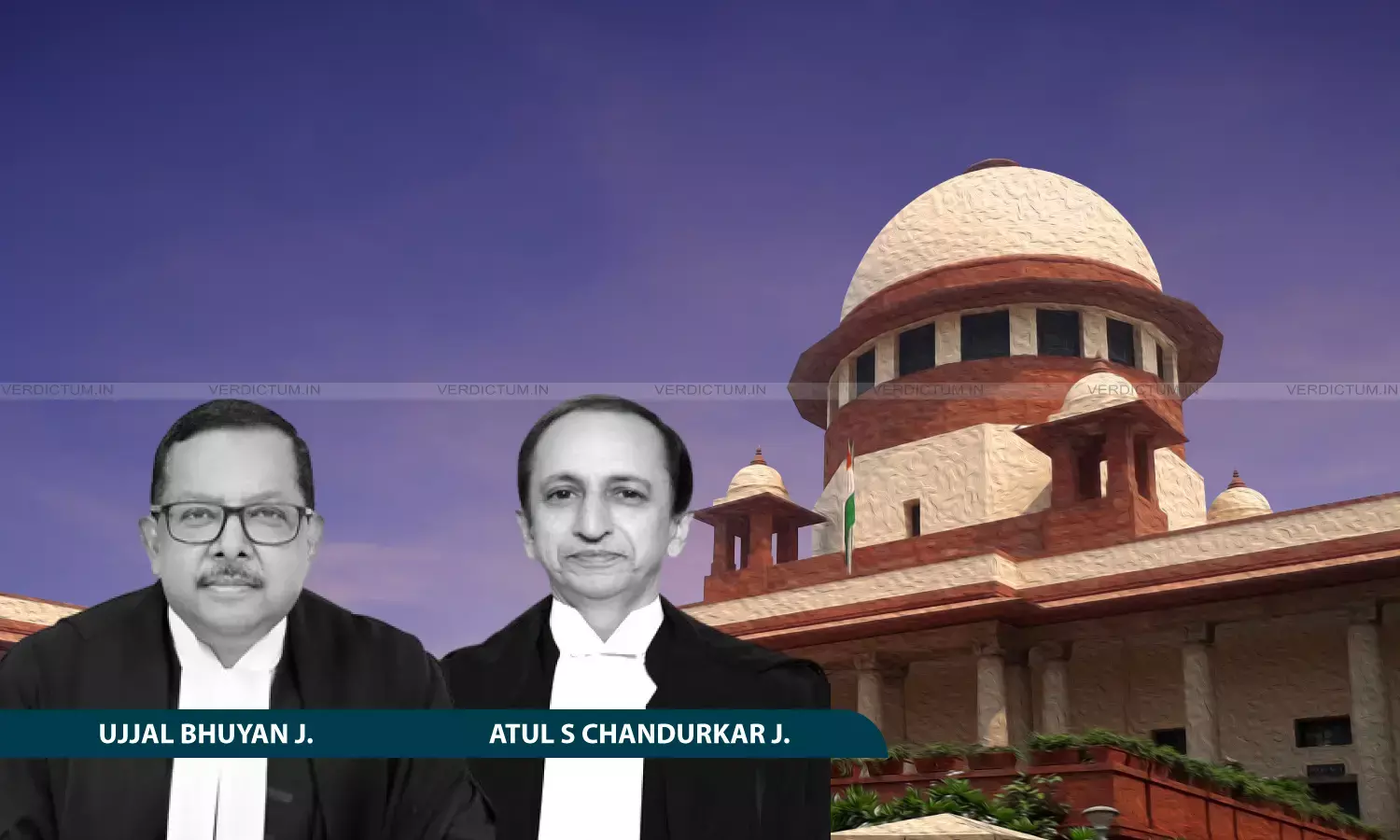
The Supreme Court has acquitted a man accused of rape and murder of his minor niece, setting aside concurrent convictions of the Sessions Court and the Sikkim High Court.
It was observed that the prosecution failed to establish a complete chain of circumstances, highlighting critical gaps including unproven "last seen together" evidence, recovery from an accessible place, and a DNA report which revealed that the recovered bone extracts were of male origin, contrary to the female victim.
The Bench of Justice Ujjal Bhuyan and Justice Atul S Chandurkar observed, "A strong doubt about his involvement in the offence is created in view of the prosecution evidence. It is also true that the victim met an unfortunate end. However, on the basis of such material on record, it would hardly be justifiable to convict the appellant for the same when none of the circumstances point towards his involvement. In the circumstances, he has to be given the benefit of doubt."
AOR Sangeeta Kumar appeared for the Appellant, while AOR Sameer Abhyankar appeared for the Respondent
Brief Facts
The Appellant filed an appeal assailing his conviction for the offence punishable under Sections 376(2)(i), 302 and 201 of the Indian Penal Code, 1860, along with his conviction under Sections 4 and 6 of the Protection of Children from Sexual Offences Act, 2012.
It was the case of the prosecution that the in 2013 the Appellant was asked by his mother/complainant to go and purchase some vegetables. The Appellant asked his maternal niece to accompany him.
According to the prosecution, the appellant, however, took the victim from the house. When the appellant and the victim did not return after some time, the complainant searched for them. She informed the victim’s mother that her child was missing. The complainant then lodged a Missing Report giving details of the victim as well as her maternal uncle, the appellant. The appellant was traced at Siliguri much later.
As per the FIR, the Appellant, while being brought back from Siliguri to Rongli, had stated that he had raped the victim and had, thereafter, throttled her to death.
Contentions of the Parties
The Appellant submitted that the Sessions Court as well as the High Court erred in convicting the appellant on the basis of circumstantial evidence. The various circumstances referred to by the prosecution were not sufficient to bring home the guilt of the appellant. Though according to the prosecution, the appellant was last seen with the victim, the evidence on record indicated otherwise.
It was argued that the prosecution witnesses were not confident as to whether they had last seen the appellant with the victim. Referring to the delay in registration of the FIR, she submitted that the prosecution failed to explain the steps taken since lodging of the Missing Report and registration of the FIR.
The State supported the impugned judgment and submitted that in the absence of any eyewitness, the prosecution was justified in relying upon various clinching circumstances that pointed to the guilt of the appellant. Each circumstance relied upon by the prosecution clearly indicated the involvement only of the appellant and, therefore, both the Courts were justified in holding him guilty.
Observations/Findings of the Court
The Court viewed that the chain of circumstances did not appear to be complete. The Court considered the circumstances independently to determine whether the chain was completed or not.
The Court observed that a grave doubt was created as to whether the appellant was, in fact, ‘last seen’ with the victim. There was no specific evidence on record on the basis of which it could be asserted that it was indeed the appellant who had taken the victim from the house or that he was last seen with the victim after which she was found missing.
Regarding the recovery under Section 27 of the Act of 1872, the Court observed that the evidence indicated that recovery of the articles made under Section 27 of the Act of 1872 was from a place that was frequented by people and the said spot could be easily seen by any person visiting the same.
"The reliability of a recovery effected under Section 27 of the Act of 1872 from a place ordinarily visible to others should be examined with care", the Court held.
As regards the DNA Report, the Court held that the prosecution failed to bring on record the fact that the bones and teeth recovered at the instance of the appellant, in fact, were of the victim. The DNA report, on the contrary, indicated that the pieces of bone were of male origin while the victim was a female.
"Thus, when it is found that the chain of circumstances relied upon by the prosecution is not complete and that the same does not inspire confidence for its acceptance, the response of the appellant recorded in his statement under Section 313 of the Code cannot be a circumstance against him, especially when other circumstantial evidence is not found to be satisfactory pointing out to the guilt of the appellant alone and none other", the Court held.
The Court held that the evidence led by the prosecution was woefully short of pointing to the guilt of the appellant.
"Therefore, the appellant’s statement under Section 313 of the Code could not be taken as an additional link in the chain of circumstances. In other words, the chain of circumstances has not been formed on the basis of the prosecution evidence", the Court added.
Accordingly, the Court allowed the appeal and quashed the judgment and order passed by the Sessions Court and later affirmed by the High Court.
Cause Title: Santish Gurung v. State of Sikkim [Neutral Citation: 2026 INSC 1073]
Appearances:
Appellant: Advocate on Record Sangeeta Kumar, Advocate Vidushi Garg
Respondent: Advocate on Record Sameer Abhyankar, Advocate Krishna Rastogi, Advocate Aryan Srivastava, Advocate Aakash Thakur, Advocate Yachna Sharma, Advocate Arushi Chopra, Advocate Yashika