Government Approval U/S 3(f)(vi) Land Acquisition Act Must Be For Actual Cooperative Housing Scheme With Layout & Blueprint, Not Mere Requisitions: Supreme Court
The Court found that the government file contained only a land sketch and a cryptic approval, while a later development agreement indicated that no layout had been finalised before the acquisition.
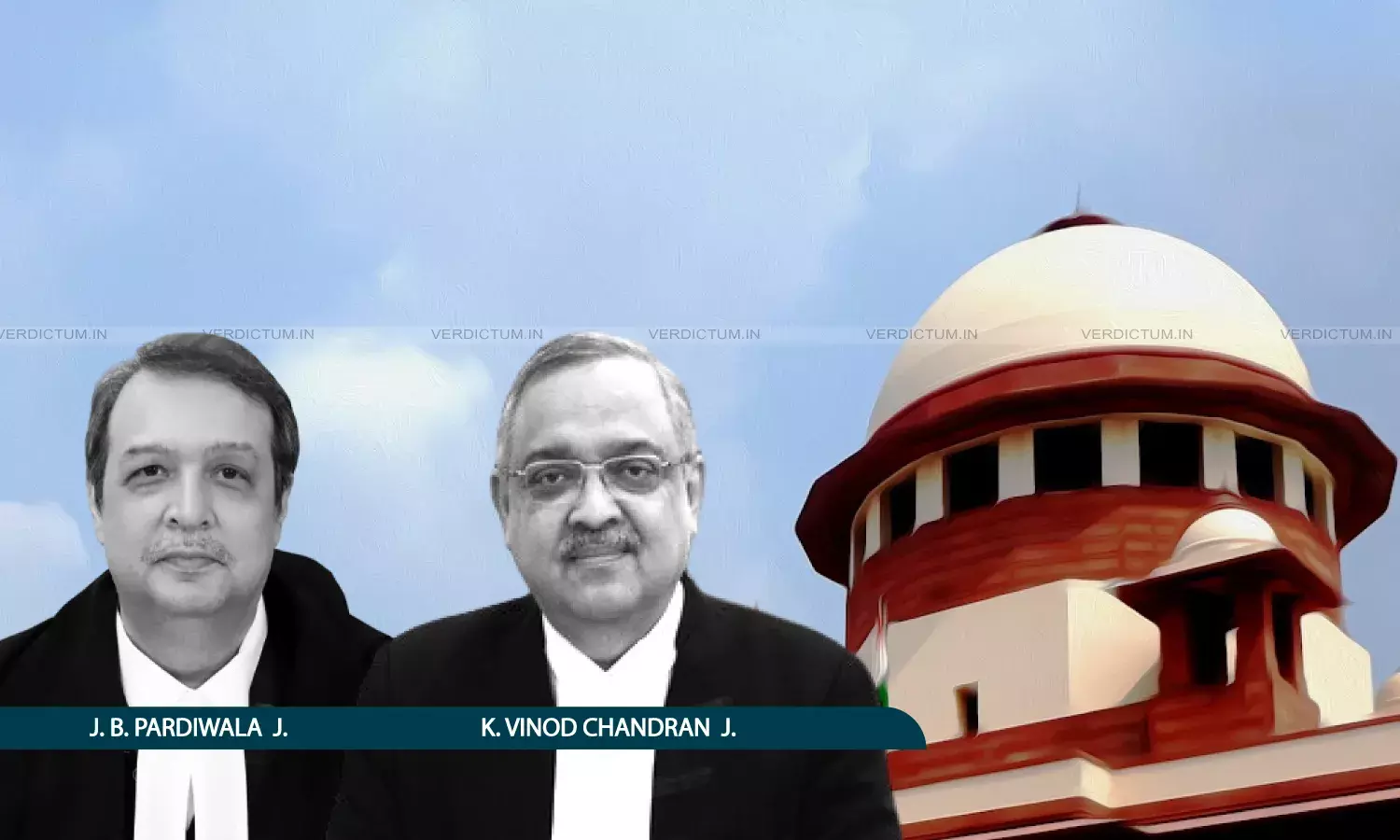
Justice J. B. Pardiwala, Justice K. Vinod Chandran, Supreme Court
The Supreme Court has held that prior government approval under Section 3(f)(vi) of the Land Acquisition Act, 1894, for acquiring land to implement a cooperative society’s housing scheme must cover an actual, formulated scheme containing its layout and blueprint.
The Apex Court clarified that the approval of the society’s mere requisition or the proposed extent of land is insufficient. The Court consequently set aside the Karnataka High Court Division Bench’s judgment and restored the Single Judge’s order quashing the acquisition.
The Court was hearing appeals by landowners against a common Division Bench judgment which had dismissed their challenge to the acquisition on the grounds of delay and res judicata, reversing a Single Judge’s finding that the proceedings were vitiated by fraud and colourable exercise of power.
A Bench of Justice J.B. Pardiwala and Justice K. Vinod Chandran observed: “It is crystal clear that the acquisition for a public purpose for implementation of a housing scheme by a Cooperative Society, can be only carried out with the prior approval of the appropriate Government. The approval of the appropriate Government is not of the mere requisition made, by a Cooperative Society. It should be for the scheme; not one in contemplation but, forma et descriptio (the layout and the blueprint), placed before the appropriate authority.”
Senior Advocates Kiran Suri and Basava Prabhu S. Patil appeared for the appellants. Senior Advocate Vikas Singh appeared for the cooperative society, while Senior Advocate Sanjay Hegde, assisted by Additional Advocate General Omar Hoda, appeared for the State.
Background
The cooperative society entered into an agreement with Bhagya Enterprises on September 21, 1984, under which Bhagya Enterprises undertook to facilitate acquisition through the Government machinery and secure approval of the layout from the Bangalore Development Authority. Three days later, the 1984 amendment brought cooperative-society housing schemes within the definition of “public purpose” under Section 3(f)(vi), subject to prior government approval.
The society submitted its acquisition application on October 8, 1984. Government approval was communicated in November 1987, followed by a preliminary acquisition notification in November 1988 and a declaration in December 1989 covering 59 acres and six guntas.
The landowners argued that no formulated housing scheme, layout or blueprint had been approved and that the agreement with Bhagya Enterprises demonstrated a colourable exercise of acquisition powers. The society contended that its proposal contained membership, financial and land particulars, proposed plot dimensions and a broad map, and had been approved after scrutiny by the Three-Men Committee and the State-Level Coordination Committee. The State maintained that the prescribed procedure had been followed and relied on an earlier decision concerning the same acquisition.
Court’s Observations
Approval Required A Formulated Housing Scheme
The Court observed that Section 3(f)(vi), introduced by the 1984 amendment, treated acquisition for a cooperative society’s housing scheme as serving a public purpose only where the appropriate Government had granted prior approval of the scheme.
Referring to H.M.T. House Building Cooperative Society v. Syed Khader (1995) and Bangalore City Cooperative Housing Society Ltd. v. State of Karnataka (2012), the Bench stated that the Government was required to examine the number of eligible members, the land required, proposed plot sizes and the broad manner in which the land would be developed.
The Court added: “What is required is not just an approval of the extent and the mere expression of a laudable housing scheme, but housing sites demarcated for allotment to landless members with the detailed descriptive lay-out plan laid before the Government. We find no such scheme having been laid out before the Government.”
Approval Had To Be Expressed In The Governor’s Name
The Court examined the Karnataka Government (Transaction of Business) Rules, 1977, and found no formal approval order issued by the Minister-in-charge. It held that Rule 18 required orders or instruments made or executed on behalf of the Government to be expressed in the Governor’s name.
The Bench observed: “Hence, any approval of the Government, for a housing scheme to be carried on as a public purpose and to facilitate acquisition under the LA Act, it should be expressed to be approved in the name of the Governor of Karnataka.”
No Layout Or Blueprint Was Placed For Approval
The Court found that the society’s application merely specified the lands, survey numbers and extent sought to be acquired. Although the accompanying checklist mentioned the number of members, available funds and proposed sites, it contained no layout plan.
The Bench observed that the government file contained only a sketch of the land, without demarcated housing sites, access roads or common areas. It also found that the Three-Men Committee and the State-Level Coordination Committee proceeded without examining a properly formulated housing scheme.
The Court held: “Though, the application was made by the 4th respondent Society after clause (f) was substituted in Section 3 of the LA Act, 1894, by the Act 68 of 1984 w.e.f. 24.09.1984, the cryptic consideration of the same and the absolute absence of a housing scheme with a proper layout plan placed for the approval of the Government, vitiates the acquisition and reveals the colourable exercise of power.”
The Court further observed that a 2007 agreement engaging another party to form the layout demonstrated that no layout had been finalised before the acquisition.
Possession Notification Created Only A Rebuttable Presumption
The Court held that a notification under Section 16(2), as introduced by the Karnataka amendment, created only a rebuttable presumption that possession had been taken. It relied on the absence of possession mahazars and material showing that Section 47 had been invoked for at least part of the land.
The Bench observed: “Section 16(2) of the LA Act, incorporated by a State Amendment, is only a rebuttable presumption. The complete absence of mahazars of taking over, was brushed aside by the Division Bench on the ground that it would be required only if Section 47 of the LA Act is invoked, which was not required in the present acquisition. Contrary to the said finding, Annexure R18, produced as an additional document, clearly indicates the invocation of Section 47, at least with respect to certain extent of land in Nelkadaranahalli Village.”
Fraud Defeated Delay And Res Judicata Objections
The Court held that the pre-amendment agreement with Bhagya Enterprises, incomplete membership records, payments to intermediaries and the findings of the G.V.K. Rao Committee supported the Single Judge’s conclusions concerning fraud and colourable exercise of power.
The Bench stated: “We are unable to sustain the decision of the Division Bench which failed to look into the compelling contentions regarding fraud and colourable exercise of power and upset a detailed consideration by the learned Single Judge merely on grounds of res judicata and delay; which pale into insignificance, especially in the teeth of the established allegations of illegal acquisitions through fraud and undue influence.”
Conclusion
The Supreme Court allowed the appeals, set aside the Division Bench’s judgment and restored the Single Judge’s order quashing the acquisition. Due to the passage of time, it deleted the direction to initiate contempt proceedings against government officers. Costs were enhanced to ₹50,000 for each petitioner or the combined legal representatives of an original petitioner.
The Court directed restoration of possession to all affected landowners, irrespective of whether they had challenged the acquisition. Upon restoration, they must refund any compensation received from the Government, without interest. Amounts received through private transactions would not be refundable, and the society would have no claim over the acquired lands.
Where land could not be restored because an owner was unable or unwilling to refund government compensation, the State was directed to auction it under the supervision of a judicial officer not below the rank of District Judge (Selection Grade). The proceeds were directed to be used for victim compensation and remitted to the appropriate account under the directions of the Chief Justice of the Karnataka High Court, in consultation with the Karnataka Legal Services Authority.
Pending applications were rejected.
Cause Title: N. Arasappa v. State of Karnataka and Others (Neutral Citation: 2026 INSC 1151)
Appearances
Appellants: Senior Advocates Kiran Suri and Basava Prabhu S. Patil
Respondents: Senior Advocate Sanjay Hegde, assisted by Additional Advocate General Omar Hoda, for the State; Senior Advocate Vikas Singh for the cooperative society