

Trial Is Progressing Actively & At A Rapid Pace: Rajasthan High Court Upholds Denial Of Bail To UAPA Accused in Kanhaiya Lal Murder Case
The Rajasthan High Court was considering the Criminal Appeals preferred under Section 21(4) of the National Investigation Agency Act, 2008 (NIA Act).

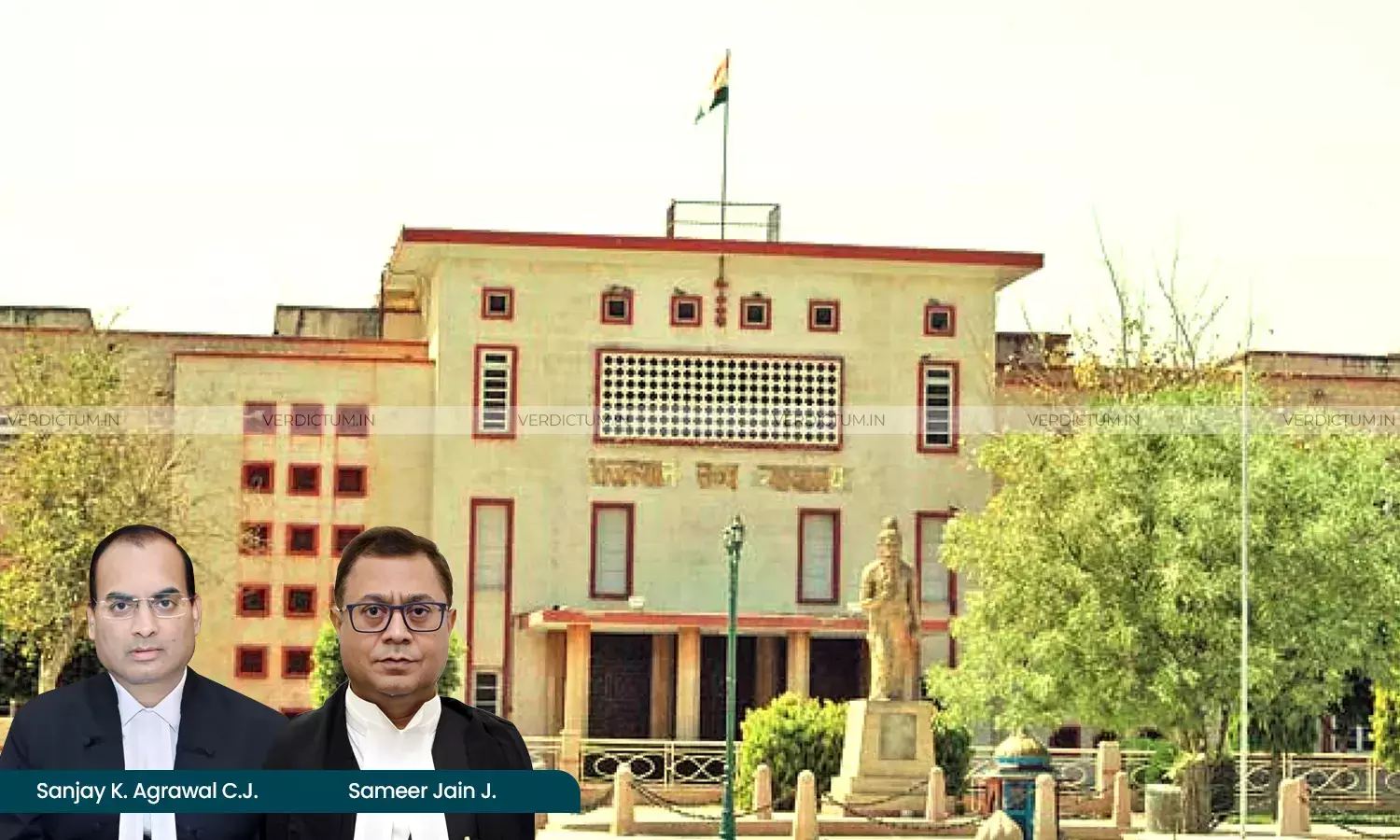
Chief Justice Sanjay K. Agrawal, Justice Sameer Jain, Rajasthan HC (Jaipur Bench)
The Rajasthan High Court has dismissed the appeal of 5 accused booked in the Udaipur tailor Kanhaiya Lal murder case while observing that the brutal murder by entering the shop of the deceased-victim in broad daylight, coupled with the recording and dissemination of the act of such a grave and heinous nature to create communal disharmony and terror, strikes at the very foundation of the State.
The High Court was considering the Criminal Appeals preferred under Section 21(4) of the National Investigation Agency Act, 2008 (NIA Act), challenging the impugned orders dismissing the bail applications on behalf of the accused-appellants under Section 483 of the Bharatiya Nagarik Suraksha Sanhita, 2023 (BNSS).
The Bench comprising Chief Justice Sanjay K. Agrawal and Justice Sameer Jain held, “Considering the overall facts and circumstances of the present case, and without commenting upon the final merits of the evidence which is subject to trial, we find that the gravity of the offence, the specific roles attributed to the appellants in the larger criminal conspiracy, and the heinous nature of the terrorist act disentitle the accused-appellants to the benefits of bail, at this stage, as it is observed that trial is progressing actively and at a rapid pace, negating the sole ground of delay urged by the learned counsel for the appellants as enshrined under Article 21 of the Constitution of India."
The Court also added: "Coming to the facts emerging from the present bunch of appeals, we are of the view that the brutal murder by entering the shop of the deceased-victim in broad daylight, coupled with the recording and dissemination of the act of such a grave and heinous nature to create communal disharmony and terror, strikes at the very foundation of the State. Criminal conspiracy for such an organized terror activity has a profound and devastating impact on society at large, far exceeding that of an individual, ordinary crime. In such matters, falling within the statutory framework of the UAPA, and relying upon the above-discussed precedents laid down by the Hon’ble Supreme Court, we are of the considered view that the grant of bail must deviate from the ordinary rule, and a strict approach must be adopted unless the rigors of Section 43D(5) are successfully dislodged by the accused, which the accused-appellants have failed to do in the present instance.”
Advocate Syed Saadat Ali represented the Petitioner while Senior Advocate (ASG) Raja Thakare represented the Respondent.
Factual Background
The case pertains to the incident where one Nupur Sharma, the then spokesperson of a political party, made certain remarks regarding Prophet Mohammad in May 2022 during a television debate, and her comments led to widespread agitation and protests across the country. As per the case of the appellants, the deceased, Kanhaiya Lal, subsequently made remarks and forwarded comments relating to Nupur Sharma through a Facebook post. The said action allegedly agitated residents belonging to a particular community in his neighborhood. Consequently, one Nazim lodged an FIR. Thereafter, Kanhaiya Lal was arrested in connection with the said FIR and was subsequently released on bail by the Trial Court.
The alleged incident occurred on June 28, 2022. A formal complaint was lodged by Yash Teli, son of Kanhaiya Lal,regarding the brutal murder of his father. The said complaint was initially registered under Sections 452, 302, 153-A, 153- B, 295-A and 34 of the IPC read with Sections 16, 18, and 20 of the UAPA. Subsequently, pursuant to the directions issued by the Ministry of Home Affairs, Government of India, the National Investigation Agency (NIA) re-registered the case and took over the investigation. The FIR related to the gruesome and brutal murder of Kanhaiya Lal Teli by two assailants armed with sharp weapons inside his shop located at Bhoot Mahal Maaldas Street, Udaipur.
During the said incident, two shop assistants present at the scene were also grievously injured. The Trial Court framed charges against the accused. The accused-appellants, namely Wasim Ali, Muslim Khan, Mohsin Khan, Mohammad Mohsin, and Asif Hussain, were arrested, and they have been in judicial custody since their respective dates of arrest.
Reasoning
On a perusal of the provisions of the Act, the Bench explained that Section 43D(5) of the UAPA places a statutory embargo on the grant of bail if the Court, on a perusal of the charge-sheet, is of the opinion that there are reasonable grounds for believing that the accusation against such person is prima facie true.
The Bench was of the view that this Court must balance the statutory mandate as enshrined under Section 43D (5) of the UAPA against the constitutional safeguards as enshrined under Article 21 of the Constitution of India.
The Bench took note of the fact that the NIA had completed a detailed and comprehensive investigation, filed the charge-sheet, and the Trial Court had already framed charges against the accused-appellants. “This establishes that upon a prima facie evaluation, there exists sufficient material to proceed against the appellants, and therefore, the foundational test laid down by the Hon’ble Supreme Court in Zahoor Ahmad Shah Watali (supra) is squarely met at this stage”, it added.
The Bench further noted that the nature of the crime alleged against the accused appellants was not an ordinary offence and was a calculated act of terror designed to strike fear into the populace at large.“The prosecution has alleged a deep-rooted, organized criminal conspiracy involving a group of persons, including the appellants, who allegedly played active and specific roles in facilitating the crime. A conspiracy of this nature is often established by circumstantial material, tacit understandings, and electronic records (CDRs), which the prosecution has placed on record”, it stated.
The Bench further held, “Upon perusal of the detailed charge-sheet placed on record by the respondent-NIA, we find that the accusations against the appellants regarding their participation in the conspiracy are prima facie made out.”
Taking note of the specific roles attributed to the appellants in the larger criminal conspiracy, and the heinous nature of the terrorist act, the Bench held that the same would disentitle the accused-appellants to the benefits of bail. Thus, dismissing the appeals, the Bench ordered, “The learned Trial Court shall proceed with the trial uninfluenced by the observations made hereinabove.”
Cause Title: Wasim Ali v. National Investigation Agency (Neutral Citation: 2026:RJ-JP:40450-DB)
Appearance
Appellant: Advocates Syed Saadat Ali, Salim Khan, Nadeem Qadeer, Uzma Ilyas, Aafreen Rizvi, K.M. Siddiqui, Sumit Kumar, Anshul Mathur, Aatif Aman Khan
Respondent: Senior Advocate (ASG) Raja Thakare, Specaial Public Prosecutor Sneh Deep Khyalia, Advocates Rohit Khare, Siddharth Sharma, Himanshu Choudhary