Rajasthan High Court Stays Order Restoring Two-Vakalatnama Or Appearance Condition For Members To Vote In Bar Association Polls
The Division Bench directed the Rajasthan High Court Bar Association election to proceed under the original General Notice.
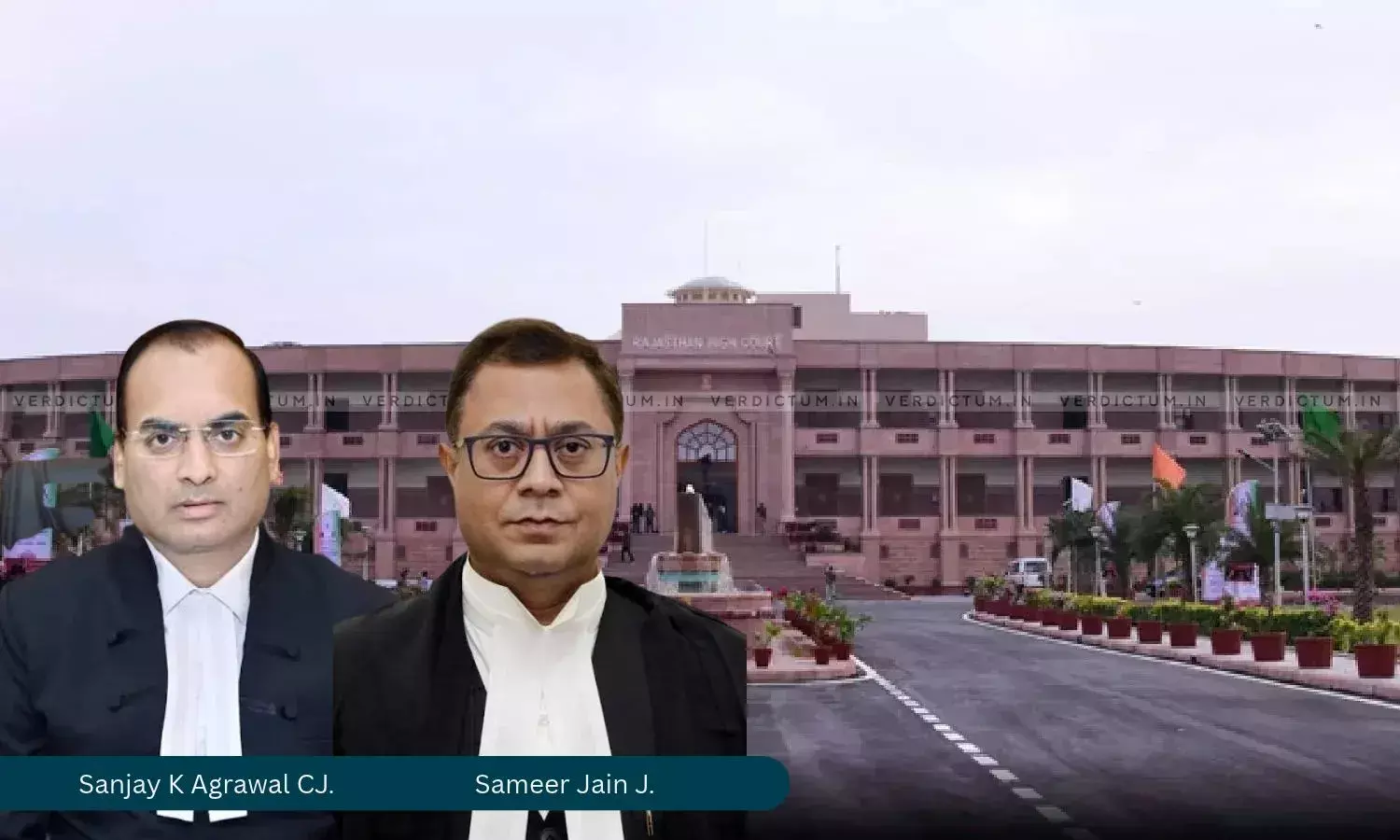
The Rajasthan High Court has stayed the Single Judge’s order insofar as it restored an additional requirement that members have at least two vakalatnamas or two recorded appearances before the High Court to vote in the Rajasthan High Court Bar Association, Jaipur, election.
Taking a prima facie view, the Division Bench directed the election process to continue under the Association’s original General Notice without hindrance.
The Court was hearing three special appeals challenging the Single Judge’s order that quashed a subsequent notice issued by the Election Committee and restored its earlier notices prescribing the additional voting condition.
A Bench of Chief Justice Sanjay K. Agrawal and Justice Sameer Jain observed: “Taking prima facie view and that the elections are scheduled on 11.12.2026 (Friday) and the election process has begun vide Notification dated 02.11.2026 and the Committee, as per the Notification dated 02.11.2026, was directed to act in accordance with the directions of the Division Bench, as reproduced above, we are inclined to direct that the effect and operation of para 26 of the impugned order dated 20.11.2026 passed by the learned Single Judge, with consequential effect of para 27 along with other consequential steps, shall remain stayed and the election process has to continue as per General Notice dated 02.11.2026, originally issued by the Rajasthan High Court Bar Association, Jaipur, without any hindrance.”
Advocate Sunil Samdaria appeared for the appellants, while one appellant appeared in person. The contesting respondent also appeared in person, and Advocate Prateek Kasliwal represented the Bar Council of Rajasthan.
Background
An earlier Division Bench had prescribed eight mandatory norms governing voter eligibility and the conduct of elections by Bar Associations throughout Rajasthan. According to the appellants, those norms were later affirmed or modified by the Supreme Court and reiterated by another Division Bench.
The Rajasthan High Court Bar Association, Jaipur, subsequently issued a General Notice announcing its annual election and constituting a three-member Election Committee. The notice stated that the election would be conducted in compliance with the directions issued by the Supreme Court and the Division Bench.
The Election Committee thereafter issued two notices imposing an additional requirement that a member must have at least two vakalatnamas or two recorded appearances before the Rajasthan High Court to exercise voting rights. It later issued another notice, which the Single Judge quashed while restoring the two earlier notices and the additional condition.
The appellants submitted that the Election Committee had introduced a condition beyond the eight mandatory norms after the election process had begun. They argued that the change could deprive approximately 2,500 members of voting rights and would particularly affect young advocates who had not received opportunities to argue matters.
The respondents questioned the maintainability of the appeals and submitted that the Election Committee had the authority to take decisions in the interests of the Bar. They defended the additional requirement as neither arbitrary nor irrational and contended that rules governing membership and eligibility to vote involved different considerations. They further argued that candidates participating in an election could not seek to reshape the electorate to improve their prospects.
Court’s Observations
Earlier Division Bench Had Prescribed Mandatory Election Norms
The Court examined the eight norms prescribed by the earlier Division Bench. Those norms dealt with the Election Committee, secret-ballot voting, eligibility to contest office, identity cards, payment of dues, voting in multiple Bar Associations and disqualification arising from convictions involving moral turpitude.
The earlier Division Bench had specified the immediate conditions governing voting eligibility: “Notwithstanding anything contained in the by-laws of the Bar Association, no member of any Bar Association shall be eligible to cast his/her vote at the election unless - (a) he/she is in possession of identity card issued by the Bar Association at the time of casting his/her vote and shows it on demand, if so required; and (b) he/she has paid his/her subscription/membership fee/fee on or before a month prior from the date of election being held and is not in arrears on any account.”
The earlier Division Bench had also stated: “The directions given above are mandatory and every Bar Association in the State of Rajasthan is required to adhere the same. In the event of violation of any of the mandatory norm/condition aforesaid, the Association concerned shall loss its recognition and that Bar Association shall not be treated as an Association annexed with the court concerned.”
Single Judge Had Restored The Additional Voting Condition
The Division Bench examined the precise operative direction under challenge. The Single Judge had held: “For the reasons mentioned hereinabove, notice dated 17.11.2026 issued by the Election Committee is hereby quashed and set aside and earlier notices dated 03.11.2026 and 04.11.2026 issued by the Election Committee are hereby restored and the same shall remain effective.”
The Court considered that direction against the original General Notice, which had begun the election process and required the Election Committee to act in accordance with the earlier judicial directions.
Election Process Directed To Continue Under Original Notice
The Division Bench took a prima facie view because the election had been scheduled and the election process had already begun. It stayed the operation of paragraph 26 of the Single Judge’s order, the consequential effect of paragraph 27 and all other consequential steps.
The Court directed that the election process continue without hindrance under the General Notice originally issued by the Rajasthan High Court Bar Association, Jaipur. Its order was interim, and the substantive dispute concerning the additional eligibility condition remained pending in the special appeals.
Conclusion
The High Court allowed the applications seeking leave to appeal and issued notice to the respondents, returnable within three weeks. It stayed the portions of the Single Judge’s order restoring the two-vakalatnama or two-recorded-appearance condition and directed the election process to continue under the original General Notice. The Court directed the respondents to file their replies in the meantime and ordered that the appeals be listed after three weeks.
Cause Title: Gajendra Singh Shekhawat v. Virendra Agrawal and Others, connected with Mahendra Shandilya v. Virendra Agrawal and Others and Kuldeep Sharma v. Virendra Agrawal and Others
Appearances
Appellants: Sunil Samdaria and other Advocates; Mahendra Shandilya and Kuldeep Sharma, appellants in person
Respondents: Prateek Kasliwal and other Advocates; Virendra Agrawal, respondent in person