

Rajasthan Municipality| Nominated Members Who Have No Right To Vote Not To Be Included For Computing Two-Thirds No-Confidence Majority: Rajasthan High Court
The issue before the Rajasthan High Court was whether the nominated members could be rightly excluded from the total number of members or whole number of members for the purpose of considering the requisite 2/3 majority.

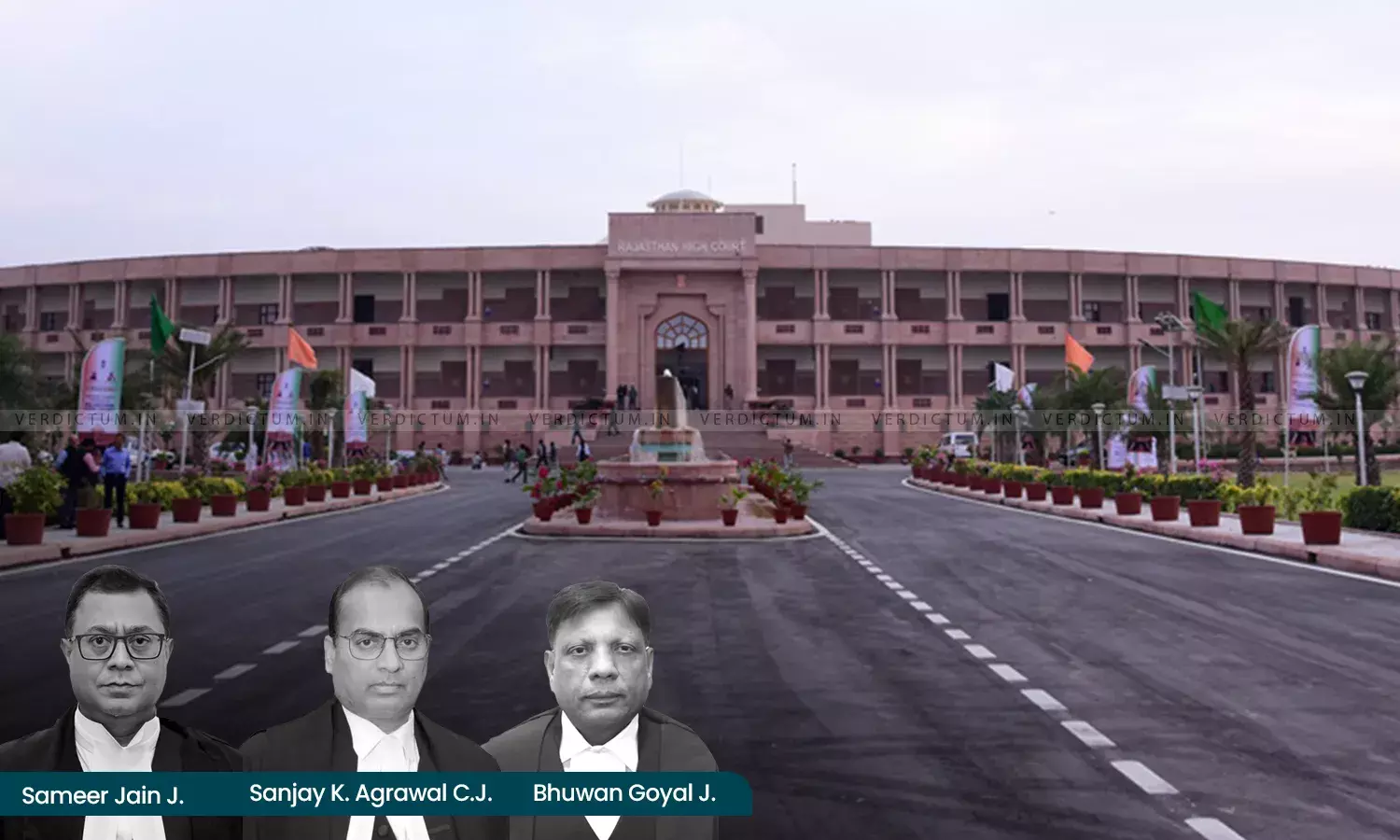
Chief Justice Sanjay K. Agrawal, Justice Sameer Jain, Justice Bhuwan Goyal, Rajasthan High Court
The Rajasthan High Court has clarified that under the statutory scheme governing a motion of no confidence, nominated members who have no right to vote are not to be included in the whole number or total number of members for computing the requisite 2/3 majority.
The issue before the Bench was whether the nominated members could be rightly excluded from the total number of members or whole number of members for the purpose of considering the requisite 2/3 majority.
The 3-Judge Bench of Chief Justice Sanjay K. Agrawal, Justice Sameer Jain and Justice Bhuwan Goyal held, “Accordingly, reference is answered in affirmative under the Rajasthan statutory scheme governing a motion of noconfidence, nominated members who have no right to vote are not to be included in the whole number or total number of members for computing the requisite majority, as held by their Lordships of the Supreme Court in Ramesh Mehta (supra) and as such, Prem Raj Bohra (supra) was correctly decided holding that the nominated member would not have the voting right and should not be included in the total number of members in counting 2/3 majority of voting for passing no-confidence motion. The reference is, accordingly, answered.”
Senior Advocate Abhay Kumar Bhandari represented the Petitioner while Advocate Abhishek Sharma represented the Respondent.
Factual Background
A No-confidence motion was carried on against Hemraj Sharma, Vice Chairman, Municipal Board, Mangrole, District Baran, which was conducted by the Sub-Divisional Officer, Baran on September 13, 2001 leading to filing of the revision by him before the State Government under Section 300 of the Rajasthan Municipalities Act, 1959. The State Government allowed the revision holding that the 2/3 majority required under the Rajasthan Municipalities (Motion of No Confidence against Chairman or Vice Chairman) Rules, 1974 would include the nominated members also in light of the decision of the Supreme Court in Raees Ahmad vs. State of U.P. (2000) and consequently, set aside the order carrying out the no-confidence motion.
Dharmpal, who is the appellant, was the intervenor before the State Government. He filed two writ petitions before this Court under Article 226 and 227 of the Constitution. The Single Judge dismissed the writ petitions affirming the order of the State Government holding that the nominated members have also to be included in computing 2/3 of the total number of members of the Municipality. Being aggrieved, the appellant preferred the special appeals, in which by order dated March 7, 2003, finding disagreement to the decision rendered by this Court in Prem Raj Bohra vs. Jairoopa and Ors (2001), the aforesaid question for determination was referred to larger Bench, while holding that the principle of law laid down in Raees Ahmad vs. State of U.P. (2000) cannot be brushed aside, which makes a clear distinction to the effect that the nominated members have also to be included while counting 2/3 out of the total number or whole number of members existed in the Municipality.
Reasoning
The Bench noted that the reference was made when the Rajasthan Municipalities Act, 1959 was in force. Thereafter, the Act of 1959 was repealed and the Rajasthan Municipalities Act, 2009 was brought into force with effect from September 15, 2009.
The Bench noted that the Apex Court in case of Ramesh Mehta (supra) held that the ‘majority’ would mean ‘majority of persons entitled to vote’. It was held therein that under pre-1994 and post-1994 provisions, the legislature intended that the Chairman/Vice Chairman shall be removed on passing of no-confidence motion by requisite majority of members having right to vote. The Bench also noticed that in Ramesh Mehta (supra), Justice S.B. Sinha gave a concurring and separate opinion and answered the question that only members with voting right are entitled to participle in that proceedings and not the nominated members.
The Bench also found that the Supreme Court distinguished the principle of law laid down in Raees Ahmad (supra) and therein the provisions of Rajasthan Municipality Act were involved. The Chairman was the elected member of the Municipal Board and the Apex Court held that the nominated members should remain members and had to be counted for vote even though a proviso denied them a right to vote.
The Bench thus observed, “The decision of the Supreme Court in Ramesh Mehta (supra) directly construes the very Act and the very Rules of 1974 in issue here, and its ratio governs the instant question of law. The whole number of members under the Rules of 1974 read in its statutory and constitutional context, means the whole number of members entitled to vote on the motion. Nominated members, having no voting right, are accordingly excluded from the denominator. The decision in Raees Ahmad (supra) is clearly distinguishable from the facts of the present case.”
The Bench thus clarified that the nominated members who have no right to vote are not to be included in the whole number or total number of members for computing the requisite majority.
Considering that the no-confidence motion was carried way back in 2001, the Bench held that remitting the matter would not serve any useful purpose and thus disposed of the appeals as having become infructuous.
Cause Title: Dharam Pal Singh Jain v. The State of Rajasthan (Neutral Citation: 2026:RJ-JP:40615-DB)
Appearance
Appellant: Senior Advocate Abhay Kumar Bhandari, Advocates Rakshit Jain, Niti Jain Bhandari, Hans Kumar Sharma
Respondent: Advocates Abhishek Sharma, Pooja Sharma, Additional Advocate General Manoj Sharma