

Manufacturer Liable To Motor Vehicle Tax On Finished Vehicles Stocked In Factory, Proof Of Road Use Not Necessary: Rajasthan High Court
The High Court also held that Section 39 of the Motor Vehicles Act applies to driving of unregistered vehicles inside factory premises, as a factory yard is “any other place”.

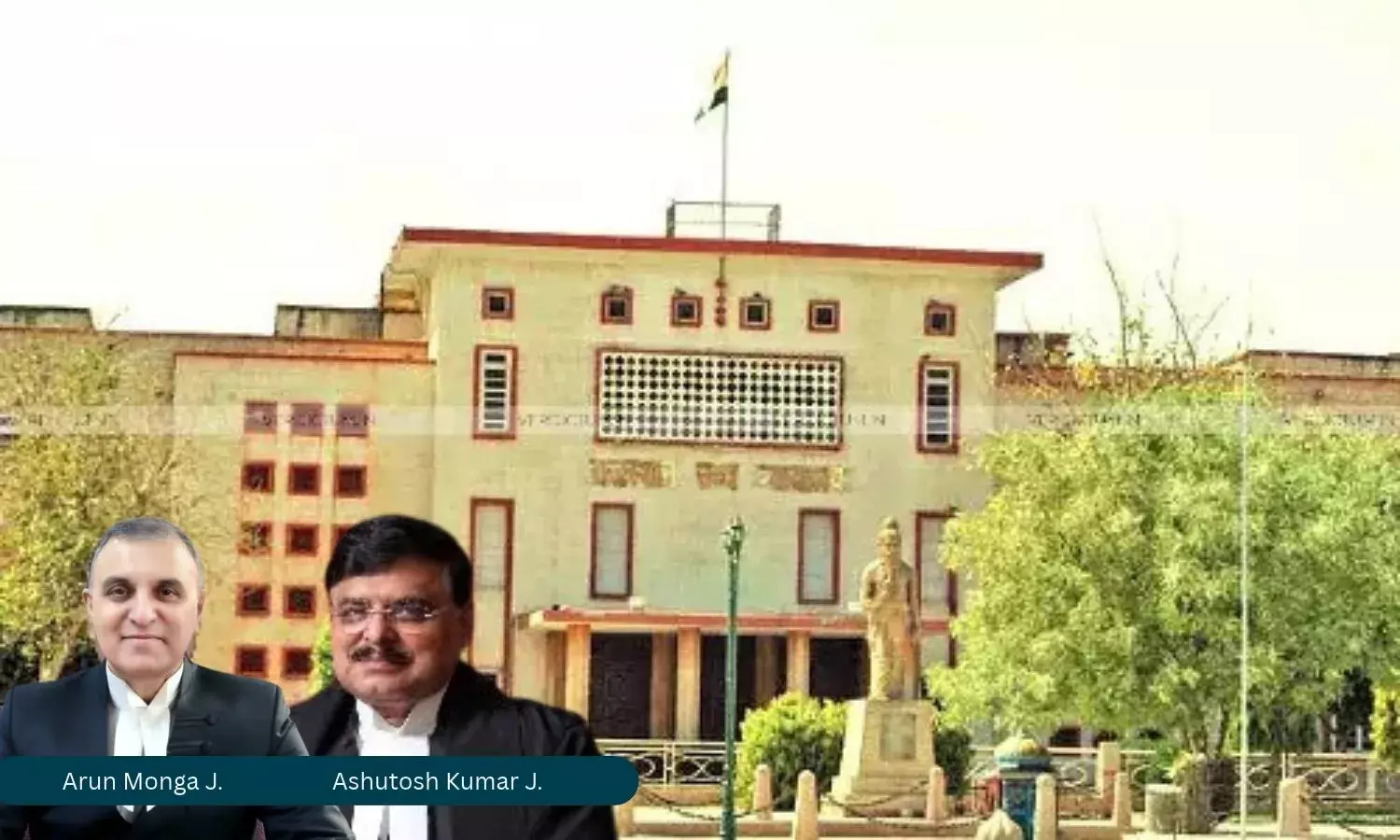
The Rajasthan High Court has held that a manufacturer of motor vehicles is liable to tax under Section 4(1)(d) of the Rajasthan Motor Vehicles Taxation Act, 1951 for finished vehicles held inside its factory before despatch to dealers, and that proof of use of the roads of the State by any particular vehicle is not an ingredient of the charge.
The Court observed that the taxable event under Section 4(1)(d) is the possession of motor vehicles by a dealer or manufacturer in the course of business, and that the expression “used or kept for use in the State” denotes availability for use and not actual use. Vehicles held in the factory in Rajasthan fall within the charge, whichever State they are later despatched to for sale.
The Court upheld the vires of the proviso to Section 39 of the Motor Vehicles Act, 1988, Rule 33 of the Central Motor Vehicles Rules, 1989, Section 4(1)(d) of the Act of 1951 and the Notification dated March 31, 2000, and dismissed the batch of writ petitions filed by Honda and Hero MotoCorp. It reserved liberty to the petitioners to challenge the individual assessments in appeal on limited grounds.
The Division Bench of Justice Arun Monga and Justice Ashutosh Kumar observed, “The taxable event under Section 4(1)(d) of the Act of 1951 is the possession of motor vehicles by a dealer or manufacturer in the course of his business as such. It is not the use of any road by any vehicle. The expression “used or kept for use in the State” in the opening part of Section 4(1) denotes availability for use and not actual use. It is not confined to vehicles destined for use within this State. Motor vehicles adapted for use on roads, held by a manufacturer inside his factory in this State pending despatch to dealers within or outside the State, are therefore within the charge.”
Senior Advocates Lakshami Kumaran and Sudhir Gupta appeared for the Petitioners, while Additional Solicitor General Bharat Vyas and Advocate General Rajendra Prasad appeared for the Respondents.
Brief Facts
The batch comprised two sets of writ petitions, one by Honda and the other by Hero MotoCorp Ltd. The Court took the facts from the petition filed by Honda Cars India Ltd., which manufactures and markets motor cars and began production in February 2014.
In March 2016, the Transport Inspector, Bhiwadi visited the factory under Section 18 of the Act of 1951 and drew up a memo recording that, under Rule 33 of the Rules of 1989 and the notification dated March 31, 2000, a manufacturer could keep an unregistered vehicle only after obtaining a trade certificate. The petitioner was asked to give details of vehicles manufactured from February 2014 onwards and to deposit tax.
The petitioner replied, disputing the need for a trade certificate and contending that a certificate was needed only for the purposes listed in Rule 41 of the Rules of 1989. However, on March 31, 2016, the District Transport Officer assessed tax for the period April 01, 2014 to March 31, 2015 under Section 4(1)(d) read with the notification, and a demand notice was issued the same day.
The petitioner’s appeal under Section 14 was dismissed because the pre-deposit required by the second proviso to Section 14(2) had not been made.
The petitioner then approached the High Court, which granted interim protection upon deposit of fifty per cent of the demand. That petition was later withdrawn with liberty to challenge the vires of the provisions. Fresh petitions were filed each year as demands were raised for later years.
Contentions of the Parties
The petitioners contended that Section 4(1)(d) taxes only vehicles used or kept for use in the State and held under a trade certificate, and that vehicles lying in a factory yard awaiting despatch meet neither condition, since about ninety-five per cent of the production leaves the State on trailers and never touches a road here.
They argued that Section 39 of the Act of 1988 prohibits driving an unregistered vehicle and has no application where the vehicle is not driven at all, and that a trade certificate is needed only for the purposes in Rule 41.
It was argued that the power under Entry 57 of List II is limited to a regulatory and compensatory levy bearing a nexus with vehicles using the public roads. It was also contended that a levy computed on the number of vehicles manufactured is in substance a duty of excise, that it amounts to double taxation and discrimination under Article 14, and that Rule 33 is ultra vires the proviso to Section 39, as the proviso speaks only of a dealer.
The State contended that clause (d) creates a special charge on a distinct class, with possession in the course of business as the taxable event, and that Entry 57 nowhere makes actual user an ingredient. It argued that the compensatory tax doctrine was discarded by a nine-Judge Bench in Jindal Stainless Limited v. State of Haryana, and that a storage yard and the internal roads of a factory are “any other place” under Section 39, as the vehicles are driven from the assembly line to the yard and onto the carriers. It also submitted that the claim that no vehicle ever touches a road in the State was a bare averment not supported by a single despatch record.
Observations/Findings of the Court
On Entry 57 of List II, the Court noted that the framers used the words “suitable for use on roads” in Entry 57 and they did not use the words “used on roads”. It was added that the entry identifies the object of tax by the character of the vehicle. It does not identify it by any activity of the vehicle.
It added that a levy dependent on proof of a particular vehicle using a particular road would be unworkable. It would also be evaded simply by laying up the vehicle.
Construing clause (d), the Court held that it charges a person and not a journey. On the words “granted or deemed to be granted”, it observed, “If liability arose only where a certificate had actually been taken out, the deeming words would be surplusage. Worse, an assessee could fix his own liability at nil simply by never applying for a certificate. A construction that lets the subject decide the incidence of a charge by his own abstention cannot be accepted.”
The Court also rejected one argument of the State, that a comma in clause (d) confined the words “under the authorisation of a trade certificate” to dealers alone, observing that the punctuation is a frail guide to the construction of statute. It cannot control the plain sense of the words.
Rejecting the territorial objection, the Court observed, “They are “kept for use in the State”. They are not “kept for use only in the State”. Nor are they “used in the State”... Throughout the time the vehicle lies in the yard, it is physically in this State. It is also capable of being used on the roads of this State. That satisfies the description. Where the vehicle finally goes is a matter of the petitioners’ commercial arrangements. It is foreign to the charge.”
On Section 39 of the Act of 1988, the Court explained that the registration exists so that every vehicle in motion can be identified and the person responsible for it traced. The occasions that make identification necessary, namely accident, injury to a third person, theft and the commission of offences, arise on private premises as much as on a public road.
Agreeing with the Patna High Court in Tata Engineering and Locomotive Company Limited v. State of Bihar, it held that a storage yard and the internal roads of a factory are “any other place”.
The Court held that the compulsion to obtain a trade certificate is practical and not textual. It observed, “If a vehicle is truly never moved, no exemption is needed and no certificate is required. If it is moved anywhere at all, the holder must either register it or hold a trade certificate.”
On the challenge to Rule 33, the Court accepted that the petitioners’ argument had “some foundation”, since the proviso to Section 39 speaks only of dealers. It nevertheless rejected the challenge, observing, “A Court will not strike down, at a person’s instance, the very provision that protects him, merely so that a collateral consequence may follow.”
It added that Section 4(1)(d) draws its validity from Entry 57 of List II and would not fall with Rule 33 in any event.
Rejecting the contention that the levy was a duty of excise, the Court held that the contention confuses the subject of a charge with its measure. A tax does not become a tax on manufacture merely because a manufacturer is the person charged. It noted that the same clause charges dealers, “and a dealer manufactures nothing.”
On the compensatory tax argument, the Court held that after Jindal Stainless, “the compensatory character of a tax on motor vehicles is no longer an independent constitutional limit on the power under Entry 57 of List II.”
On Article 14, the Court held that the taxable events were distinct, and that double taxation is not by itself a ground of invalidity without an express constitutional or statutory bar.
It added that every manufacturer with a plant in Rajasthan is treated alike, and “A manufacturer with no plant here is outside the charge for want of territorial nexus, not because of any preference.”
Accordingly, the Court dismissed the petitions insofar as they challenged the vires of the provisions and vacated the interim orders.
It reserved liberty to the petitioners to file or revive appeals under Section 14(1) of the Act of 1951 within eight weeks.
The Court directed that the fifty per cent already deposited would be treated as sufficient compliance with the pre-deposit requirement, and that recovery of the balance demand would remain stayed until the appeals are decided.
Cause Title: Honda Motorcycle and Scooter India Pvt. Ltd. v. Union of India & Ors. and connected matters [Neutral Citation: 2026:RJ-JP:31407-DB]
Appearances:
Petitioners: Senior Advocates Lakshami Kumaran and Sudhir Gupta, Advocates Umang Gupta, Shweta Chauhan, Vinay Kumar Jain, Priyavada Joshi, Sakshya Jain, Sanjay Kumar, Anshul Sehgal, Pranshu Paul, Pranav Pareek, Aman Lodiya, Rachit Somani, Madhusudan Purohit and Harshit Bansal.
Respondents: Additional Solicitor General Bharat Vyas, Advocate General Rajendra Prasad, Advocates Dhrishti Laddha, Tanay Goyal, Niti Jain Bhandari, Devesh Yadav and Rakesh.