

Bald Plea Of Signing Blank Papers Can't Rebut Presumption U/S. 139 NI Act: Punjab & Haryana High Court Upholds Conviction In Cheque Bounce Case
The Punjab & Haryana High Court was considering a revision petition directed against the judgment of conviction under Section 138 of the NI Act.

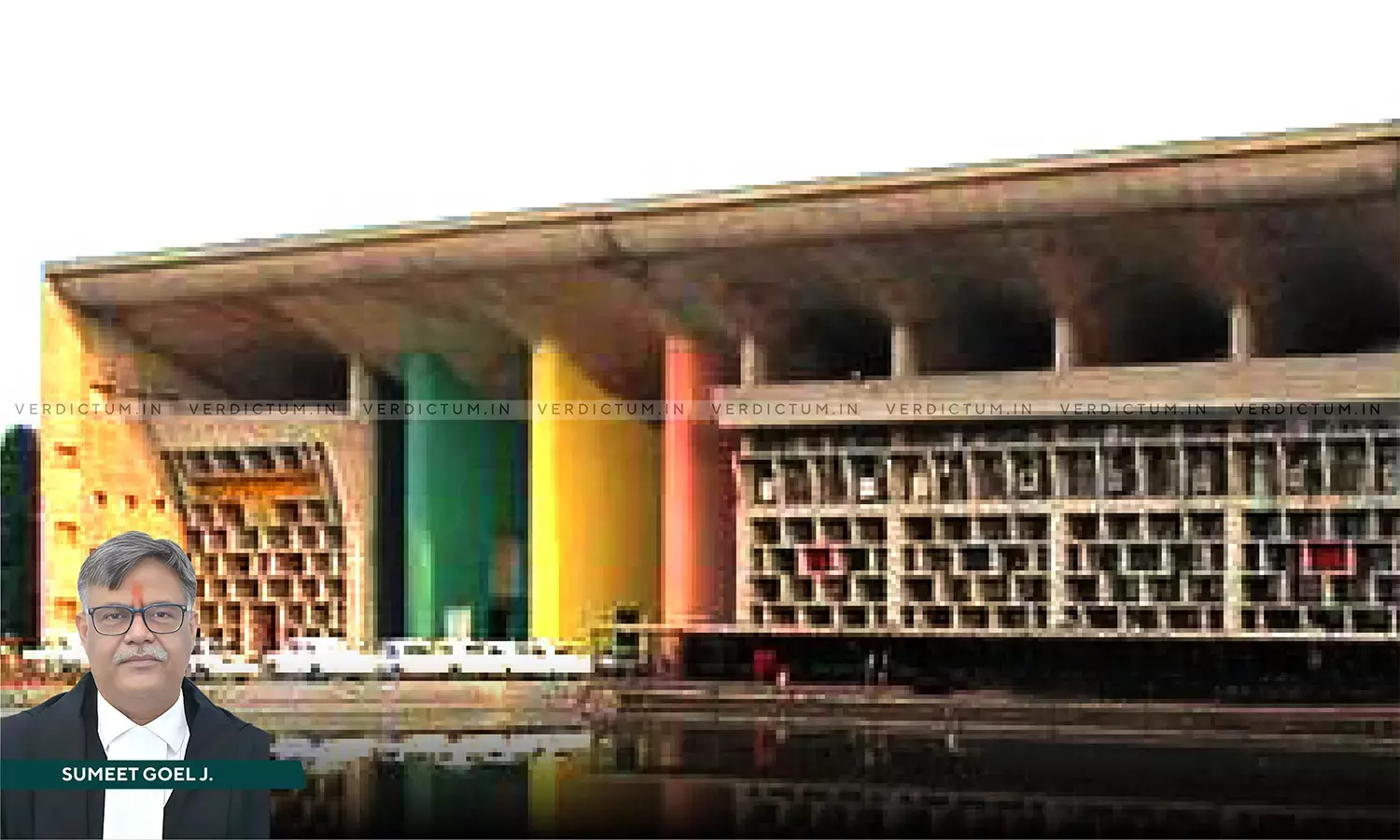
Justice Sumeet Goel, Punjab and Haryana High Court
While noting that the accused had miserably failed to raise any probable defence to rebut the presumption attached to the cheque in question being issued in discharge of legal liability under Section 139 of the Negotiable Instruments Act and considering that a bald plea of signing blank papers was raised by him, the Punjab & Haryana High Court has affirmed the judgment of conviction passed against the accused in a cheque bounce case.
The High Court was considering a revision petition directed against the judgment whereby the petitioner was convicted for the offence punishable under Section 138 of the Negotiable Instruments Act, 1881, as well as the judgment dismissing the appeal preferred by the petitioner.
The Single Bench of Justice Sumeet Goel held, “Further, the argument regarding the circumstances or necessity for execution of the agreement loses its significance once the petitioner - accused admitted his signature on the said agreement. The bald plea raised on behalf of the petitioner - accused that he has signed blank papers cannot serve any purpose in his favour as he has all the opportunity to disprove the execution of said agreement by examining witnesses but he chose not to do.”
“In view of the above findings, the petitioner - accused has miserably failed to raise any probable defence to rebut the presumption attached to the cheque in question being issued in discharge of legal liability under section 139 of the Negotiable Instruments Act”, it added.
Advocate Krishan Singh represented the Petitioner while AAG Gurmeet Singh represented the Respondent.
Factual Background
The complainant filed a complaint under Section 138 of the Negotiable Instruments Act alleging that the petitioner-accused was known to him and had approached him seeking a friendly loan of Rs 1,50,000 to meet the medical expenses relating to the delivery of his wife. It was alleged that on account of cordial relations between the parties, the complainant advanced the said amount to the accused. Thereafter, the accused again approached the complainant and requested an additional amount of Rs 2,20,000 on the ground that his newly born child required medical treatment. The complainant lent this amount to the accused – petitioner.
According to the complainant, in discharge of the aforesaid liabilities, the accused issued a cheque which, upon presentation, was dishonoured with the remarks “Funds insufficient”. Thereafter, a legal notice was issued to the accused-petitioner asking to repay the amount. Despite service of notice, the accused failed to make the payment, which compelled the complainant to institute proceedings under Section 138 of the Negotiable Instruments Act before the Trial Court. Aggrieved by the Trial Court judgment and order of sentence, the petitioner - accused preferred an appeal before the Additional Sessions Judge, Sirsa. The Appellate Court concurred with the findings returned by the Trial Court on all counts and dismissed the appeal as being devoid of merit.
Reasoning
Considering that, as per Section 139 of the Negotiable Instruments Act, there is a legal presumption in favour of the holder of a cheque regarding the cheque having been issued in discharge of legal liability unless the contrary is proved, the Bench refused to accept the argument of the petitioner - accused that the complainant had failed to establish the pre-existing liability of the petitioner as required under Section 139. “Therefore, the burden was upon the petitioner to prove that the cheque in question was without any legal liability”, it added.
One of the contentions raised by the accused was that the cheque in question was a blank security cheque and the alleged liability of Rs 3,70,000 was never proved by the complainant. The Bench rejected this argument on the ground that, rather than raising the question before the Court qua necessity of the petitioner - accused to issue a cheque, it was for the petitioner – accused to explain and prove the circumstances of issuing the cheque, especially when he admitted his signature on said cheque. “However, except for a bald assertion, no cogent or convincing evidence has been led by the petitioner - accused to substantiate the said plea”, the order read.
Dealing with the facts of the case, the Bench stated that the Advocate had been examined only to prove the issuance of a statutory notice under Section 138 of the Negotiable Instruments Act. The Bench further clarified that the bald plea raised on behalf of the petitioner - accused that he signed blank papers could not serve any purpose in his favour as he had all the opportunity to disprove the execution of said agreement by examining witnesses, but he chose not to do so.
Holding that the petitioner - accused, except for raising the factual grounds, miserably failed to point out any jurisdictional error or perversity in the findings returned by both the Courts below, the Bench dismissed the Revision Petition.
Cause Title: Narender Kumar State of Haryana (Neutral Citation: 2026:PHC:081800)
Appearance
Petitioner: Advocate Krishan Singh
Respondent: AAG Gurmeet Singh, Advocates P.S. Jammu, Gaurav Luhani, Muskan Maver