District Courts Cannot Direct Change Of Investigating Agency Or Order A CBI Enquiry: Patna High Court
The Court held that such power is vested only in the constitutional courts, i.e., the Supreme Court and the High Courts, in exercise of their powers under Articles 32 and 226 of the Constitution.
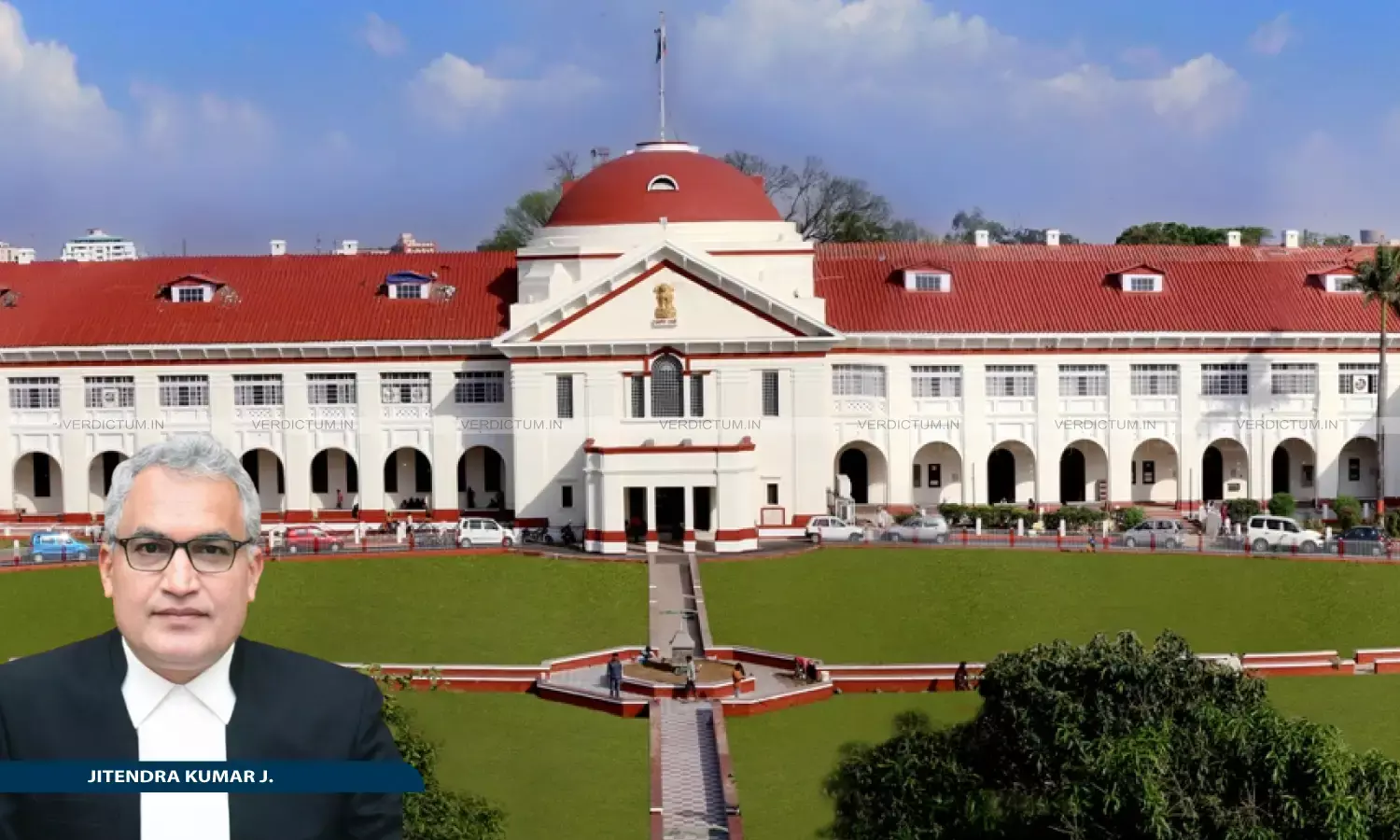
Justice Jitendra Kumar, Patna High Court
The Patna High Court has held that District Courts, including Sessions Courts and Magistrates, do not possess the authority to direct a change in the investigating agency or entrust investigation to the Central Bureau of Investigation (CBI).
The Court observed that while constitutional courts may, in appropriate cases, transfer investigations or direct investigations by the CBI in the exercise of their powers under Articles 32 and 226 of the Constitution, subordinate criminal courts remain confined to the powers conferred upon them by statute.
Allowing a writ petition filed by the Central Bureau of Investigation, the Court set aside an order of the Sessions Judge directing the CBI to conduct an independent investigation while deciding an anticipatory bail application.
A Bench of Justice Jitendra Kumar observed: "No District Court, be it Sessions Courts or Magisterial Court, has power to change Investigating Agency. It is for the State Government to entrust the investigation to any of the Investigating Agencies or it is only the Constitutional Courts i.e. Hon’ble Apex Court and High Courts, who can, under constitutional power, direct the change of the Investigating Agency or direct Central Bureau of Investigation to take up the matter for investigation or for further investigation."
Senior Advocate Satyabir Bharti represented the appellant, while Raghwanand, GA-11, appeared on behalf of the respondents.
Background
The writ petition was filed by the Central Bureau of Investigation, challenging an order passed by the Sessions Court during the hearing of an anticipatory bail application, directing the CBI to conduct an independent investigation and submit a preliminary investigation report before the Court.
The case arose out of a criminal case registered following the death of a candidate who allegedly sustained injuries after being assaulted by police personnel during a recruitment process. During the pendency of anticipatory bail proceedings filed by some of the accused, the Sessions Court initially directed the Intelligence Bureau to investigate the matter. After the Intelligence Bureau informed the Court that it lacked jurisdiction to investigate criminal offences, the Sessions Court modified its order and directed the CBI to undertake an independent investigation.
Aggrieved by the direction, the Central Bureau of Investigation approached the High Court, contending that neither a Sessions Court nor a Magistrate possesses jurisdiction to direct investigation by the CBI and that such an order was beyond the scope of bail jurisdiction.
Court's Observations
The Court held that the issue was no longer res integra and stood settled by a consistent line of decisions of the Supreme Court recognising that only constitutional courts possess the power to direct investigation by an independent investigating agency such as the CBI.
The Bench observed: "The question is not res integra. There is a long line of judgments of Hon’ble Apex Court holding that the Constitutional Courts i.e. Supreme Court and High Courts, being guardians of the fundamental rights, have power to direct the investigation of cognizable offence by any Investigating Agency including the C.B.I., if so requires, for enforcement of fundamental rights as granted and guaranteed by the Constitution. However, Courts other than the Constitutional Courts have no such power to direct the C.B.I. to investigate the crime."
Examining the constitutional scheme, the Court observed that policing is a State subject and the Delhi Special Police Establishment Act requires consent of the State Government before the CBI can exercise jurisdiction within a State. While constitutional courts derive their powers directly from the Constitution, District Courts function strictly within the limits of the statutes creating them.
The Court observed: "However, the Constitutional Courts, being guardians of the fundamental rights and being possessed with constitutional power of judicial review under Article 32/ Article 226 of the Constitution, can direct the C.B.I. or any other Investigating Agency to take up the matter for investigation, if so requires, for protection of fundamental rights of the petitioner. However, District Courts, be it Sessions Court or Magisterial Court, who function within the four corners of the enabling statutes, cannot direct Central Bureau of Investigation (C.B.I.) to investigate any crime."
The Court relied upon the Supreme Court's decision in CBI v. State of Rajasthan, reiterating that even where the State Government has granted consent under the Delhi Special Police Establishment Act, a Magistrate cannot direct the CBI to investigate under Section 156(3) CrPC.
Quoting the Supreme Court, the Court observed: "What is envisaged in Sections 5 and 6 of the Delhi Act is not one of conferring power on a Magistrate to order CBI to conduct investigation in exercise of Section 156(3) of the Code."
The Court further referred to Sakiri Vasu v. State of U.P., where the Supreme Court held: "No doubt the Magistrate cannot order investigation by CBI... but this Court or the High Court has power under Article 136 or Article 226 to order investigation by CBI. That, however, should be done only in some rare and exceptional case..."
The Bench also relied extensively upon the Constitution Bench judgment in State of West Bengal v. Committee for Protection of Democratic Rights, observing that the constitutional power of judicial review vested in the Supreme Court and High Courts cannot be curtailed by statutory provisions such as Section 6 of the Delhi Special Police Establishment Act.
Referring to the Constitution Bench, the Court quoted: "The power of the High Court under Article 226 of the Constitution cannot be taken away, curtailed or diluted by Section 6 of the Special Police Act... the restriction imposed by Section 6 of the Special Police Act on the powers of the Union, cannot be read as restriction on the powers of the constitutional courts."
The Court also relied on Vinay Tyagi v. Irshad Ali, K.V. Rajendran v. Superintendent of Police, Chandra Babu @ Moses v. State, and Dharam Pal v. State of Haryana, noting that while superior constitutional courts may transfer investigation from one agency to another in exceptional circumstances, such power must be exercised sparingly and only where the interests of justice so demand.
The Bench disagreed with a contrary view expressed by the Gujarat High Court, observing that the decision had been rendered without considering the constitutional scheme, the federal structure, or the distinction between statutory and constitutional powers.
The Court observed: "The order passed by Gujarat High Court... is cryptic and contrary to binding judicial precedents."
Applying the settled legal principles to the facts of the case, the Court concluded that the Sessions Judge had acted wholly without jurisdiction in directing the CBI to investigate the case.
The Court further held that the impugned direction was independently unsustainable because it had been issued while exercising bail jurisdiction.
The Bench observed that bail jurisdiction is confined to deciding whether an accused is entitled to be released on bail and cannot be expanded to issue directions concerning investigation.
The Court observed: "The impugned order is not sustainable also on the ground that learned Sessions Court cannot pass order like the impugned one while exercising bail jurisdiction, which is limited to adjudicating the question whether the petitioner is entitled to get released on bail or not."
Conclusion
Holding that the Sessions Court had exceeded its jurisdiction, the Patna High Court set aside the order directing the Central Bureau of Investigation to conduct an independent investigation. The Court, however, clarified that the legal representatives of the victim would remain at liberty to seek a change of the investigating agency or further investigation before the competent constitutional court in accordance with the law.
Cause Title: The Central Bureau of Investigation v. State of Bihar & Ors.
Appearances
Petitioner (CBI): Satyabir Bharti, Senior Advocate; Shivaditya Dhari Sinha, Advocate; Bipin Kumar Sinha, Advocate; Sanjay Kumar, Standing Counsel, CBI.
Respondents: Raghwanand, GA-11; Sanjay Kumar Tiwari, AC to GA-11.