Attempt To Rape Conviction Requires Overt Act Beyond Preparation Towards Penetration: Patna High Court Alters Conviction To Section 354 IPC
The Court held that entering a sleeping widow’s house at night, extinguishing the lamp, lying upon her and pressing her mouth established an offence under Section 354 IPC, but did not prove attempted rape without evidence of any further act towards penetration.
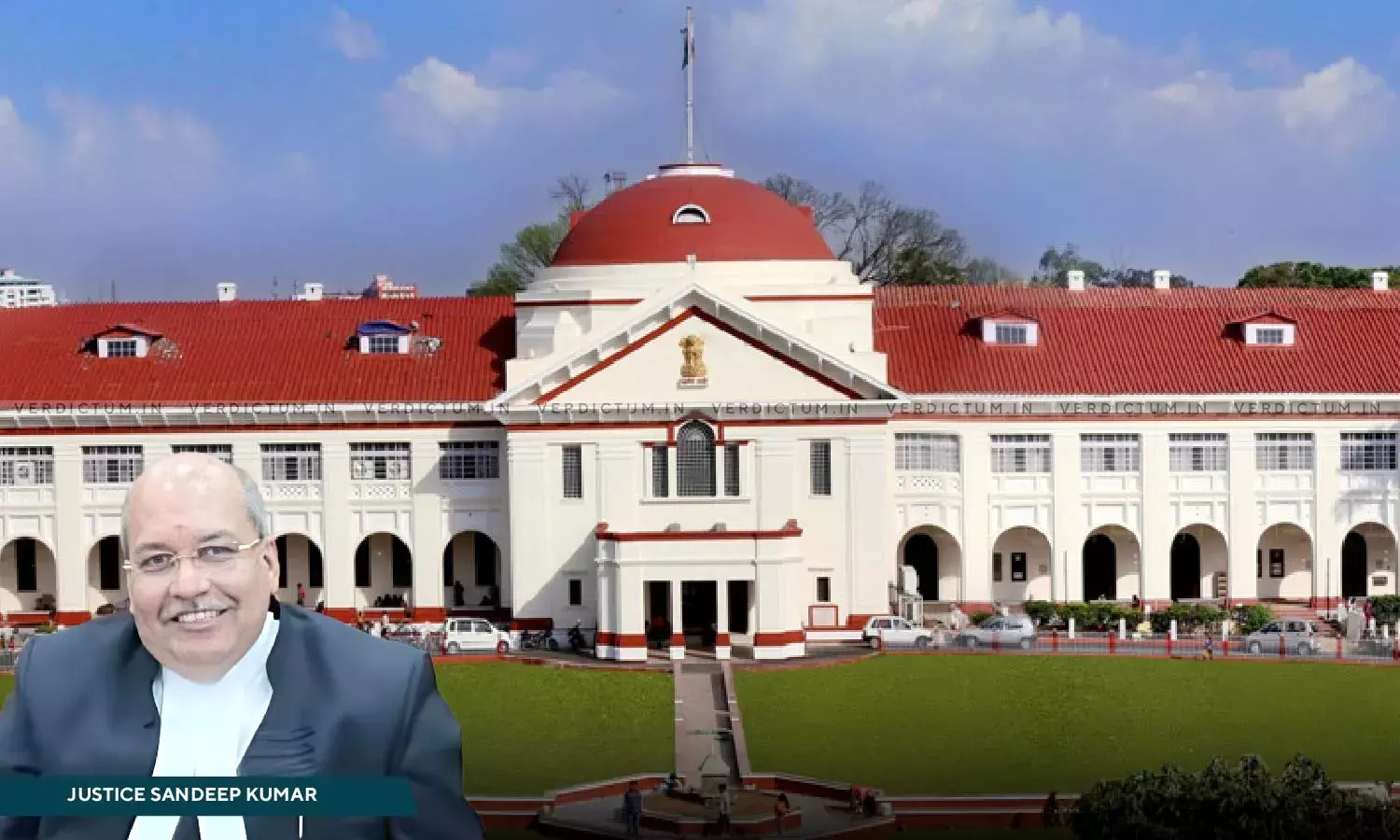
The Patna High Court has held that a conviction for attempting to commit rape requires evidence of an overt act beyond preparation and towards penetration.
Finding no such evidence, the Court set aside the appellant’s conviction under Sections 376 read with 511 IPC and instead convicted him under Section 354 IPC while affirming his conviction for house-trespass.
The Court was hearing an appeal challenging a trial court judgment that convicted the appellant of attempted rape and house-trespass and sentenced him to four years’ rigorous imprisonment for the former offence and six months’ rigorous imprisonment for the latter.
A Bench of Justice Sandeep Kumar observed: “… the act of the appellant in entering, late at night, in the dwelling house of a widow who was sleeping, extinguishing the lamp, lying upon her person and pressing her mouth is an act which is unquestionably capable of shocking the sense of decency of a woman, and the culpable intention of the appellant is manifest from the act itself and from his antecedent conduct deposed to by the prosecutrix. All the ingredients of the offence under Section 354 of the I.P.C. are, therefore, established. However, in the absence of any evidence that the appellant undressed himself or the prosecutrix, or did any act towards penetration, it cannot be held that he had gone beyond the stage of preparation and had done an act which, if not interrupted, would have resulted in the commission of rape.
The Bench added: “In the words of the Hon’ble Supreme Court in Aman Kumar (supra), indecent assaults are often magnified into attempts at rape, and materials must exist to show a determination to gratify passion at all events and in spite of all resistance. However, in the present case, no such material has come on record to suggest that the same. Therefore, the conviction of the appellant under Sections 376/511 of the I.P.C. cannot, therefore, be sustained.”
Advocate Parithosh Parimal appeared for the appellant, while Additional Public Prosecutor Anita Kumari Singh appeared for the State.
Background
The original complaint alleged that the appellant had entered the prosecutrix’s house at night and committed rape. Following investigation, the police submitted a charge-sheet for attempted rape, and the trial court framed charges under Sections 376 read with 511 IPC and Section 448 IPC.
The prosecutrix testified that the appellant entered her house while she was sleeping, extinguished the lamp, lay upon her and pressed her mouth whenever she attempted to raise an alarm. She stated that neighbours assembled after she shouted and apprehended the appellant.
The prosecution examined four witnesses, including the prosecutrix and a neighbour, while two witnesses were declared hostile. Neither the investigating officer nor a medical witness was examined, and no documentary evidence was produced.
The appellant contended that the prosecutrix’s testimony did not establish an act amounting to attempted rape. He relied on her admissions that her clothes were not torn, she had no injury, there were no marks on her bed or clothing and she had not undergone medical examination.
The State submitted that the prosecutrix had consistently testified about the appellant’s entry and conduct inside her house. It argued that the neighbour’s testimony corroborated the appellant’s presence at the place of occurrence.
Court’s Observations
Appellant’s Presence Inside The House Was Proved
The Court found the prosecutrix’s evidence concerning the appellant’s presence inside her house to be clear, consistent and categorical. It noted that the appellant was known to her as a co-villager and had been apprehended at the spot by persons who gathered after hearing her alarm.
The Court observed that the neighbour was a natural witness because his house adjoined that of the prosecutrix. His evidence established that the appellant was present and was being removed from her house by other villagers.
The Court added that the neighbour had not been cross-examined on the appellant’s presence and that neither he nor the prosecutrix had been confronted with any suggestion of enmity or motive for false implication. The appellant had also offered no explanation for his presence inside the widow’s dwelling at around 10 p.m.
Two-Day Delay Did Not Affect The Prosecution Case
The Court noted that the occurrence took place at night and that the complaint was filed within two days. The prosecutrix stated that she had initially approached the local police and that an attempt had been made to resolve the matter through a village panchayat.
Relying on State of Punjab v. Gurmit Singh (1996), the Court observed that delay in reporting sexual offences was not uncommon because victims and their families could be reluctant to approach the police due to shame and fear of social stigma.
The Court held that the delay of two days by a widow who had first approached village elders and the police was neither unexplained nor fatal to the prosecution.
Non-Examination Of Investigating Officer Did Not Disprove Presence
The Court relied on Takhaji Hiraji v. Thakore Kubersing Chamansing (2001), which held that non-examination of additional witnesses was not material where reliable evidence was already available and their examination would merely duplicate it.
The Court found that the testimony of the prosecutrix and her neighbour sufficiently established the appellant’s presence. It held that non-examination of the investigating officer did not cause demonstrated prejudice on that question.
However, the Court observed that the absence of medical and investigative evidence remained relevant to determining the precise nature of the appellant’s act.
Prosecutrix’s Testimony Accepted Only On Core Occurrence
The Court observed that a conviction could rest upon the sole testimony of the prosecutrix where it inspired confidence. It referred to State of Punjab v. Gurmit Singh (1996), which held that corroboration should not be insisted upon as a rule when the victim’s testimony was reliable.
The Court also referred to Rai Sandeep alias Deepu v. State (NCT of Delhi) (2012), which explained the characteristics of a sterling witness whose uncorroborated testimony could sustain a conviction. It further relied on Santosh Prasad alias Santosh Kumar v. State of Bihar (2020), which held that the prosecutrix’s evidence could not invariably be treated as the gospel truth where her version contained material contradictions and lacked medical or other support.
Applying those principles, the Court accepted the prosecutrix’s evidence concerning the core occurrence: the appellant’s entry into her house, extinguishing of the lamp, lying upon her and pressing her mouth. However, it found her evidence inconsistent and unsupported concerning any further act that could establish attempted rape.
Evidence Must Establish The Overt Act Constituting An Attempt
The Court noted the variance between the original allegation of rape, the charge-sheet and charge concerning attempted rape, and the prosecutrix’s different descriptions of the incident during her testimony.
“There is not even a whisper that the appellant undressed himself or her, that any garment was removed or displaced, or that any overt act was done by the appellant towards penetration,” the Court observed.
The trial court had attributed the discrepancy to the prosecutrix being a rustic and illiterate woman who could not be expected to distinguish between rape and an attempt to commit rape. The High Court held that this did not resolve the evidentiary deficiency.
“The question is not what description the prosecutrix would give to the act, but whether the evidence establishes the overt act which the law requires for an attempt to commit rape,” the Court stated.
Indecent Assault Must Be Distinguished From Attempted Rape
The Court relied on Aman Kumar v. State of Haryana (2004), which held that attempted rape requires material showing that the accused intended to gratify his passion at all events and notwithstanding resistance by the prosecutrix. The Supreme Court had cautioned that indecent assaults were often magnified into attempts to commit rape.
The Court also relied on Tarkeshwar Sahu v. State of Bihar (2006), where the Supreme Court set aside a conviction under Sections 376 read with 511 IPC because the accused had neither undressed himself nor asked the prosecutrix to undress, and no attempt at penetration had occurred.
The Court contrasted those decisions with Madan Lal v. State of Jammu and Kashmir (1997), where the attempted-rape conviction was sustained because the accused had untied the prosecutrix’s clothing, mounted her and thereby gone beyond preparation.
Referring to Rupan Deol Bajaj v. Kanwar Pal Singh Gill (1995), the Court stated that the test for outraging a woman’s modesty was whether the offender’s conduct was capable of shocking her sense of decency. It also relied on Raju Pandurang Mahale v. State of Maharashtra (2004) to observe that the Court must consider the accused’s intention and whether he knew his act was likely to outrage the woman’s modesty.
Applying these principles, the Court held that the appellant’s conduct and antecedent behaviour established the culpable intention required under Section 354 IPC. However, the absence of any act towards penetration prevented the conduct from constituting attempted rape.
Conviction Altered To Section 354 IPC
The Court held that Section 354 IPC was a cognate and minor offence in relation to attempted rape because both involved the use of criminal force against a woman with sexual intent.
It referred to Section 222(2) CrPC, which permits conviction for a minor offence where the proved facts reduce the charged offence to such an offence. The Court also referred to Section 386(b)(ii) CrPC, which empowers an appellate court to alter a finding while maintaining or reducing the sentence.
Relying on Dalbir Singh v. State of Uttar Pradesh (2004), the Court observed that an appellate or revisional court could convict an accused of an offence for which no charge was framed unless it caused a failure of justice.
“The facts constituting the offence under Section 354 of the I.P.C. are the very facts which the appellant was called upon to meet at the trial,” the Court held.
The Court found that the relevant facts had been put to the appellant, the prosecution witnesses had been cross-examined upon them and no prejudice would result from altering the conviction.
The Court held that the occurrence had taken place in February 2010. Consequently, Section 354 IPC as it stood at the time of the occurrence governed the case under Article 20(1) of the Constitution, rather than the amended provision prescribing a minimum sentence.
The Court accordingly convicted the appellant under Section 354 IPC as it stood before its amendment by the Criminal Law (Amendment) Act, 2013.
Sentence Reduced, Compensation Awarded To Prosecutrix
The Court considered that the appellant was around 60 years old, had no criminal antecedents, had remained in custody for approximately two-and-a-half months and had been on bail for more than 13 years without an adverse report. It also noted that the occurrence had taken place more than 16 years earlier.
The Court accordingly reduced the substantive sentence for both offences to the period already undergone.
However, the Court stated: “At the same time, the victim of the offence cannot be forgotten.”
Relying on Hari Singh v. Sukhbir Singh (1988) and Ankush Shivaji Gaikwad v. State of Maharashtra (2013), the Court observed that courts must consider awarding compensation to victims in criminal cases.
The Court imposed a fine of ₹25,000 under Section 354 IPC and directed that the entire amount, upon recovery, be paid to the prosecutrix as compensation.
Conclusion
The Court partly allowed the appeal and set aside the conviction and sentence under Sections 376 read with 511 IPC, including the earlier fine of ₹2,000. It convicted the appellant instead under Section 354 IPC as it stood before the 2013 amendment and affirmed his conviction under Section 448 IPC.
The Court reduced the substantive sentence for both offences to the period already undergone. It directed the appellant to deposit the ₹25,000 fine within eight weeks, with any amount already deposited being adjusted. In default of payment, he was ordered to undergo six months’ simple imprisonment.
The appellant’s bail bonds were directed to stand discharged upon deposit of the fine, while the trial court was directed to disburse the entire amount to the prosecutrix after identifying her.
Cause Title: Md. Ainul Haque v. The State of Bihar