

Concession By Counsel On Proposition Of Law Or Concession Which Runs Counter To Statutory Provision Can’t Bind Parties: Orissa High Court
The Orissa High Court was considering an appeal against the orders passed in a petition challenging the decision of the Government relating to the benefit of salary to be given during the training period.

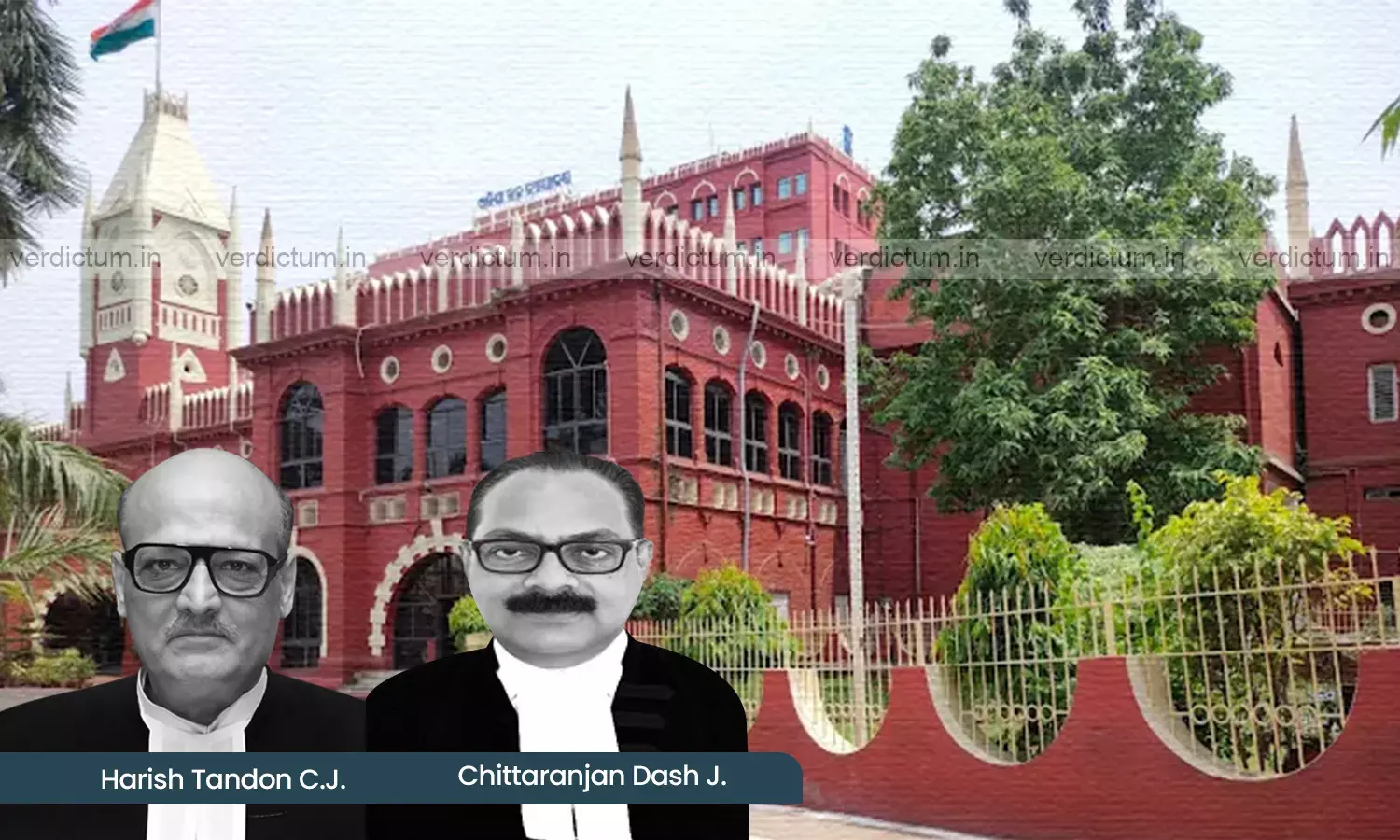
Chief Justice Harish Tandon, Justice Chittaranjan Dash, Orissa High Court
The Orissa High Court has held that a concession on a proposition of law by the counsel cannot bind the parties, as such concession is always regarded as no concession in the eye of the law. The High Court further explained that even a concession made by the counsel which runs counter to the statutory provision is regarded as a non-binding concession on the parties.
The High Court was considering an appeal against the orders passed in a writ petition challenging the order passed by the Government rejecting the claim of the appellant in relation to the benefit of salary to be given during the training period instead of stipend.
The Division Bench of Chief Justice Harish Tandon and Justice Chittaranjan Dash held, “There is no iota of doubt in our mind that a concession on proposition of law by the counsel cannot bind the parties as such concession is always regarded as no concession in the eye of law. Even a concession made by the counsel which runs counter to the statutory provision is regarded as a non binding concession on the parties as the applicability of law cannot depend upon such concession. The moment the law is enacted either to extend a benefit or to take away such benefit, the concession by a counsel at the time of hearing which undermine the object and purpose of the legislation is not permissible. Thus a distinction has to be drawn between a concession on fact and a concession on law by the counsel.”
Advocate Sidheswar Mallik represented the Appellant while Addl. Government Advocate S. K. Swain represented the Respondent.
Factual Background
The appellant was appointed as an Assistant Conservator of Forests under the Odisha Forest Service Group-A (Junior Branch) at a relevant point of time when the Odisha Forest Service Group-A (Junior Branch) (Recruitment & Conditions of Service) Rules, 2013 were in vogue. It postulates two years of training, and during the training period such appointees are to be extended the benefit of the stipend instead of salary. The said Rule of 2013 was subsequently amended with a notification in 2024 in relation to payment of salary during the training period together with other allowances as admissible to such post.
The appellant underwent training in terms of the said Rules and was later appointed to the post of Assistant Conservator of Forests. She made a representation for payment of salary in lieu of the stipend on the basis of the amendment having been carried out through the notification issued by the Government. Several writ petitions were filed by similarly circumstanced persons, which were disposed of by extending the benefit of payment of salary instead of stipend, and some of the orders disposing of the writ petition as well as the writ appeal travelled to the Apex Court. The Special Leave Petitions were dismissed. The writ petition was disposed of extending the benefit of salary instead of stipend under the said Rules.
The appellant filed an application seeking modification by extending the consequential benefit of the seniority in the cadre on the premises that there was no concession made by the Counsel appearing for the appellant on the date of disposal of the writ petition. The Single Bench rejected the application reiterating that the Senior Counsel made a concession which was duly recorded in the said order and the stand of the appellant that it was a wrong recording of the event was untenable.
Reasoning
The Bench explained that there is a significant difference between a concession in relation to a fact and a concession in relation to a law. “Such distinction is real and apparent, and it has been a consistent view taken by the Courts that the concession of a lawyer on a proposition of law is not binding on the litigant nor be recorded as a binding concession. It is no longer res integra that a wrong concession on the proposition of law enacted through a well recognised procedure is no concession in the eye of law as the applicability and the efficacy of the law cannot be decided or readily inferred on the concession”, it added.
The Bench also stated that unless the client instructs his counsel to concede a fact, no concession can be made unilaterally to bind the litigant who has been pursuing the remedy before the Court. As per the Bench, the authority of the counsel to act prejudicial to the interest of the client by making a concession on fact is to be judged on such parameters and in the event the Court finds that such concession is not supported by any instruction from the litigant, there is no fetter to expunge such concession as the litigant should not suffer for the act of the counsel.
“It is common in the judicial system that the reliefs be it main or ancillary or consequential are claimed in the litigation and the litigant may abandon any of such claims. Such right to abandon the claim can be traced from Order XXIII Rule 1 of the Code of Civil Procedure. The moment one of the reliefs is abandoned by the litigant through his counsel and restricted to a main claim, we do not find any fetter on the part of the Court in adopting such recourse”, it added.
The Bench found that the primary issue involved in the writ petition related to the payment of salary and not the stipend in view of the subsequent notification amending the said Rules which had been granted to the appellant. The Bench found that the earlier judgments were suggestive of the notion that the right to get salary instead of stipend crystallises by virtue of an amended notification and the said relief had been granted by the Court adhering to the comity of Judicial Discipline.
Considering that the Court had extended the benefit to the appellant, the Bench did not find any incongruity in that regard. Thus, finding no merit in the writ appeal, the Bench dismissed the same.
Cause Title: Manasmita Maharana v. State of Odisha and others (Neutral Citation: 2026:OHC:65-DB)