

Designated Authority Can’t Adjudicate Borrower Disputes: Madras High Court Directs Speedy Disposal Of Section 14 SARFAESI Act Applications
The Court held that proceedings under Section 14 of the SARFAESI Act are ministerial in nature and Designated Authorities cannot adjudicate disputes between secured creditors, borrowers or third parties while considering applications for taking possession of secured assets.
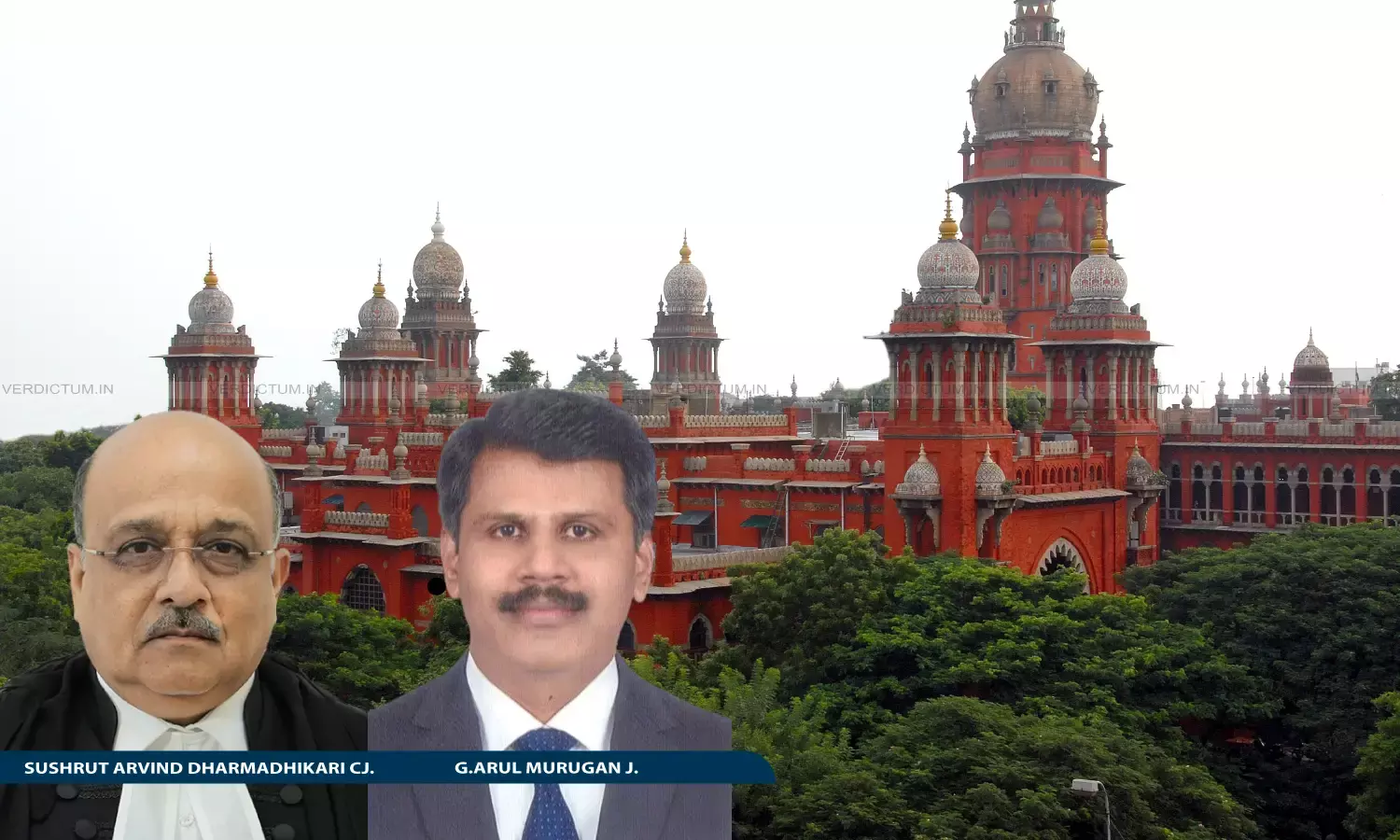
Chief Justice Sushrut Arvind Dharmadhikari, Justice G. Arul Murugan, Madras HC
The Madras High Court has issued State-wide directions for the expeditious disposal of applications under Section 14 of the Securitisation and Reconstruction of Financial Assets and Enforcement of Security Interest Act, 2002.
The High Court reiterated that Chief Metropolitan Magistrates, Chief Judicial Magistrates and District Magistrates exercising powers under the provision perform only ministerial functions and cannot assume adjudicatory jurisdiction.
The Court held that all disputed questions between secured creditors, borrowers, guarantors, tenants or third parties fall exclusively within the jurisdiction of the Debts Recovery Tribunal under Section 17 of the SARFAESI Act.
The Court was hearing a writ petition filed by an auction purchaser seeking directions to Punjab National Bank to deliver vacant possession of a secured asset purchased in a SARFAESI auction after the bank allegedly failed to secure physical possession despite issuance of a sale certificate.
A Division Bench comprising Chief Justice Sushrut Arvind Dharmadhikari and Justice G. Arul Murugan observed: “The nature of the inquiry under Section 14 of the SARFAESI Act is ministerial and not adjudicatory. The Designated Authority is not required and is indeed prohibited from adjudicating upon any dispute between the secured creditor and the borrower, or between the secured creditor and any third party (including any person in possession of the secured assets), in an application under Section 14 of the SARFAESI Act. All such disputed questions of law or fact are exclusively within the jurisdiction of the Debts Recovery Tribunal under Section 17 of the SARFAESI Act”.
The Bench accordingly directed: "Upon receipt of a written application under Section 14(1) of the SARFAESI Act from a secured creditor, the CMM/CJM/DM (hereinafter collectively referred to as "the Designated Authority") shall immediately register the application. No application under Section 14 of the SARFAESI Act shall be listed for arguments on registration".
“Upon being satisfied about the contents of the affidavit and the existence of its territorial jurisdiction, the Designated Authority shall pass a suitable order within 30 days from the date of filing of the application, as mandated by the second proviso to Section 14(1) of the SARFAESI Act”, the Bench added.
Advocate M.L. Ramesh appeared for the petitioner. M.L. Ganesh, Standing Counsel, appeared for the respondent.
Background
The petitioner was the successful auction purchaser of a secured asset sold by Punjab National Bank under the provisions of the SARFAESI Act. According to the petition, the petitioner had paid the entire sale consideration, and a sale certificate had been issued in June 2025.
However, despite issuance of the sale certificate, physical possession of the secured asset had not been delivered to the auction purchaser. The petitioner alleged that the bank had failed to effectively pursue proceedings initiated under Section 14 of the SARFAESI Act for obtaining possession through the jurisdictional Magistrate.
The respondent bank informed the Court that an application under Section 14 had already been filed before the Chief Judicial Magistrate, Chengalpattu, in August 2025, but the same had not even been numbered. The bank further submitted that nearly 200 similar applications were pending before the said Court, awaiting registration and disposal.
Taking note of the delays, the High Court undertook a detailed examination of the statutory framework governing Section 14 proceedings and the scope of powers exercisable by Magistrates and District Magistrates under the SARFAESI Act.
Court’s Observation
The High Court reproduced Section 14 of the SARFAESI Act in extenso and examined the legislative object underlying the provision.
The Court observed that Section 14 was enacted to provide expeditious assistance to secured creditors for taking possession of secured assets and that the provision prescribed strict timelines requiring orders to ordinarily be passed within 30 days, extendable up to a maximum aggregate period of 60 days upon recording reasons.
The Bench extensively relied upon the Supreme Court judgment in R.D. Jain and Company v. Capital First Limited (2023).
Referring to R.D. Jain, the Court observed: “The powers exercised by the CMM/DM is a ministerial act. He cannot brook delay. Time is of the essence. This is the spirit of the special enactment.”
The Court further noted that the Supreme Court had categorically held that no element of quasi-judicial adjudication was involved in proceedings under Section 14 and that the Magistrate’s role was confined to verification of statutory compliance contained in the affidavit filed by the secured creditor.
The Bench also relied upon Balkrishna Rama Tarle v. Phoenix ARC Private Ltd. (2023), wherein the Supreme Court reiterated that the Designated Authority under Section 14 cannot adjudicate disputes between borrowers, tenants or third parties and secured creditors.
The Court observed: “Once all the requirements under Section 14 of the SARFAESI Act are complied with/satisfied by the secured creditor, it is the duty cast upon the CMM/DM to assist the secured creditor in obtaining possession.”
The High Court further noted that the Supreme Court had clarified that disputes relating to tenancy rights, borrower objections and other inter se claims are matters falling within the exclusive domain of the Debts Recovery Tribunal under Section 17 of the Act.
The Bench thereafter referred to the decision of the Madhya Pradesh High Court in Equitas Small Finance Bank Limited v. State of Madhya Pradesh, where comprehensive guidelines had been issued after noticing widespread delays and excessive exercise of jurisdiction by Magistrates dealing with Section 14 applications.
The Court observed that Tamil Nadu was facing a similar situation with large numbers of writ petitions being filed due to inaction, delays and jurisdictional overreach by Designated Authorities.
The Court remarked: “This Court has been inundated with writ petitions filed by various banks, financial institutions and asset reconstruction companies aggrieved by the inaction or excess of jurisdiction by the Designated Authorities under Section 14 of the SARFAESI Act.”
The Bench observed that such avoidable litigation defeated the very object of the SARFAESI Act, which had been enacted for expeditious recovery of secured assets and reduction of non-performing assets in the banking sector.
The Court thereafter issued directions applicable to all Chief Metropolitan Magistrates, Chief Judicial Magistrates and District Magistrates exercising powers under Section 14 across Tamil Nadu.
The Court directed that applications under Section 14 must be immediately registered upon filing and cannot be listed for arguments on registration or subjected to any pre-registration inquiry.
The Bench clarified that the Designated Authority is required to verify only limited jurisdictional and procedural aspects, namely, territorial jurisdiction, service of notice under Section 13(2), filing of affidavit complying with clauses (i) to (ix) of Section 14(1), and applicability of exceptions under Section 31 of the SARFAESI Act.
The Court specifically held that no notice is ordinarily required to be issued to borrowers, guarantors, mortgagors or third parties before passing orders under Section 14.
However, the Bench clarified that in cases involving prior tenancy or lease claims protected under the principles laid down in Harshad Govardhan Sondagar v. International Assets Reconstruction Co. Ltd. (2014) and Vishal N. Kalsaria v. Bank of India (2016), a limited inquiry into the genuineness of tenancy claims may be undertaken consistent with principles of natural justice.
The Court further directed that unexplained delays in the disposal of Section 14 applications would be viewed seriously, and Designated Authorities may be required to explain such delays before the High Court in writ proceedings.
The Bench also directed the Registrar General of the Madras High Court and the Chief Secretary of Tamil Nadu to circulate the judgment among all Magistrates and District Magistrates dealing with SARFAESI proceedings.
Conclusion
The High Court disposed of the writ petition by directing the Chief Judicial Magistrate, Chengalpattu, to take up and dispose of the pending Section 14 application filed by Punjab National Bank within 30 days in accordance with the statutory mandate and the directions issued in the judgment.
Cause Title: Vijayanand Srinivasan v. Punjab National Bank (Neutral Citation: 2026:MHC:1947)
