

Criminal Law Can’t Be Used To Silence Citizen Merely Because He Questions Legality Of Police Action: Madras High Court Quashes Proceedings
The Madras High Court was considering a Petition filed under Section 528 of the BNSS seeking the quashing of the records relating to a criminal proceeding.

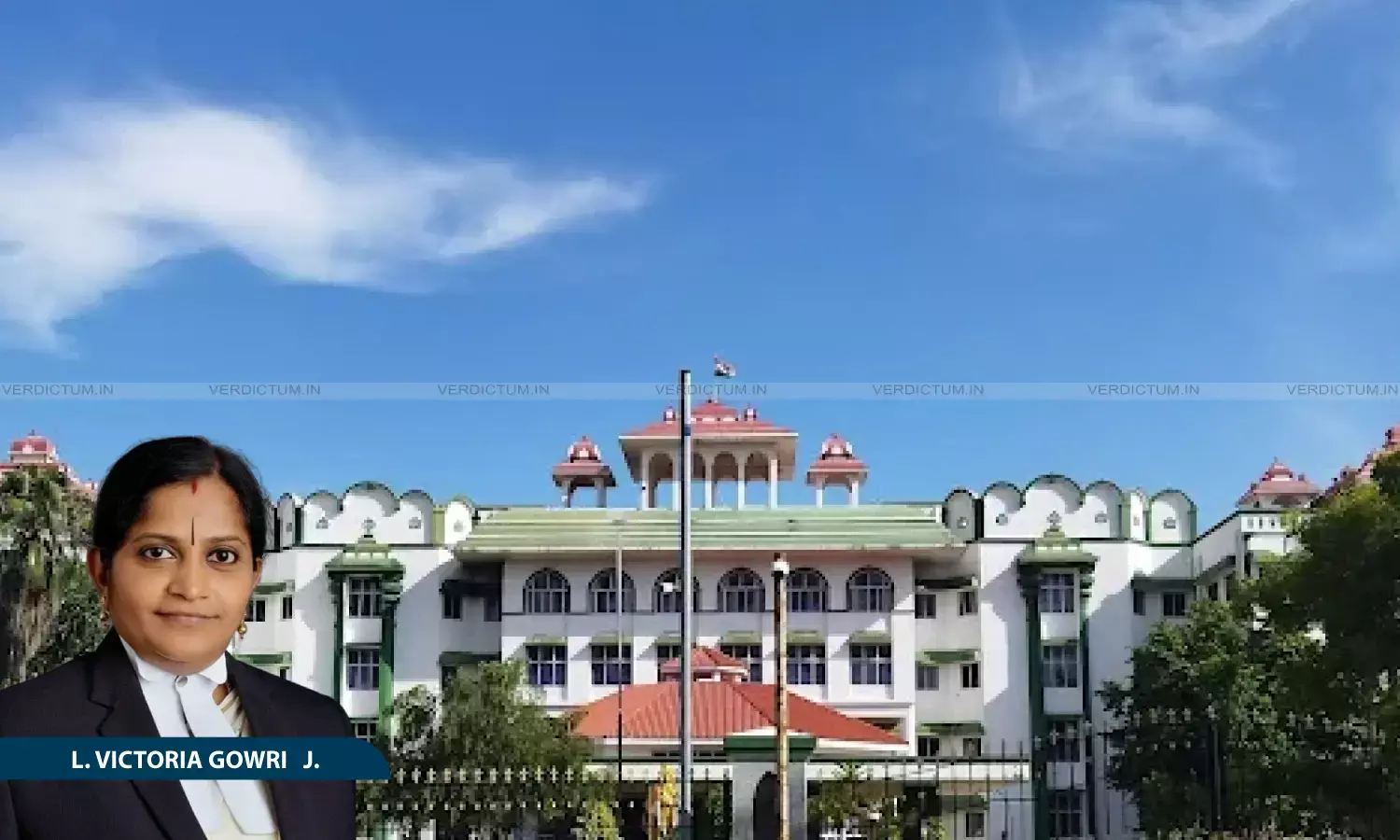
Justice L. Victoria Gowri, Madras High Court, Madurai Bench
While quashing the proceedings against two men accused of preventing a police official from performing his lawful duty, the Madras High Court has held that the criminal law cannot be used to silence a citizen merely because he questions the legality of police action. The High Court further held that public servants discharging lawful duty are entitled to protection from obstruction, assault and intimidation.
The High Court was considering a Criminal Original Petition filed under Section 528 of the BNSS seeking quashing of the records relating to the proceedings on the file of the Judicial Magistrate.
The Single Bench of Justice L. Victoria Gowri stated, “The criminal law cannot be used to silence a citizen merely because he questions the legality of police action. At the same time, public servants discharging lawful duty are entitled to protection from obstruction, assault and intimidation. The decisive question is whether the prosecution materials disclose such obstruction, assault or intimidation in the legal sense. In the present case, they do not.”
Advocate S.Sylverster Raj represented the Petitioner while Government Advocate M.Sakthi Kumar represented the Respondent.
Factual Background
A case was registered under Sections 294(b), 341, 353 and 506(ii) of the Indian Penal Code. The petitioners’ version was that the accused had attended the New Year Holy Mass at Infant Jesus Church, Ulaganathapuram, Paramakudi, and that after the mass, he and others were celebrating outside the church. The de facto complainant was stated to have come there with police personnel, made an enquiry and sent them home. The further allegation of the petitioners was that thereafter the de facto complainant came to the accused’s house without summons, notice or enquiry slip and took him for interrogation in relation to an alleged theft. According to the petitioners, when this was questioned by the first accused and later by the second accused, the complaint came to be registered.
After investigation, the first respondent police laid a final report, which was taken on file by the Judicial Magistrate, Paramakudi. Based on the said complaint, a case was registered by the first respondent police for the offences under Sections 294(b), 341, 353 and 506(ii) IPC. After the completion of the investigation, the first respondent filed a final report. According to the prosecution, the accused acted in concert and had intentionally prevented the de facto complainant from performing his lawful duty as a public servant. As per the petitioner, the complaint was lodged only to justify and cover up the earlier illegal detention and coercive interrogation.
Reasoning
The Bench, at the outset, asserted, “This Court is conscious that the defence version cannot ordinarily be accepted as gospel truth at the stage of quashment. However, where the prosecution materials themselves are vague and do not disclose the statutory ingredients of the offences alleged, the Court is duty-bound to examine whether the continuation of the proceedings would serve any legitimate purpose.”
Taking note of the substratum of the prosecution that the petitioners questioned the de facto complainant during an enquiry, the Bench stated, “Mere questioning, protest or verbal altercation with a police official, without the necessary ingredients of the penal offences alleged, cannot automatically be criminalised under serious provisions of the IPC.”
The Bench also explained that Section 294(b) IPC punishes the utterance of obscene words in or near any public place, provided such utterance causes annoyance to others. The Bench further asserted that the essential ingredients are the utterance of obscene words, which must be in or near a public place, and it must cause annoyance to others. “In cases involving Section 294(b) IPC, the complaint or final report must disclose the actual obscene words alleged to have been uttered. A general allegation that the accused abused the complainant in filthy or obscene language is not sufficient. The Court must be able to see whether the words attributed to the accused are obscene in the legal sense”, it stated.
As per the Bench, the offence under Section 341 IPC was not prima facie made out as the prosecution had not placed any specific material to show that the de facto complainant was physically prevented from moving in any particular direction. The final report did not disclose where exactly he was restrained, how he was restrained, for what duration he was restrained, and by what specific overt act each petitioner prevented his movement. The Bench further noticed that the final report did not disclose any clear act of assault or use of criminal force by either of the petitioners.
“The mere fact that the complainant is a police official does not automatically attract Section 353 IPC. There must be a specific allegation of assault or use of criminal force. A verbal protest, resistance by words, or questioning of the legality of police action, without any overt act amounting to assault or criminal force, cannot constitute an offence under Section 353 IPC”, it added.
In light of such facts and circumstances, the Bench found the allegations to be vague, omnibus and unsupported by the necessary particulars. “The final report appears to have been filed in a mechanical manner without properly examining whether the statutory ingredients of the alleged offences were satisfied. Therefore, this is a fit case for exercise of inherent jurisdiction under Section 528 BNSS to secure the ends of justice and to prevent abuse of process”, it stated.
Thus, allowing the appeal, the Bench quashed the proceedings on the file of the Judicial Magistrate against the petitioners.
Cause Title: Thomas @ Dhamas v. The State of Tamilnadu (Case No.: Crl.O.P.(MD).No.1289 of 2026)