Failure To File Cross Appeal Cannot Prevent Appellate Court From Enhancing Motor Accident Compensation In Exceptional Cases: Madras High Court
The Court held that appellate courts possess wide discretionary powers under Order XLI Rule 33 CPC to award just compensation even in the absence of a cross-appeal or cross-objection, particularly where the victim has suffered catastrophic and permanent disability.
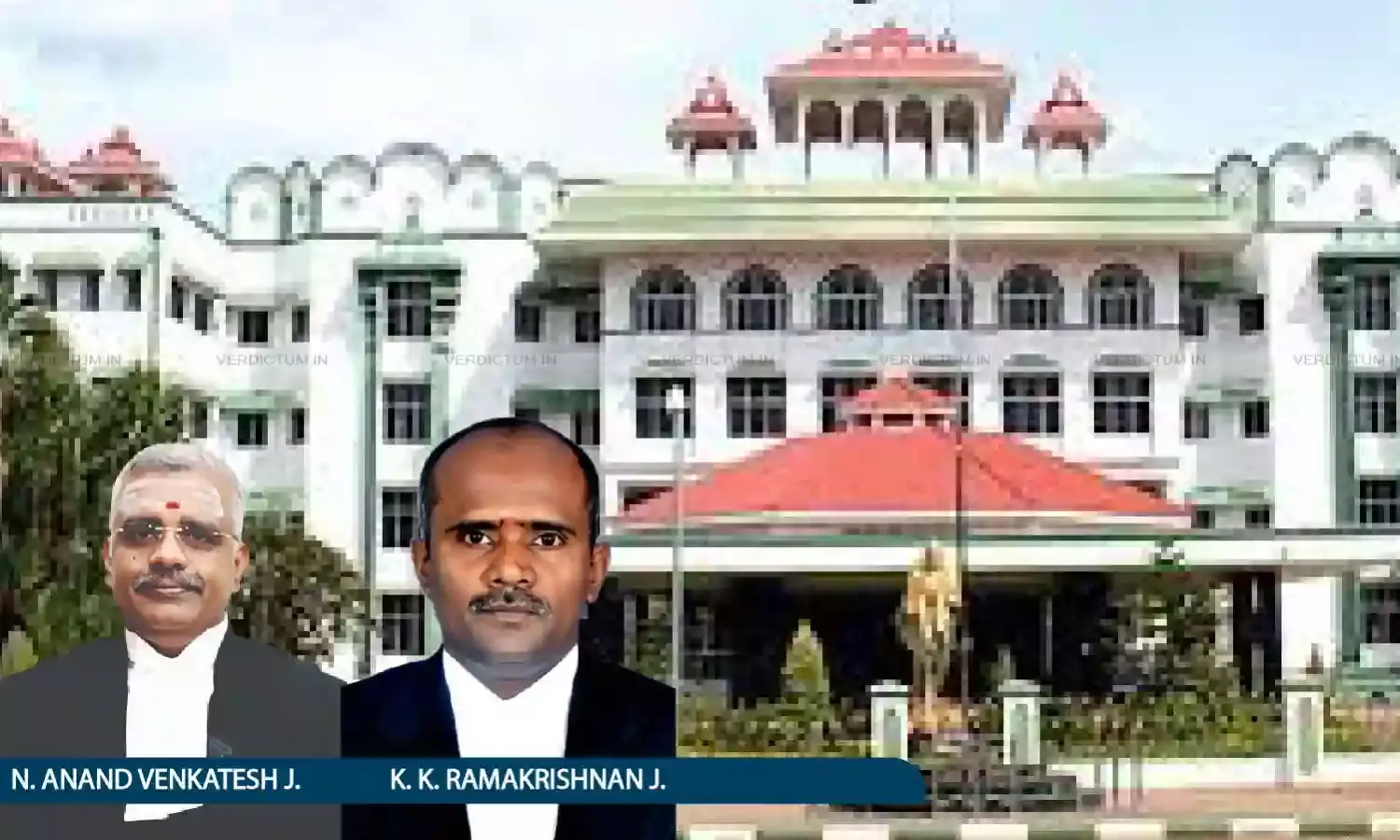
Justice N. Anand Venkatesh, Justice K. K. Ramakrishnan, Madras High Court
The Madras High Court has held that the failure of counsel to file a cross-appeal seeking enhancement of compensation cannot preclude the appellate court from exercising powers under Order XLI Rule 33 CPC to award just compensation in exceptional cases involving severe and permanent disability.
The Court was hearing Civil Miscellaneous Appeals filed by an Insurance Company challenging awards passed by the Motor Accidents Claims Tribunal, Tirunelveli, in claim petitions arising out of two successive motor accidents involving a father and son.
A Division Bench of Justice N. Anand Venkatesh and Justice K.K. Ramakrishnan observed, “the failure on the part of counsel to file a cross-appeal cannot preclude this Court from exercising its powers under Order XLI Rule 33 CPC, especially in cases of exceptional cases. The said provision confers wide discretionary power upon the appellate court to pass such orders as are necessary to do complete justice to the parties.”
Advocate G. Prabhu Rajadurai appeared for the appellant Insurance Company. Advocates R. Jim, V.S. Sakthivel and R. Karunanithi appeared for the respondent.
Background
According to the claimant-son, he was travelling in a Chevrolet car on the Ramanatham National Highway when an Eicher van allegedly overtook and dashed against the vehicle, resulting in simple injuries. An FIR was registered in connection with the first accident under Sections 279 and 338 IPC.
Thereafter, while the injured claimant was being shifted from the Government Hospital to a private hospital in a Maruti ambulance, the ambulance met with another accident involving an omnibus allegedly driven rashly and negligently. In the second accident, both the son and father sustained injuries, and another FIR was registered under Sections 279 and 338 IPC.
The claimant-son contended that the second accident caused catastrophic spinal cord injuries resulting in permanent disability, complete immobility and dependence on artificial feeding mechanisms. He sought compensation of Rs. 70 lakhs before the Motor Accidents Claims Tribunal. The father also filed a separate claim petition seeking compensation for injuries sustained in the second accident.
The appellant Insurance Company disputed liability and contended that the grievous spinal injuries had been sustained in the first accident and not in the second accident involving the insured ambulance. According to the appellant, the second accident merely aggravated the pre-existing injuries.
The insurer of the vehicle involved in the first accident opposed the plea and contended that the spinal injuries were sustained only in the second accident. The Tribunal ultimately held that the first accident resulted only in simple injuries, whereas the grievous spinal cord injuries were sustained in the second accident. Accordingly, substantial liability was fastened upon the appellant Insurance Company.
The Tribunal awarded compensation exceeding Rs. 33 lakhs to the son and Rs. 20,000 to the father. Aggrieved thereby, the Insurance Company filed appeals before the High Court.
Court’s Observation
The High Court examined the oral evidence of the claimant and the medical records relating to both accidents. The Court noted that although the claim petition contained a reference to spinal injury in the first accident, the claimant had clarified during cross-examination that the same was an inadvertent mistake committed while preparing the proof affidavit.
The Court observed that the contemporaneous medical records relating to the first accident disclosed only simple injuries without any spinal involvement. On the other hand, the evidence relating to the second accident, including the testimony of the claimant and doctor as well as documentary exhibits, established that the grievous spinal injuries had been sustained in the second accident.
The Court held: “The explanation offered for the discrepancy in the pleadings is reasonable and is supported by medical records. It is a settled principle that an admission, unless it is clear, unequivocal, and unambiguous, cannot be treated as conclusive, especially when a satisfactory explanation is offered.”
The Court further observed that the appellant Insurance Company had failed to adduce any contrary evidence to substantiate its contention that the spinal injuries were sustained in the first accident.
While considering the issue of enhancement of compensation in the absence of a cross-appeal, the Court observed that the claimant had suffered catastrophic spinal cord injury resulting in paraplegia, permanent immobility and total dependence on attendants even for basic bodily functions.
The Court expressed serious concern regarding the conduct of the counsel appearing for the claimant in failing to pursue proceedings for enhancement of compensation despite the severity of the disability suffered by the claimant. The Court observed, “Once an advocate enters appearance on behalf of a party, particularly in appellate proceedings, he assumes the role of a trustee of the client’s interests.”
The Court further observed that reliance solely upon the Court’s power under Order XLI Rule 33 CPC without discharging the primary obligation to advise and act in the client’s best interest amounted to a serious lapse and, in appropriate cases, may amount to professional misconduct.
Referring to the condition of the claimant, the Court observed that the claimant was bedridden, dependent upon artificial feeding through tracheostomy or nasal tube and incapable of performing even minimal daily activities independently. The Court observed, “This is not merely a case of injury and is not a case of mere survival where life itself has been hollowed out and has been reduced to its barest mechanical existence, leaving behind only a breathing shell.”
The Court further held that the appellate jurisdiction under Order XLI Rule 33 CPC conferred wide discretionary powers upon the Court to do complete justice between the parties even in the absence of a cross-appeal or cross-objection.
Relying upon N.K.V. Brothers (P) Ltd. v. Karumai Ammal (1980), Nagappa v. Gurudayal Singh, Surekha v. Santosh (2021) and Rajesh v. Rajbir Singh, the Court reiterated that compensation awarded under the Motor Vehicles Act must be just, fair and reasonable and that courts should not adopt a hyper technical approach in such matters.
The Court also referred to Kavita v. Deepak, Rekha Jain v. National Insurance Co. Ltd., Kajal v. Jagdish Chand (2020), Kirti v. Oriental Insurance Co. Ltd. (2021) and Abhimanyu Partap Singh v. Namita Sekhon (2022) while considering enhancement of attendant charges and compensation under other heads.
The Court ultimately held that the compensation awarded by the Tribunal was inadequate considering the extent of permanent disability, loss of amenities, continuous medical treatment and lifelong requirement of attendant assistance.
Conclusion
The High Court dismissed the appeals filed by the Insurance Company and upheld the finding that the grievous spinal injuries had been sustained in the second accident involving the insured vehicle.
Invoking powers under Order XLI Rule 33 CPC, the Court enhanced the compensation payable to the claimant-son from Rs. 33,02,600 to Rs. 57,98,000. The Court enhanced the amounts awarded towards attendant charges, pain and suffering, and additionally granted compensation towards loss of amenities and future medical expenses.
The Court directed the claimant to pay the court fee on the enhanced amount and further directed the Insurance Company to deposit the enhanced compensation together with interest at 7.5% on the enhanced component from the date of judgment.
The appeal relating to the father’s claim petition was also dismissed, confirming the award passed by the Tribunal.
Cause Title: The Divisional Manager, United India Insurance Co. Ltd. v. Kathiresan & Ors. and connected matter (Neutral Citation: 2026:MHC:1797)