

Recent Election Shows People Can Vote Without Considering Caste; Now State Must Lead Drive To Eradicate It From Their Minds: Madras HC
The Court observed that there is absolutely no "honour" in honour killings and called upon the state government to take active initiatives to eradicate the deep-rooted social evil of casteism from the minds of the younger generation.

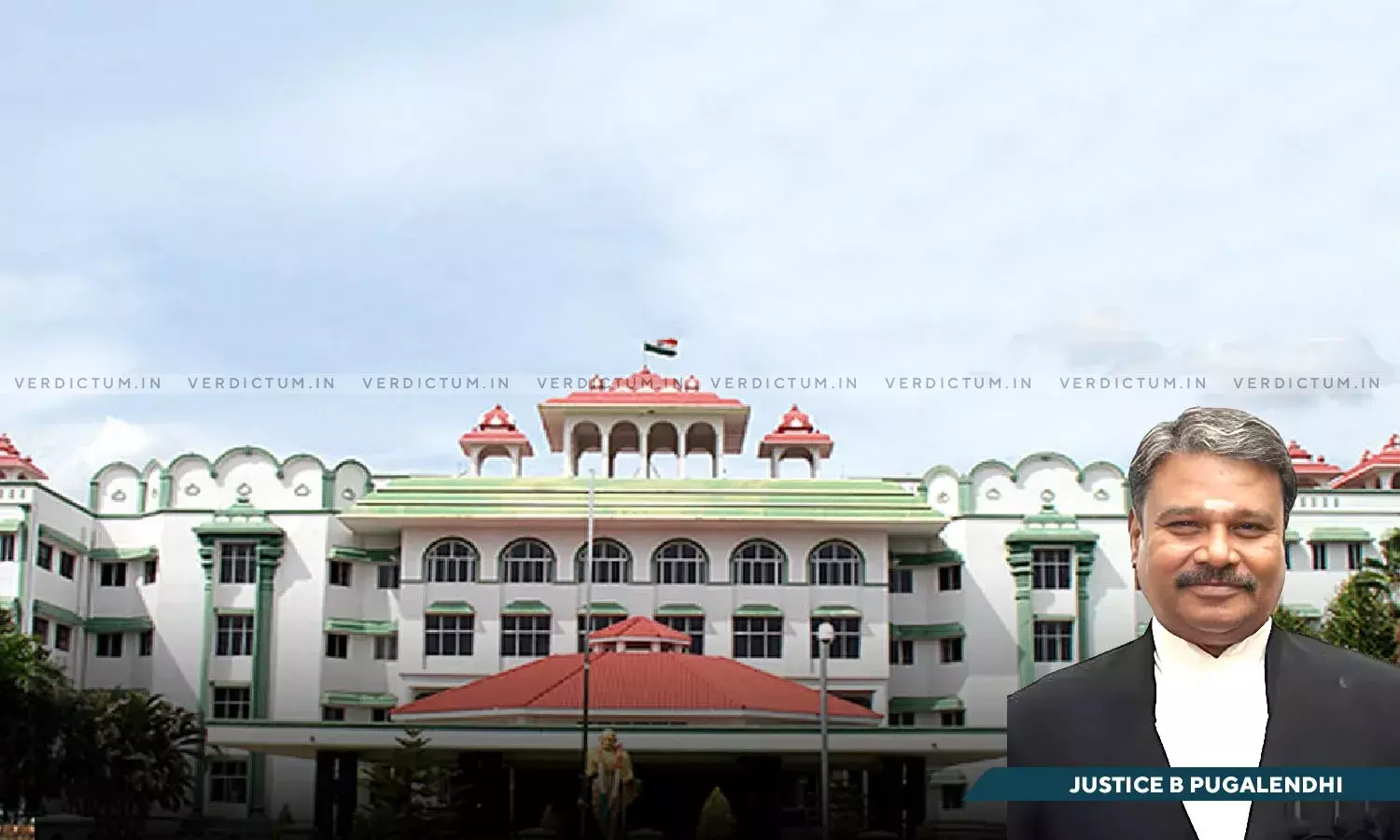
Justice B. Pugalendhi, Madras High Court, Madurai Bench
Referring to recent assembly election results in Tamil Nadu, the Madras High Court has said that people can be convinced to vote without considering the caste or community of the contestants.
It has also observed that the state can claim "true change" only when there is a complete transformation in the mindset of the people.
While enlarging a Sub-Inspector of Police on bail who was accused of harbouring his son following a brutal act of honour killing, Justice B. Pugalendhi emphasized that the newly formed government must actively assume the institutional responsibility and take strong initiatives to permanently eradicate the social evil of casteism from the minds of the people.
The Bench of Justice B Pugalendhi observed, "The recent assembly election results in the state of Tamil Nadu have shown that people can indeed be convinced to vote without considering the caste or community of the contestants. In fact, a government has been formed by largely nullifying the factors of caste. It must be remembered that the state can claim “true change" only when the mindset of the people is also changed. Therefore, this government shall take the responsibility and initiative to eradicate caste from the minds of the people."
Advocate Ananth appeared for the Appellant, while Advocate D. Venkatesh appeared for the Respondent.
Brief Facts of the Case
The prosecution's case arose out of an incident of honour killing. The deceased, an engineering graduate, was in love with the daughter of the appellant (Accused No. 2/A2). The appellant, working as a Sub-Inspector of Police, and his son (Accused No. 1) were aware of this love affair. On the day of the occurrence, Accused No. 1 picked up the deceased on a two-wheeler and took him to the place of occurrence, where a wordy altercation ensued. Accused No. 1 threw chilli powder at the deceased and brutally assaulted him with an aruval (sickle), causing nineteen injuries which resulted in his immediate death.
Following the commission of the offence, Accused No. 1 contacted the appellant and informed him about the incident. It was alleged that the appellant, along with his wife, actively assisted Accused No. 1 in screening the evidence and facilitated his hiding at a relative’s property. It was further alleged that the appellant had previously provided two-wheelers with fake registration number plates to his son and daughter.
The investigation was subsequently transferred to the CB-CID, Tirunelveli, which completed the investigation and filed the final report before the special court. The appellant was arrested and remanded to judicial custody, and his subsequent bail applications before the trial court were dismissed. Aggrieved by the rejection of his bail plea, the appellant preferred the present criminal appeal before the High Court.
Contentions of the Parties
The appellant submitted that the appellant was entirely innocent and played no active role or part in the commission of the principal offence of murder. It was contended that there was no material on record to show that the appellant caused the disappearance of any evidence. It was strongly argued that the allegation of harbouring was baseless, as it was the appellant himself who immediately informed the police on duty about his son's involvement and handed him over to the custody of the police.
The Respondents submitted that the appellant provided false information regarding his own whereabouts and the community of the deceased to screen the crime, and further facilitated the destruction of crucial evidence like blood-stained clothes and mobile phones.
Observations of the Court
The High Court observed that there were no phone calls between the appellant and his son, or between the appellant and the deceased, prior to the occurrence, which indicated that the available materials were insufficient to presume an active role of the appellant in the execution of the murder. The Court remarked that the continuous detention of the appellant, especially when the final report was filed and the main trial proceedings against him were stayed, would amount to impermissible pre-trial punishment.
Deploring the societal evil of honour killings, the Court observed that such crimes were the extreme reflection of a deep-rooted casteist mindset that continued to spoil the social fabric.
The Court observed, "This kind of mindset is more prevalent in the Southern districts and when there was an incident of violence among the school students, the Government appointed a Committee headed Justice K.Chandru (Rtd) to suggest measures to eradicate casteism and to ensure social harmony in the schools and this committee has submitted its report to the government. However it appears the recommendations have not been implemented in full. The legislations like Scheduled Castes and Scheduled Tribes (Prevention of Atrocities) Act, 1989 have not yielded the expected results. The incidents being reported under this Act are increasing day by day and reforms have to be made from the school level to change the mindset of the younger generation."
The Court noted that even state institutions, historical leaders, and the judiciary itself were not spared from communal stereotyping.
"If those entrusted with safeguarding the nation can unite towards a common cause, their example should inspire every citizen to reject caste prejudices and work towards the creation of a society where every individual is treated with respect. The sun gives light to everyone, the rain falls on everyone and the air is shared by everyone. Nature does not recognizes caste. Only when the society transcends the artificial barriers of caste, will it truly awaken to the enduring truth that all human beings are equal and that there is truly no “honour” in honour killings and it is a shameful act", it added.
While holding that the appellant could not escape moral responsibility for raising his son with such caste prejudices, the Court emphasized that a institutional reform starting from the school level, along with strong state initiative, was required to eradicate casteism.
Holding that nature does not recognize artificial barriers of caste and that there is no "honour" in honour killings, the Court set aside the impugned order and enlarged the appellant on bail subject to stringent conditions, including a direction to reside outside the native district during the interregnum.
Cause Title: The State of Tamil Nadu v. Tamil Selvi [Crl.A(MD)No.277 of 2026]
Appearances:
Appellant: Advocate Ananth
Respondent:Advocates D. Venkatesh and C.M. Arumugam
Click here to read/download the Order