

“Trial Judge Influenced By Horror Of Incident”: Madras High Court Refuses To Confirm Death Sentence For A Father Accused Of POCSO Offences
The Court held that sentencing must be guided by principled judicial standards and not by emotional response to the gravity of the offence.
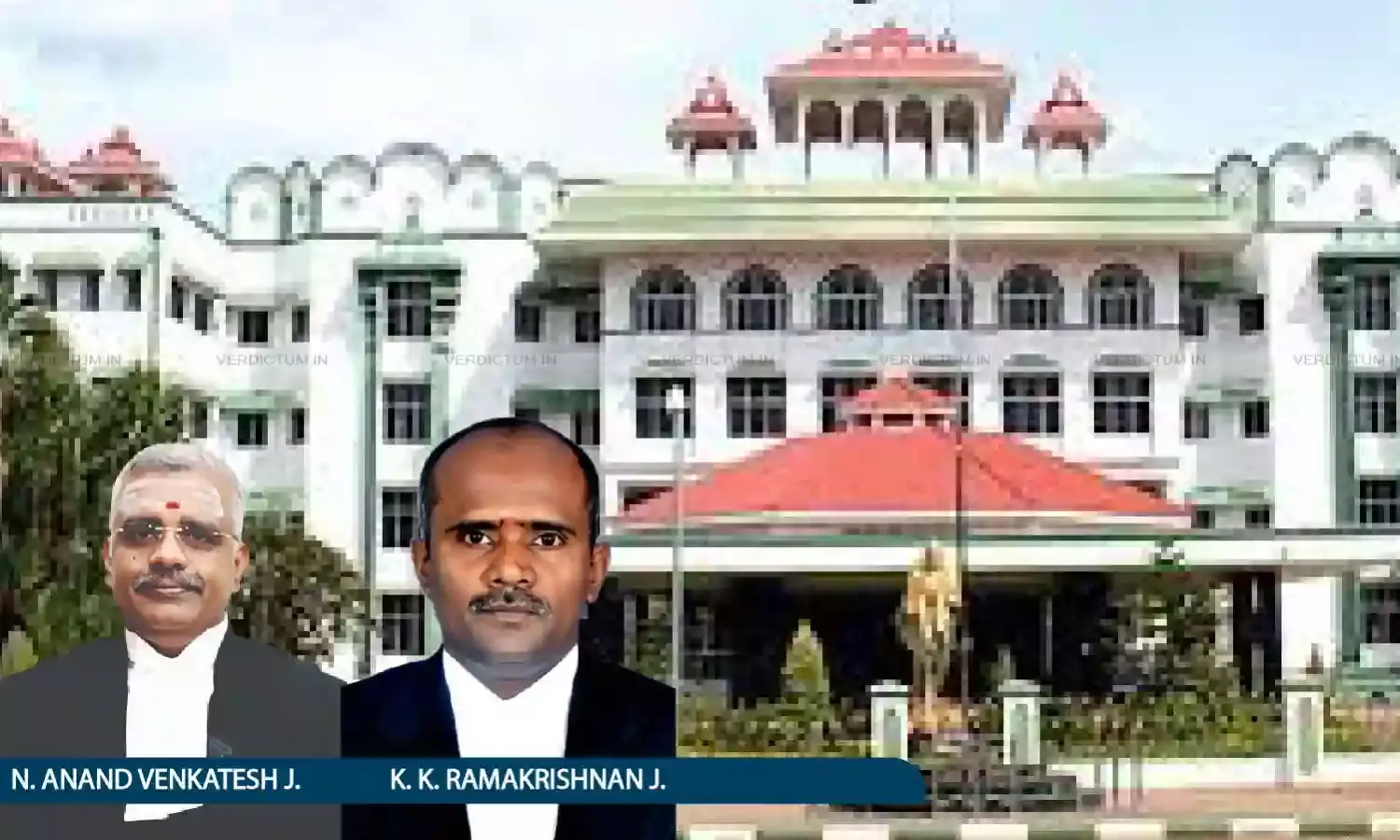
Justice N. Anand Venkatesh, Justice K. K. Ramakrishnan, Madras High Court
The Madras High Court, while refusing to confirm the death sentence under the Protection of Children from Sexual Offences Act, 2012, for a father accused of raping his minor daughter on multiple occasions, held that sentencing must be based on established legal principles and not influenced by the emotional gravity or horror of the incident.
The Court found that the trial court had allowed such considerations to weigh upon its decision while imposing capital punishment.
The Court was hearing a death reference under Section 407 of the Bharatiya Nagarik Suraksha Sanhita, 2023, along with a criminal appeal challenging the conviction and sentence imposed by the Special Court under the POCSO Act.
A Division Bench of Justice N. Anand Venkatesh and Justice K.K. Ramakrishnan observed that “the learned trial Judge was influenced by emotion, sentiment and the horror of the offence and this Court finds it necessary to interfere with the sentence of death imposed by the learned trial Judge as this case does not meet the strict threshold for death penalty and in this case the appropriate sentence is life imprisonment for the remainder of the natural life that ensures an enduring retributive and deterrent effect, consistent with the objectives of punishment under the POCSO Act, rather than imposing the irreversible penalty of death”.
The State was represented by Hasan Mohammed Jinnah, State Public Prosecutor; Advocate R. Manickam appeared as Legal Aid Counsel for the accused.
Background
The case arose from a prosecution under Sections 5 and 6 of the Protection of Children from Sexual Offences Act, 2012 and relevant provisions of the Bharatiya Nyaya Sanhita, 2023. The Trial Court, upon appreciation of oral, medical, and scientific evidence, recorded a conviction and imposed the sentence of death.
In compliance with statutory mandate, the Trial Court made a reference to the High Court for confirmation of the death sentence. The accused also preferred an appeal challenging both the conviction and the sentence.
Court’s Observation
The High Court first reiterated the scope of its jurisdiction in death reference proceedings under Sections 407 to 412 BNSS, emphasising that the High Court is under a dual obligation to independently assess both the correctness of conviction and the appropriateness of sentence.
Relying on precedents including Masalti v. State of U.P. (1965) and State of T.N. v. Rajendran (1999), the Court observed that “the confirmation proceedings of death sentence impose a dual and heightened responsibility upon the High Court and the High Court must independently examine whether the guilt of the accused has been proved beyond reasonable doubt, based on the entire evidence on record and only upon being fully satisfied about the correctness of the conviction, the Court must further to determine whether the present case falls within the category warranting extreme penalty of death”.
On merits, the Court found that the prosecution had established the foundational facts required under the POCSO Act. It noted that the testimony of the victim was cogent and consistent and was corroborated by medical and scientific evidence. The Court also examined the statutory presumptions under Sections 29 and 30 of the POCSO Act and held that once foundational facts are proved, the burden shifts to the accused, who must rebut the presumption.
The Court observed that the testimony of the victim, when found to be credible and trustworthy, is sufficient to sustain a conviction even in the absence of independent corroboration, and further held that the scientific evidence, including DNA analysis, conclusively supported the prosecution's case.
Addressing the defence contention regarding delay and procedural aspects of investigation, the Court held that such aspects did not affect the core of the prosecution case in the absence of any material suggesting tampering or illegality. It further held that the accused had failed to offer any plausible explanation to rebut the statutory presumptions under the POCSO Act.
Having affirmed the conviction, the Court proceeded to examine the question of sentence. It undertook a detailed analysis of the “rarest of rare” doctrine as laid down in Bachan Singh v. State of Punjab (1980) and Machhi Singh v. State of Punjab (1983), along with subsequent jurisprudence governing capital punishment.
The Court emphasised that sentencing must involve a balanced evaluation of aggravating and mitigating circumstances, including the possibility of reformation, availability of social reintegration, and adequacy of legal representation. It was observed that sentencing cannot be driven solely by the gravity or emotional impact of the offence, but must adhere to constitutional principles and structured judicial reasoning.
“It is also pertinent to note that even in cases involving offences under the POCSO Act, including those coupled with extreme aggravating factors, the Hon’ble Supreme Court has, in appropriate cases, commuted the death sentence to imprisonment for life till the end of natural life, upon finding that the case did not satisfy the stringent threshold of the ‘rarest of rare’ category”, the Bench added.
The Court also engaged in a comparative analysis of sentencing philosophies, particularly between capital punishment and life imprisonment, emphasising the qualitative difference between the two. It highlighted that while the death penalty brings finality, life imprisonment till the end of natural life operates as a continuing form of punishment that preserves the possibility of introspection, accountability, and moral reckoning over time.
Elaborating on this distinction, the Court observed that “the death penalty is final, immediate, and irreversible… it extinguishes not only life but also the possibility of repentance, remorse, or moral transformation,” whereas “life imprisonment till the end of natural life… is a living punishment… a continuing process of accountability… where guilt may deepen, remorse may emerge… and the weight of one’s actions may be felt with increasing intensity.”
The Court further underscored that such a sentence ensures a sustained confrontation with one’s actions, compelling the offender to endure the consequences within incarceration over the course of his natural life.
The Court also examined the nature of the offence in cases involving breach of trust within a familial setting, noting that such acts carry a distinct degree of gravity owing to the violation of a child’s sense of safety and security. It was observed that when the offender is a person entrusted with the care and protection of the child, the impact transcends physical harm and results in deep psychological trauma, fundamentally disrupting the child’s ability to trust and feel secure within their own environment.
Expanding on the sentencing framework in such cases, the Court observed that “the offence has been committed through a grave betrayal of the child’s trust… resulting in a profound ‘shattering’ of the child’s sense of security,” and further noted that “the psychological impact of such familial betrayal is often more enduring than physical injury.”
The Court, however, held that while severe punishment is warranted in such cases, the choice of sentence must balance retribution, deterrence, and the possibility of reformation, observing that prolonged incarceration can itself operate as a mechanism of justice by ensuring both accountability and eventual social disengagement of the offender.
The Court also found a serious procedural infirmity in the sentencing exercise, holding that the accused was not afforded a meaningful opportunity to present mitigating circumstances as mandated under Section 258(2) of the Bharatiya Nagarik Suraksha Sanhita, 2023. It was observed that a fair sentencing process requires active engagement with the accused on all relevant materials that may have a bearing on the nature and extent of punishment.
Emphasising this requirement, the Court noted that “the accused must be given a real opportunity to place mitigating circumstances before the Court,” and found that the failure to furnish relevant materials relied upon for sentencing and the absence of proper questioning on such aspects vitiated the process. It held that “this omission strikes at the very root of a fair sentencing hearing,” rendering the imposition of capital punishment procedurally unsustainable.
Furthermore, the Court underscored that the "the trial judiciary, entrusted with this onerous responsibility, stands as the first sentinel of justice, having had the singular advantage of observing the demeanour of witnesses, the anguish of the victim, and the conduct of the accused, ...however, while exercising such grave responsibility, it is imperative that the decision, particularly in the sentencing phase, is not swayed by emotion or sentiment".
In this context, the Court found that the Trial Court had failed to properly consider crucial aspects such as the possibility of reformation, the requirement of a meaningful hearing on sentence, and the need to avoid shifting the burden improperly on the accused. It held that the Trial Court’s approach was influenced by “emotion, sentiment and the horror of the offence”.
"The learned trial Judge, while imposing the death sentence, had failed to consider the above discussed crucial aspects viz: the absence of social reintegration, the erroneous shifting of burden regarding reformation, the lack of adequate legal assistance, and the denial of a meaningful hearing on sentence", the Bench further added.
On an overall assessment, the Court concluded that the case did not satisfy the strict threshold required for imposition of the death penalty and instead fell within the category warranting life imprisonment for the remainder of the natural life of the accused.
Conclusion
Accordingly, the High Court affirmed the conviction of the accused under the provisions of the Protection of Children from Sexual Offences Act, 2012 and the Bharatiya Nyaya Sanhita, 2023.
However, it held that the case did not meet the stringent threshold required for imposition of the death penalty and that the sentencing exercise by the Trial Court was vitiated by improper considerations.
Accordingly, the Court refused to confirm the death sentence and modified the sentence to “life imprisonment till natural death”, while clarifying “which shall mean imprisonment for the remainder of his natural life” without being “entitled to premature release, remission, or commutation”.
Cause Title: State of Tamil Nadu v. Murugan
Appearances
State: Senior Advocate Hasan Mohammed Jinnah, State Public Prosecutor; assisted by Additional Public Prosecutor E. Antony Sahaya Prabahar; Advocates S. Arun Pandi, P. Jeba Malar
Accused: Advocate R. Manickam (Legal Aid Counsel)
