

Temporary Release Cannot Be Indefinitely Denied To Convicts Merely Because Appeal Is Pending: Madras High Court
Pending a final decision on the legal issues concerning leave under the Tamil Nadu Suspension of Sentence Rules, 1982, the Court directed prison authorities to continue processing applications in accordance with the Full Bench decision in T. Ramalakshmi v. State.
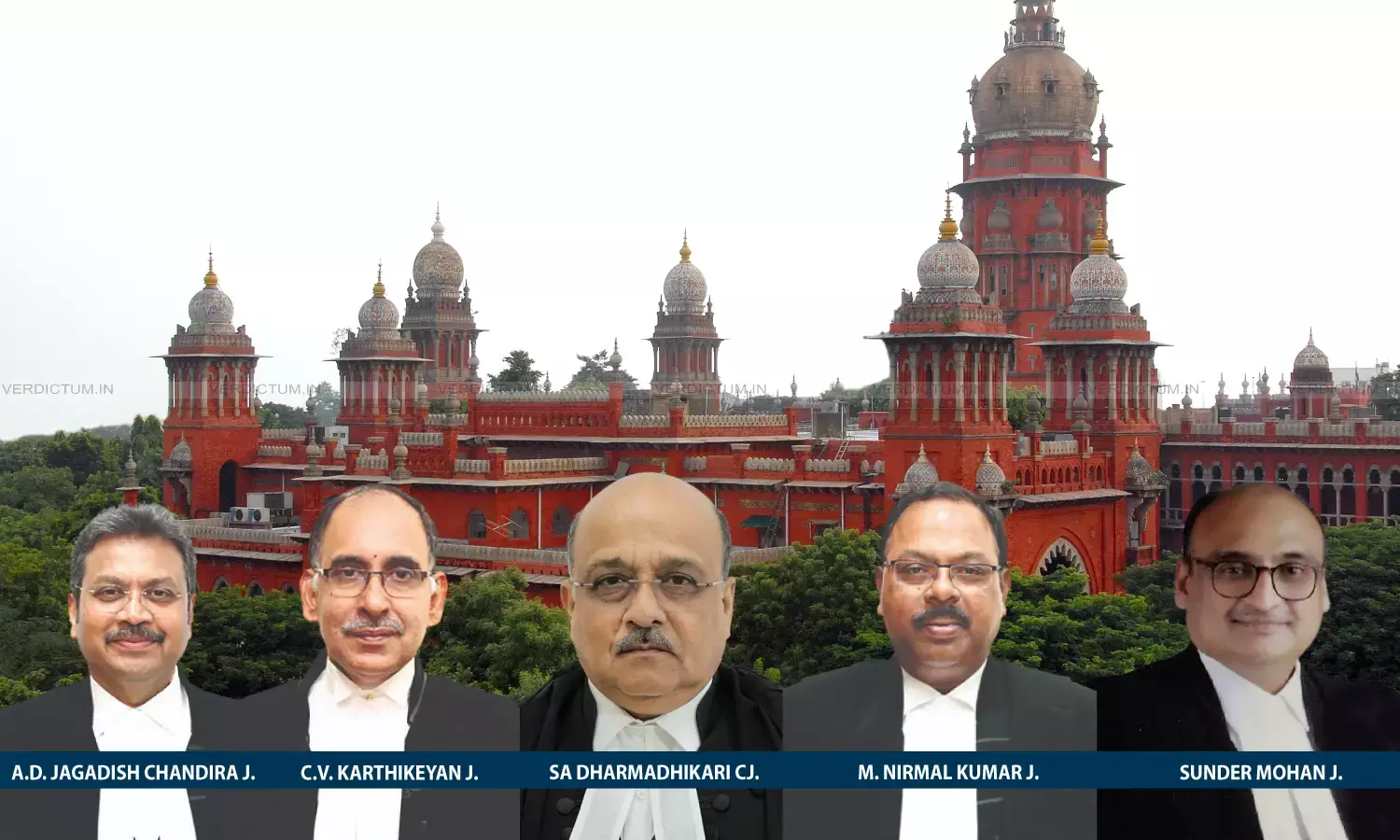
The Madras High Court has held that the pendency of a criminal appeal does not, by itself, justify indefinitely depriving a convict of the benefit of temporary release under the Tamil Nadu Suspension of Sentence Rules, 1982.
Issuing interim directions, the Court kept in abeyance an earlier direction restraining the Registry from entertaining applications for ordinary and emergency leave and directed that such applications be processed in accordance with the Full Bench decision in T. Ramalakshmi v. State until the legal issues are finally settled.
The Larger Bench was considering a reference arising out of conflicting Full Bench decisions regarding the grant of leave to convicts whose appeals against conviction are pending before the High Court or the Supreme Court under the Tamil Nadu Suspension of Sentence Rules, 1982.
A Five-Judge Bench comprising Chief Justice Sushrut Arvind Dharmadhikari, Justice C.V. Karthikeyan, Justice A.D. Jagadish Chandira, Justice M. Nirmal Kumar and Justice Sunder Mohan observed: "We are, thus, of the view that leave and temporary release are facets of human dignity that cannot be suspended indefinitely merely due to the pendency of a judicial appeal."
Advocate R. Sankarasubbu appeared for the petitioners, while R. John Sathyan, State Public Prosecutor, represented the respondents. Abudu Kumar Rajaratnam, Senior Advocate, appeared as Amicus Curiae.
Background
The reference before the Larger Bench arose from conflicting Full Bench decisions concerning whether prisoners whose appeals against conviction remain pending before the High Court or the Supreme Court are entitled to ordinary or emergency leave under the Tamil Nadu Suspension of Sentence Rules, 1982.
The reference required the Court to determine whether leave under the 1982 Rules could be granted during the pendency of an appeal and whether the State could exercise its power under Rule 40 of the Rules in light of the Constitution Bench decision in K.M. Nanavati v. State of Bombay. During the hearing, the Court was also informed that similar issues concerning parole and furlough policies across States were under consideration before the Supreme Court in Mukesh Kumar v. State (Govt. of NCT of Delhi).
Court's Observations
The Court observed that the reference required a harmonious interpretation of the Tamil Nadu Suspension of Sentence Rules, 1982, while keeping in view the constitutional guarantee of personal liberty and the reformative objectives underlying the temporary release of prisoners.
Examining Rule 2(4) of the 1982 Rules, the Bench noted that although a conviction pending appeal may not have attained absolute finality, the legal status of the prisoner nevertheless changes from that of an undertrial to that of a convict.
The Court observed: "We find merit in the argument that while an appeal is pending, the conviction is not 'finally fixed' in the sense of absolute finality, yet the status of the individual has legally transitioned from an 'under-trial' to a 'convict'."
The Bench further noted that Rule 35 expressly excludes only prisoners facing pending trials and does not prohibit the grant of leave to convicts whose appeals remain pending.
The Court observed: "We are prima facie of the view that, by necessary implication, the 1982 Rules remain a potent instrument for reformative leave for all other categories of prisoners, including those in the appellate stage. To deny the benefit of the 1982 Rules to the prisoners would be to ignore the explicit exclusionary boundary set by Rule 35 of the 1982 Rules."
The Court extensively relied upon the Supreme Court's jurisprudence recognising that prisoners continue to enjoy fundamental rights notwithstanding incarceration. Referring to State of A.P. v. Challa Ramkrishna Reddy, the Bench reiterated that imprisonment does not extinguish constitutional protections.
Quoting the Supreme Court, the Bench observed: "Right to life is one of the basic human rights... A prisoner, be he a convict or undertrial or a detenu, does not cease to be a human being. Even when lodged in the jail, he continues to enjoy all his fundamental rights including the right to life guaranteed to him under the Constitution. On being convicted of crime and deprived of their liberty in accordance with the procedure established by law, prisoners still retain the residue of constitutional rights."
The Court also referred to Francis Coralie Mullin and observed that the right to maintain social and family relationships forms part of the broader guarantee of personal liberty under Article 21.
The Bench observed: "The right to have interviews with members of the family and friends is clearly part of personal liberty guaranteed under that article."
Emphasising the constitutional role of High Courts, the Bench held that the power under Article 226 remains available to ensure protection of prisoners' fundamental rights and to prevent injustice wherever statutory authorities fail to exercise their powers lawfully.
The Court observed: "The power of this Court under Article 226 to ensure the protection of these rights remains an indestructible part of the basic structure of our Constitution."
The Court distinguished the Constitution Bench decision in K.M. Nanavati, observing that it dealt with executive suspension of sentence during the pendency of proceedings before the Supreme Court and did not concern statutory reformative leave under the 1982 Rules.
The Bench observed: "Prima facie, we are of the view that the said decision would not be an impediment for the authorities concerned to consider the temporary release of the convicts."
The Court also distinguished the earlier Full Bench decision in State v. Yesu @ Velaiyan, holding that it addressed the concept of parole outside the statutory framework and did not decide whether leave under the 1982 Rules could be granted during the pendency of criminal appeals.
The Bench observed: "The decision in Yesu (supra), therefore, never considered and did not pronounce upon, the question now referred to us, viz., whether leave under the 1982 Rules may be granted to a prisoner whose appeal against conviction is pending before this Court or the Supreme Court."
Finding that legal uncertainty should not operate to the detriment of prisoners, the Court observed that the embargo imposed by the reference order on entertaining leave petitions created immediate hardship.
The Court observed: "Pending the resolution of the questions by this Larger Bench and the final decision of the Apex Court in the Mukesh Kumar case (supra)... a state of legal uncertainty cannot be allowed to prejudice the liberty of convict prisoners."
Conclusion
Pending final adjudication of the reference and the Supreme Court's decision in Mukesh Kumar v. State (Govt. of NCT of Delhi), the Madras High Court kept in abeyance the earlier direction restraining the Registry from entertaining leave petitions.
The Court directed that applications for ordinary and emergency leave be entertained and processed in accordance with the Full Bench decision in T. Ramalakshmi v. State, with each application to be decided on its own merits.
The Court further clarified that K.M. Nanavati would not operate as an automatic bar to the consideration of statutory leave applications during the interim period.
Cause Title: Sheefa Rani v. The Home Secretary & Connected Matters
Appearances
Petitioners: Advocates R. Sankarasubbu, M. Radhakrishnan, R. Muniyapparaj, Janardhanan
Respondents: R. John Sathyan, State Public Prosecutor, and A. Mohammed Imran, Government Advocate; Senior Advocate Abudu Kumar Rajaratnam, assisted by Advocate Thiruvadi Kumar
