

Employee Can Be Treated As “Aggrieved Person” To Invoke Writ Jurisdiction Seeking Vigilance Action: Madras High Court
The Court held that an employee has a right to protect the reputation of the institution in which they are employed, and where allegations of fraud and misappropriation affecting the institution are raised, such an employee can be treated as an “aggrieved person” competent to invoke writ jurisdiction seeking vigilance action.
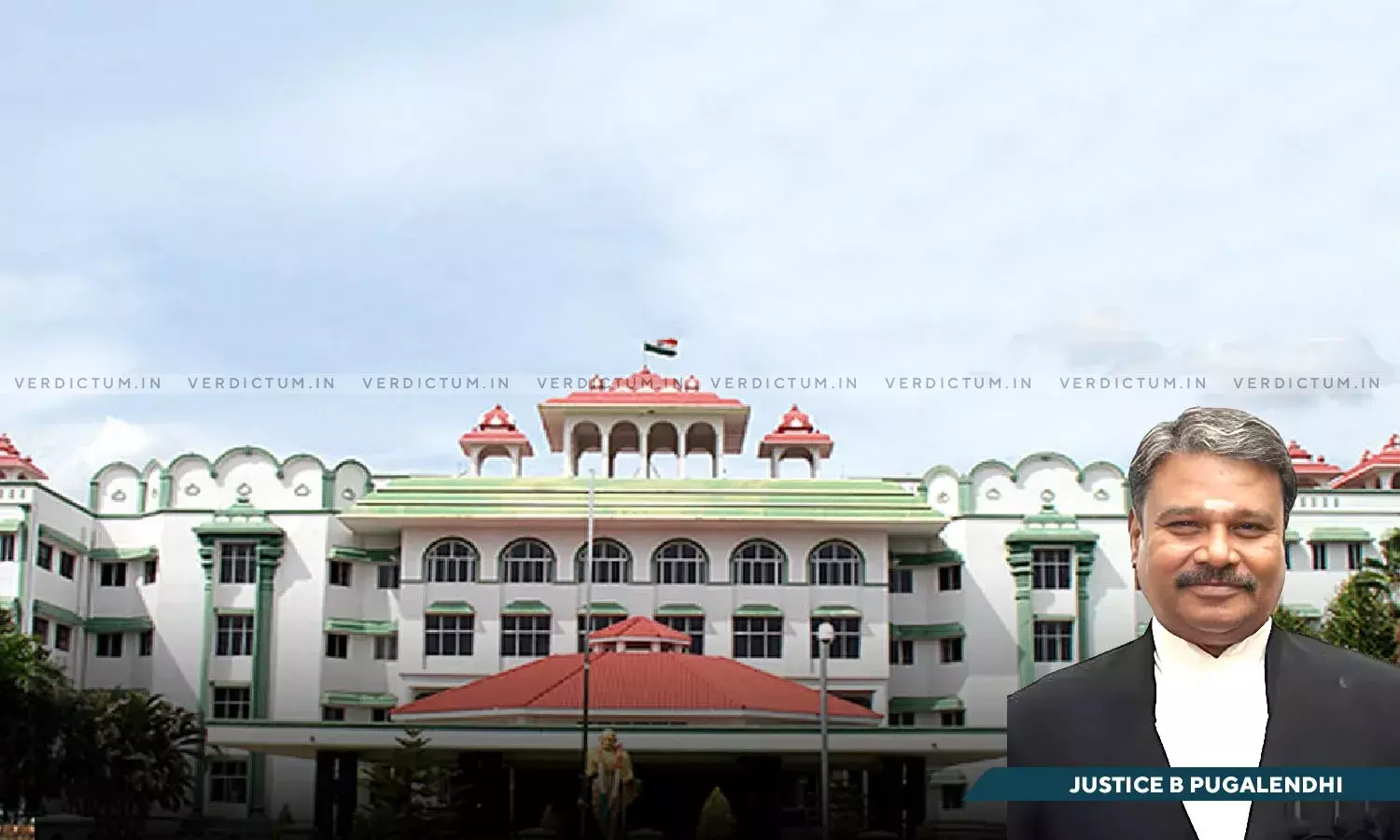
Justice B. Pugalendhi, Madras High Court, Madurai Bench
The Madras High Court has held that an employee can be treated as an “aggrieved person” for invoking the jurisdiction of the High Court under Article 226 of the Constitution, where serious allegations of fraud, fake records and misappropriation affecting the reputation of the institution are raised before the authorities.
The Court further held that while frivolous complaints and misuse of writ jurisdiction by strangers or busybodies must be discouraged, authorities, including the Vigilance Department and public corporations, cannot avoid their legal duty to conduct an enquiry into serious allegations by merely imposing minor punishments on lower-level employees and closing the matter.
The Court was hearing a writ petition filed by a dismissed employee and trade union secretary seeking directions to the Vigilance Department and the Government to take action against officials of the Tamil Nadu State Transport Corporation over allegations that buses were not being operated on approved routes and fake records were created through the issuance of multiple ticket sets to show the operation of non-existent buses, resulting in financial loss to the Corporation.
A Bench of Justice B. Pugalendhi observed, “Every employee is a part of the institution in which they are employed. It is not just the amount of money misappropriated, but the reputation of the institution is also involved in this issue. Every employee has the right to protect the reputation of the institution in which they are employed, and when the reputation of their institution is damaged by such allegations, then the employee is affected and can be considered to be an aggrieved person.”
The Court further observed: “In the event any public official fails to perform their constitutional / statutory / public duty, this Court has the discretion to issue a writ of mandamus, which is a prerogative writ issued to compel the performance of such duties. This discretion is governed by consideration of public policy, public interest and public good”.
Advocate P. Balamurugan appeared for the petitioner. C. Venkatesh Kumar, Special Government Pleader and S.C. Herold Singh, Standing Counsel, appeared for the respondents. Advocate D. Sivaraman assisted the Court as Amicus Curiae.
Background
The petitioner claimed to be a trade union secretary and an erstwhile employee of the Tamil Nadu State Transport Corporation. He lodged a complaint before the Vigilance Department and the Government, alleging grave irregularities in the operation of buses by the respondent corporation.
According to the petitioner, buses were not being operated on approved routes, and fake records were created as if buses had operated on those routes, thereby causing huge losses to the respondent corporation. The petitioner alleged that diesel expenses, salary amounts and maintenance charges were misappropriated by creating false operational records.
The petitioner specifically referred to Bus No.TN-57-N-2084 operating on the Vedasandur–Trichy route on 16.07.2022, and alleged that three different sets of tickets were issued to passengers travelling on a single route to create records as if three buses had operated on the route. The petitioner further alleged that conductors were compelled by higher officials to issue multiple sets of tickets on the same route for the creation of fake records.
A representation dated 29.08.2022 was submitted before the authorities seeking action on the complaint. Since no action was taken, the petitioner approached the High Court seeking the issuance of a writ of mandamus directing the authorities to act upon the complaint.
In response, the respondent corporation filed a counter affidavit admitting that, pursuant to an audit inspection conducted on 18.07.2022, it was found that three different ticket slips relating to Route Nos. 515A, 601B and 680A had been issued on a single bus operating on the Vedasandur–Trichy route.
The respondent Corporation further admitted that fake records had been created as if three buses were operated when only one bus. It was stated that charge memos were issued to the Branch Manager and a Junior Assistant, and disciplinary proceedings were initiated against them.
The Corporation, however, denied involvement of the Managing Director in the alleged scam and argued that the petitioner, being a dismissed employee and third party, lacked locus standi to maintain the writ petition. It was further contended that the complaint had been lodged out of personal vengeance following the petitioner’s dismissal from service.
Court’s Observation
The High Court first examined the issue relating to the maintainability of the writ petition and the concept of “person aggrieved” in exercise of writ jurisdiction under Article 226 of the Constitution.
The Court referred to the decisions of the Supreme Court in Jasbhai Motibhai Desai v. Roshan Kumar Haji Bashir Ahmed (1975) and Ranjit Prasad v. Union of India (2000), dealing with locus standi and maintainability of writ petitions filed by third parties.
Referring to Jasbhai Motibhai Desai (1975), the Court reproduced the distinction drawn by the Supreme Court between a “person aggrieved”, a “stranger” and a “busybody or meddlesome interloper”. The Court noted that persons acting for cheap publicity or interfering in matters that do not concern them cannot be permitted to misuse the writ jurisdiction of constitutional courts.
The Court further referred to Ranjit Prasad (2000), wherein the Supreme Court held that disciplinary proceedings ordinarily constitute matters between employer and employee, and strangers cannot invoke writ jurisdiction seeking directions regarding such proceedings.
However, the Court observed that the question of whether a person can be treated as an “aggrieved person” depends upon the facts and circumstances of each case.
The Court thereafter examined dictionary and legal definitions of the expression “aggrieved person” from Sumeet Malik’s Law Lexicon, Webster's Comprehensive Dictionary and Black’s Law Dictionary. The Court also referred to Attorney General of the Gambia v. Peirra Sarr N’Jie (1961), Maharaj Singh v. State of Uttar Pradesh (1977) and Re Sidebothem, ex parte Sidebothem (1880).
The Court noted that the allegations raised by the petitioner were serious in nature and had substantially been admitted by the respondent corporation itself. The Court observed that the respondent corporation had admitted that three different sets of tickets were issued for a single bus route, and fake records were created as if three buses had operated on the route.
The Court further noted that despite the seriousness of the allegations involving fake operational records and misappropriation, the respondent corporation had closed the issue by imposing only minor punishment of stoppage of increment upon two lower-level employees.
The Court observed, “It also appears that the disciplinary proceedings were initiated to give a closure to this issue by imposing a minor punishment on two employees rather than finding out the truth.”
The Court additionally expressed concern regarding the functioning of the Vigilance Department and observed that although it was expected to monitor approximately 14 lakh government employees, the Department was functioning 'only for name's sake' and was routinely forwarding complaints to departmental heads without conducting a meaningful enquiry.
The Court observed, “Certainly, both the Vigilance Department and the respondent corporation have a legal duty to conduct an enquiry when serious allegations are bought to their notice, which they have not satisfactorily done so.”
The Court also noted that the counter-affidavit filed by the respondent corporation did not disclose whether similar fraud had been played on other routes and whether the role of higher officials, including the Managing Director, had ever been examined. The Court further remarked that it had serious doubts whether such fraud could have been committed without the involvement of higher officials.
Applying the principles governing locus standi to the facts of the case, the Court held that the petitioner could not be treated as a mere stranger or third party.
The Court observed, “In such a situation, the petitioner cannot be considered to be a third party and left remediless.”
Conclusion
The High Court held that the allegations raised by the petitioner warranted a proper vigilance enquiry and that the Vigilance Department had failed in discharging its legal duty by merely forwarding the complaint to the respondent corporation without conducting an independent examination.
Accordingly, the writ petition was disposed of with directions to the fourth respondent Vigilance Department, to examine the petitioner’s complaint and take appropriate action if irregularities were discovered.
The Court further directed the Vigilance Department to file a status report before the Court regarding action taken on the complaint by 03.09.2026.
The Court also placed on record its appreciation for the assistance rendered by Amicus Curiae D. Sivaraman.
Cause Title: S. Murugesan v. Additional Chief Secretary To Government & Ors. (Neutral Citation: 2026:MHC:1860)
