

Inseparable Eyewitness Testimony Cannot Be Accepted In Part & Rejected In Part: Madras High Court Acquits 3 Accused In Politician's Murder Case
The Court found conspiracy theory, FIR delay, recovery evidence and prosecution narrative riddled with inconsistencies.

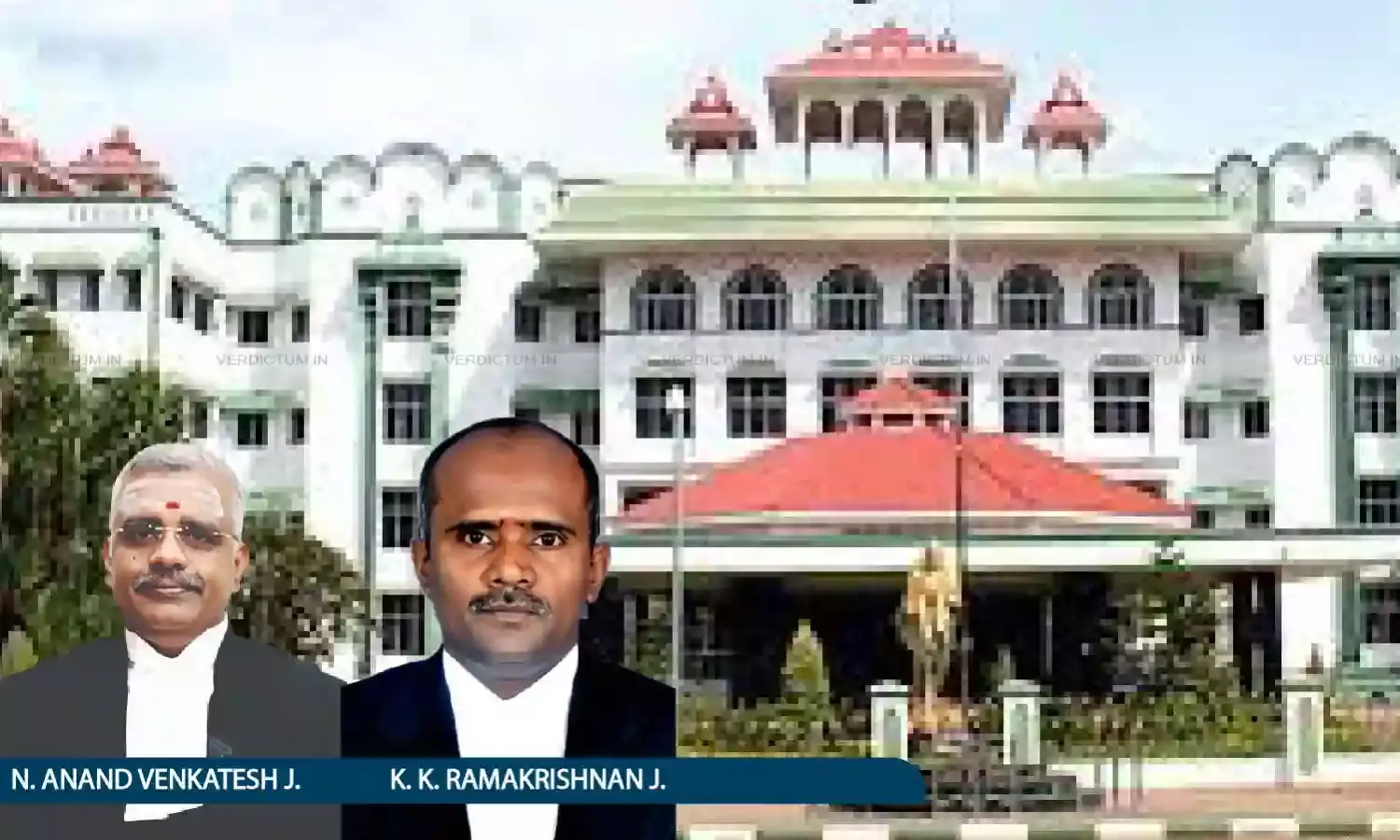
Justice N. Anand Venkatesh, Justice K. K. Ramakrishnan, Madras High Court
The Madras High Court has acquitted three accused who had been convicted for the 2021 murder of a political functionary, Rajini, who belonged to a Scheduled Caste community, holding that the prosecution failed to prove the case beyond reasonable doubt.
The Court found that the trial court had erred in selectively relying on an inseparable eyewitness testimony to convict some accused while acquitting others on the same set of evidence.
Justice N. Anand Venkatesh and Justice K.K. Ramakrishnan observed, “This Court is of the view that when the evidence of eyewitnesses forms a single, inseparable narrative, the Court cannot, in the absence of independent corroboration, accept one part and reject the other in a mechanical manner, particularly when the disbelieved portion goes to the root of the prosecution case”.
“On a cumulative consideration of the above circumstances namely, the unexplained delay in FIR, doubtful presence of eyewitnesses, unreliable evidence relating to conspiracy, inconsistencies between ocular and medical evidence, acquittal of co-accused without any indivisible nature of evidence over the conviction of the appellants and the weak nature of recovery, this Court is of the considered view that the prosecution has failed to prove the case beyond reasonable doubt”, the Bench observed.
Advocate G. Bhagavath Singh appeared for the appellant and A. Thiruvadi Kumar, Additional Public Prosecutor appeared for the respondent.
In the matter, the prosecution alleged that the deceased, Rajini, was brutally hacked to death on July 9, 2021, near Vadassandai Cross Road in Thanjavur district after he advised a caste-abuse victim to lodge a police complaint against one of the accused.
According to the prosecution, the accused subsequently conspired to eliminate Rajini and intercepted him while he was travelling on a two-wheeler, attacking him with billhooks and inflicting multiple fatal injuries.
A trial court had convicted Accused Nos. 1, 2 and 6 for murder, criminal conspiracy and allied offences under the IPC and the SC/ST (Prevention of Atrocities) Act, while acquitting Accused Nos. 3, 4, 5 and 7. Challenging their conviction, the appellants argued that the same eyewitness account had been disbelieved against the acquitted accused and could not be selectively accepted against them.
Allowing the appeal, the High Court found serious infirmities in the prosecution case. It held that the testimony of the two principal eyewitnesses was inseparable and indivisible, yet the trial court had impermissibly rejected it against some accused while relying upon it against others.
“The learned Trial Judge committed error in relying upon certain documents relating to the prior incidents which were neither marked as exhibits nor put to the accused during the course of the 313 Cr.P.C… he strongly relied oral testimony of the number of witnesses in the said case to find guilty of the appellants in the present case. The said procedure is strange one and also the learned Trial Judge failed to put a question during the 313 Cr.P.C. also. It well settled 313 Cr.P.C. is not on a empty formality and the purpose of the 313 Cr.P.C. is to bring the notice of the accused and be given an opportunity to the accused to explain the same. The said non-indication of the incriminating material during the 313 Cr.P.C. questioning would vitiate the conviction. Therefore, in this case the reliance based on the judgment and the material evidence in the S.C.No.33 of 2021 to hold the accused guilty under the charged offence is not legally correct”, the Bench, thus, observed.
The Court also noted contradictions regarding how the injured was transported to hospital, doubts about the eyewitnesses’ presence at the scene, unexplained delay in forwarding the FIR to court, and inconsistencies between the ocular and medical evidence.
The Bench further rejected the prosecution’s conspiracy theory, observing that the witnesses who allegedly overheard the conspiracy displayed unnatural conduct and that their statements reached the court after an unexplained delay.
It also found the recovery of weapons unreliable, noting that they were allegedly recovered from an open public place and were not scientifically linked to the deceased through forensic evidence.
Therefore, holding that the prosecution had failed to establish guilt beyond reasonable doubt, the Court set aside the conviction and sentence imposed on the appellants and acquitted them of all charges.
Cause Title: Rajesh & Ors. v. The State rep by its, The Deputy Superintendent of Police & Anr. (Neutral Citation: 2026:MHC:1826)
Appearances:
Appellants: G. Bhagavath Singh, Advocate.
Respondents: A. Thiruvadi Kumar, Additional Public Prosecutor, J. Alaguram Jothi, Legal Aid Counsel.