Coordinated Defamatory Or Caste-Based Attacks On Sitting Judges Not Protected Free Speech: Madras High Court
The Court directed the State not to permit gatherings intended to personally target, defame or intimidate sitting judges, while declining to impose a blanket prohibition on lawful criticism or peaceful assemblies concerning judicial decisions.
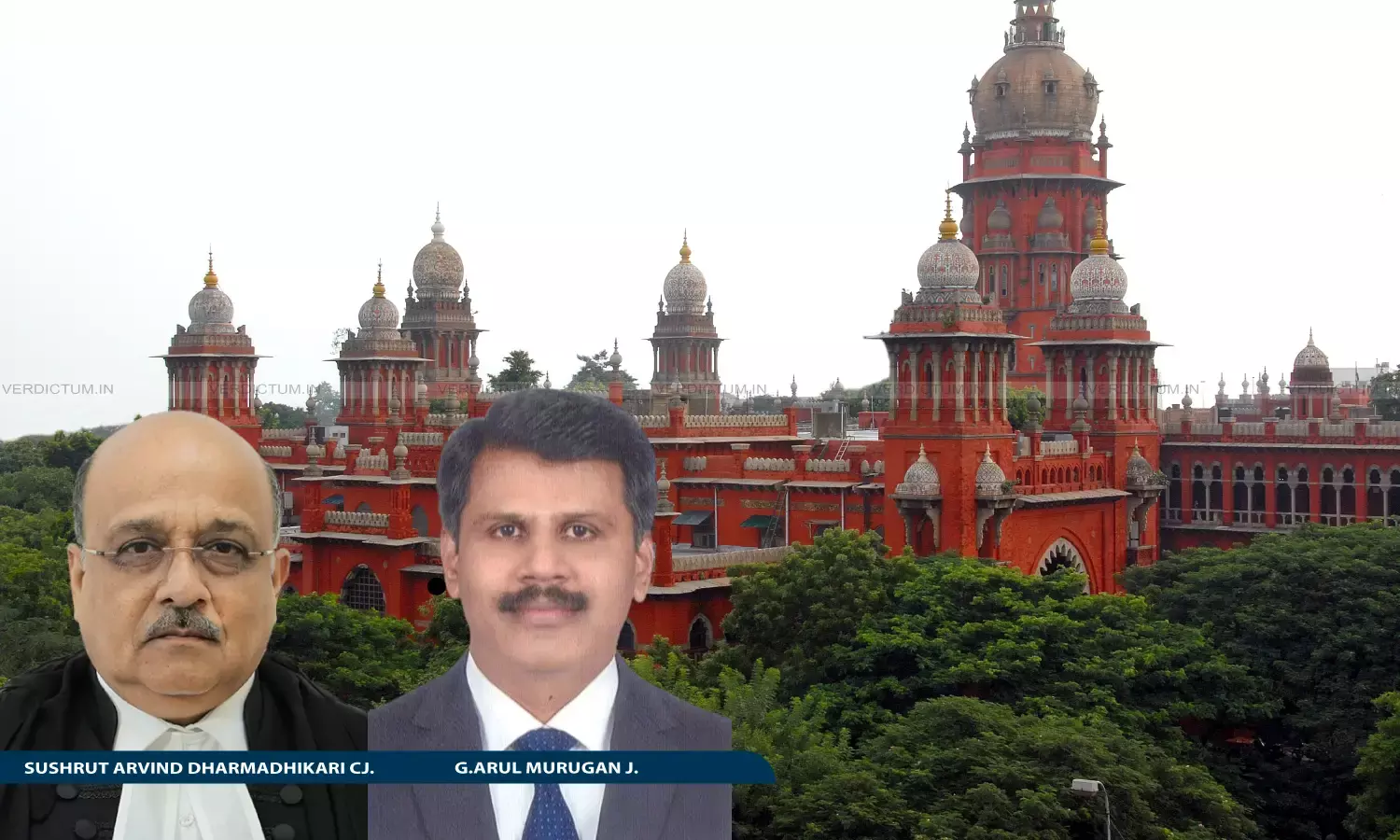
Chief Justice Sushrut Arvind Dharmadhikari, Justice G. Arul Murugan, Madras HC
The Madras High Court has held that citizens have an undeniable right to disagree with and criticise judicial decisions, but coordinated campaigns using abusive, defamatory or caste-based language to attack an individual sitting judge are not protected speech.
The Court directed the police and district administration to examine applications for meetings, marches and protests concerning judicial matters on a case-by-case basis. It ordered that permission must not be granted for gatherings intended to personally target, defame or intimidate a sitting judge.
The Court was hearing a public interest litigation seeking preventive and penal action against organised campaigns allegedly targeting a sitting High Court judge following a judicial decision concerning backwards-class benefits after religious conversion.
A Bench comprising Chief Justice Sushrut Arvind Dharmadhikari and Justice G. Arul Murugan held: “Citizens have an undeniable right to disagree with a judgment. However, there is a clear legal line between criticizing a legal conclusion and attacking the individual judge who authored it. Coordinated actions that use abusive, defamatory or caste-based language to attack a sitting judge do not fall under protected free speech. They violate the reasonable restrictions set out under Article 19(2) of the Constitution of the India.”
Advocate Rajendran Raghavan appeared for the petitioner. Central Government Senior Panel Counsel Dr G. Babu appeared for the Union of India. Government Advocate S. Ganesh Babu appeared for the State, while State Public Prosecutor John Sathyan, assisted by Government Advocate N. Palanivel, appeared for the Director General of Police.
Background
The proceedings arose following a June 25, 2026 judgment delivered by the Madurai Bench in W.P.(MD) No.7217 of 2022. The Court had declared a government order unconstitutional and held that a person could not claim backward-class benefits purely by virtue of religious conversion.
The petitioner alleged that several organisations subsequently organised protests across Tamil Nadu which went beyond criticism of the decision and became hostile and defamatory campaigns against a member of the Bench. According to the petitioner, posters, rallies and social-media videos contained abusive and caste-based remarks intended to undermine public confidence in the administration of justice.
The petitioner sought directions requiring the authorities to act against those responsible and to frame guidelines governing public meetings and demonstrations relating to judicial proceedings or personally targeting constitutional courts and sitting judges.
The State opposed a blanket prohibition and submitted that the police had denied permission for an unpermitted protest in Madurai on June 29, 2026. It stated that FIR Nos.152 and 158 of 2026 were registered when groups assembled despite the denial of permission.
Court’s Observations
Personal Intimidation Threatens Judicial Independence
The Court observed that the case required it to balance the constitutional right to free speech against the institutional requirement of judicial independence. It stated that judges must remain free to decide cases solely on the law and the facts before them.
The Bench observed: “True judicial independence means judges must be free to decide cases based solely on the law and the facts before them. The Supreme Court of India has reiterated that an independent judiciary is a part of the basic structure of our Constitution. If judges are subjected to personal abuse, hostile threats or coordinated intimidation because of their judicial decisions, it will strike at the root of the legal system.”
The Court distinguished criticism of a legal conclusion from personalised attacks against the judge who delivered it. It held that lawful disagreement remains protected, but personal abuse, threats and coordinated intimidation cannot be presented as legitimate public protest.
Police Action Was Taken But Uniform Response Required
The Court found that the State police had not remained entirely passive. It noted that permissions had been denied for demonstrations in busy commercial areas and criminal cases had been registered when the orders were defied.
However, the Bench observed that the scale of the physical and digital campaigns demonstrated that ordinary local measures might not always be adequate. It held that law-enforcement authorities must act promptly and uniformly across districts to prevent personal vitriol from masquerading as legitimate protest.
FIR Need Not Name Every Alleged Offender At The Outset
The petitioner argued that some individuals visible at the forefront of the protests in photographs and videos had not been named as accused in the FIRs. The Court rejected the contention that this omission, by itself, established institutional passivity.
The Bench stated: “The registration of FIR No.152 of 2026 and FIR No.158 of 2026 establishes that criminal law has been duly set in motion. The precise identification and culpability of specific front-runners captured in digital evidence are matters strictly falling within the domain of factual verification during the statutory investigation. Therefore, the mere absence of individual names at the preliminary stage does not attract the doctrine of res ipsa loquitur to imply institutional passivity, so long as the ongoing investigative process is carried to its logical conclusion in a fair and thorough manner.”
The Court therefore left the identification and culpability of the persons appearing in the digital material to the statutory investigation.
Blanket Ban Would Infringe Democratic Expression
The Court declined to prohibit every public discussion or peaceful gathering concerning judicial decisions. It held that such a blanket restriction would exceed what was necessary to protect judicial institutions.
The Bench observed: “A blanket order completely banning all public discussions or peaceful gatherings concerning court rulings would go too far. It would infringe upon legitimate democratic expression. However, the State remains under a strict obligation to ensure that its public spaces and digital networks are not used to threaten the safety and integrity of our judicial institutions.”
The Court consequently required the authorities to distinguish between legitimate criticism and gatherings intended to target, defame or intimidate an individual judge.
Conclusion
The High Court disposed of the PIL with directions requiring the State police and district administration to continue examining applications for meetings, marches and protests concerning judicial matters individually under the BNSS and local police laws.
The Court directed that no permission be granted for a gathering intended to personally target, defame or intimidate a sitting judge. If a permitted assembly turns into a personal attack, the officers concerned must end the event immediately and take appropriate legal action.
The Cyber Crime Division was directed to maintain active surveillance over digital platforms and act swiftly, in accordance with law, where online content crosses into criminal intimidation against sitting judges.
The police were also directed to complete the investigation into FIR Nos.152 and 158 of 2026 registered at B-5 Southgate Police Station fairly, thoroughly and expeditiously. The Court made no order as to costs and closed the connected miscellaneous petitions.
Cause Title: R. Karthikeyan v. Union of India and Others