

Verification Of Caste Certificate Permissible After Superannuation; Retirement Benefits From Fraudulent Appointment Can’t Be Protected: Madras High Court
A Full Bench held that a retirement or pre-1995 appointment does not bar verification of caste status where public employment may have been secured on a false community claim.
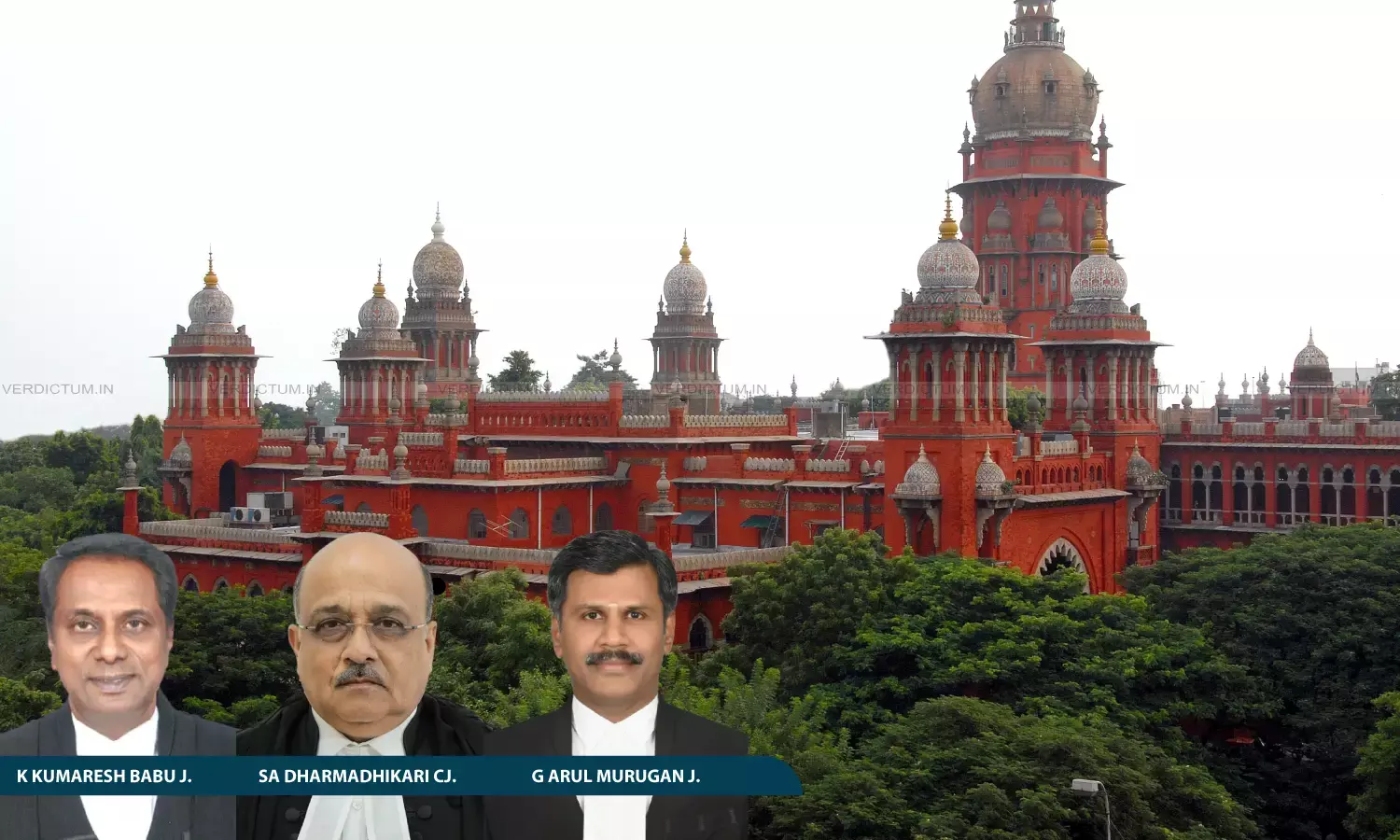
The Madras High Court has held that verification into the genuineness of a community certificate or caste status of an employee is legally permissible even after retirement, since an appointment obtained by fraud is void from inception and retirement cannot cure the foundational illegality.
The Court further held that retirement benefits flowing from a void entry into service cannot be protected, and that employers and Scrutiny Committees may verify community certificates irrespective of whether the certificate was issued or employment was granted before the Supreme Court’s procedural framework in Kumari Madhuri Patil v. Additional Commissioner (1994).
The Court was hearing a batch of writ petitions placed before a Full Bench to resolve conflicting views of coordinate Benches on post-retirement verification of community certificates, verification of pre-1995 certificates or appointments, and continuation of verification proceedings after superannuation.
A Full Bench of Chief Justice Sushrut Arvind Dharmadhikari, Justice K. Kumaresh Babu and Justice G. Arul Murugan observed: “Verification into the genuineness of a community certificate or caste status of an employee remains legally permissible even after their retirement from service. Since an appointment obtained by fraud is ab initio void, retirement does not wash away the foundational illegality, and retiral benefits flowing from a void entry cannot be protected.”
Senior Advocate V. Raghavachari appeared for some of the petitioners, while Advocate General Vijay Narayan appeared for the State
Background
The Full Bench was constituted to answer three referred questions: whether community certificate or caste status verification is permissible after retirement; whether such verification is permissible where the certificate or employment predated 1995; and whether a verification process initiated before retirement can continue after superannuation.
The petitioners argued that the State and employers could not keep verification pending for decades and then use it at the time of retirement to withhold pensionary benefits. They relied on directions in Kumari Madhuri Patil (1994), State Government orders, and several decisions where retired employees were permitted to draw pension or where post-retirement inquiries were closed.
The State opposed the petitions, contending that fraud vitiates everything and that an appointment secured on a false caste claim is void from inception. It relied principally on Food Corporation of India v. Jagdish Balaram Bahira (2017), arguing that neither delay nor retirement can legalise a fraudulent entry into public employment.
Court’s Observations
At the outset, the Full Bench described the issue as one requiring balance between the rights of retired employees and the constitutional obligation to protect social reservations from fraud.
The Court stated: “This Full Bench is constituted to resolve a cleavage of judicial opinion that has split Coordinate Benches of this court. At the heart of this dispute lies a delicate issue, viz., on one hand, the right of an individual to live out their twilight years in peace following a lifetime of labour; and on the other, the foundational mandate of our Constitution of India to protect social reservations from being hijacked by fraud and/or deceit.”
The Court examined Kumari Madhuri Patil (1994), where the Supreme Court laid down the framework for verification of social status certificates through Scrutiny Committees, and Dayaram v. Sudhir Batham (2012), where those directions were upheld as binding.
The Bench observed that the Madhuri Patil framework did not create a new offence or new substantive liability, but supplied an administrative mechanism to detect false claims.
The Court noted: “As illuminated by the Three-Judge Bench in Dayaram (supra), the directions issued in Kumari Madhuri Patil (supra) are intrinsic to the fulfillment of the fundamental and socio-economic rights of backward classes.”
It added: “Therefore, the administrative mechanism of the Scrutiny Committee functions as a binding 'quasi-legislative' stopgap scheme that remains fully operative until replaced by explicit State legislation.”
Rejecting the argument that certificates or appointments before 1995 were immune from scrutiny, the Full Bench held that fraud does not acquire legitimacy by lapse of time.
The Court stated: “The substantive law that fraud vitiates all subsequent actions has always been the law of the land. Kumari Madhuri Patil (supra) did not create a new offence, it merely provided an administrative forum to uncover preexisting and ongoing frauds. A false certificate presented before 1995 is just as fraudulent and void as one presented after 1995.”
The Bench further observed: “Since fraud unravels everything, the date of 1995 holds no magical immunity. Both Dayaram (supra) and Food Corporation of India (supra) affirm that the verification mechanism applies continuously to any unchecked or disputed certificate relied upon by a candidate to secure or enjoy a reserved vacancy. A false representation made in prior to 1995 does not metamorphose into a legal truth simply because it escaped detection until the employee's retirement.”
The Court treated Food Corporation of India (2017) as the governing authority and summarised its binding propositions, including that appointment against a reserved post by a person who does not belong to that community is a nullity.
The Full Bench noted: “The foundational ruling that completely governs the issues before us is the Supreme Court's decision in Food Corporation of India (supra).”
It was then highlighted that an appointment secured through a false certificate is “no appointment in law”, and that equity, compassion or administrative delay cannot sustain a benefit taken from a genuine reserved category candidate.
The Court also relied on the Supreme Court’s view that withdrawal of benefits follows necessarily once the caste claim is invalidated.
The Bench rejected the route adopted in some cases where retired employees were permitted to draw pension on undertakings that their children or descendants would not claim reservation benefits. The Court held that such undertakings cannot preserve benefits obtained through misrepresentation.
The Bench stated: “That apart, allowing employees to draw pension upon giving an undertaking that their progeny would never claim the social reservation benefits runs athwart the decisions of the Supreme Court. Allowing administrative delay or retirement to permanently immunize a fraudulent entry into service would result in a grave constitutional failure, leaving stolen public reservations completely unchecked.”
The Court expressly overruled contrary views taken in S.R. Krishnakumari and N. Vasugi.
On whether pre-1995 community certificates or appointments are immune from scrutiny, the Court held: “The employers and Scrutiny Committees are fully empowered to verify the genuineness of a community certificate or caste status, irrespective of whether the certificate was issued or the employment was granted prior to the year 1995. Fraud has no expiry date, and the procedural mechanics established vide Kumari Madhuri Patil (supra) in 1994 do not grant immunity to older deceptions.”
On whether a caste-status verification initiated before retirement can continue after superannuation, the Bench held: “A lawful verification process into an employee's caste status initiated prior to retirement does not lapse upon superannuation and must be permitted to continue to its logical conclusion. To hold otherwise would allow dilatory tactics to defeat constitutional accountability.”
The Bench also issued directions to prevent delayed verification from becoming harassment. It directed the State to strengthen State Level Scrutiny Committees and District Level Vigilance Committees with adequate manpower and anthropological experts.
It further directed public employers to initiate and complete verification within the initial years of service rather than waiting until the end of an employee’s career or after retirement.
For post-retirement inquiries, the Court directed: “In cases where inquiries are pursued post-retirement, they must be conducted on a fast-track, day-to-day basis and completed within a maximum period of two months to avoid keeping pensionary benefits suspended indefinitely.”
The Court also directed that undertakings not to claim future reservation benefits cannot be accepted as a device to protect benefits obtained on active misrepresentation.
Conclusion
The Full Bench answered the reference by holding that community certificate verification is permissible after retirement, pre-1995 certificates and appointments are not immune from verification, and proceedings initiated before retirement may continue after superannuation.
The Registry was directed to place the individual writ petitions before the appropriate roster Bench for disposal on merits and to mark a copy of the order to the Chief Secretary, Government of Tamil Nadu.
Cause Title: R. Gurusamy v. The Tamil Nadu State Level Scrutiny Committee and others
Appearances
Petitioners: Senior Advocate V. Raghavachari with M.A.P. Thangavel; V. Vijay Shankar; L. Chandrakumar; S. Udayakumar
Respondents: Advocate General Vijay Narayan with Government Pleader R. Veeramani; Sunita Kumari, Senior Panel Counsel; K. Karthik Jagannath; P.T. Ram Kumar, Standing Counsel; R. Malaichamy; Dhruva C.K.V.; K. Ramanamoorthy, Senior Panel Counsel
