

Madras High Court Directs State To Consider “SINGAPEN Sensitisation Workshop” For Trauma-Sensitive Implementation Of POCSO Act
The Court observed that the object of child protection jurisprudence lies in ensuring emotional safety, psychological healing, educational continuity and social reintegration of children entering the justice delivery system under the POCSO framework.
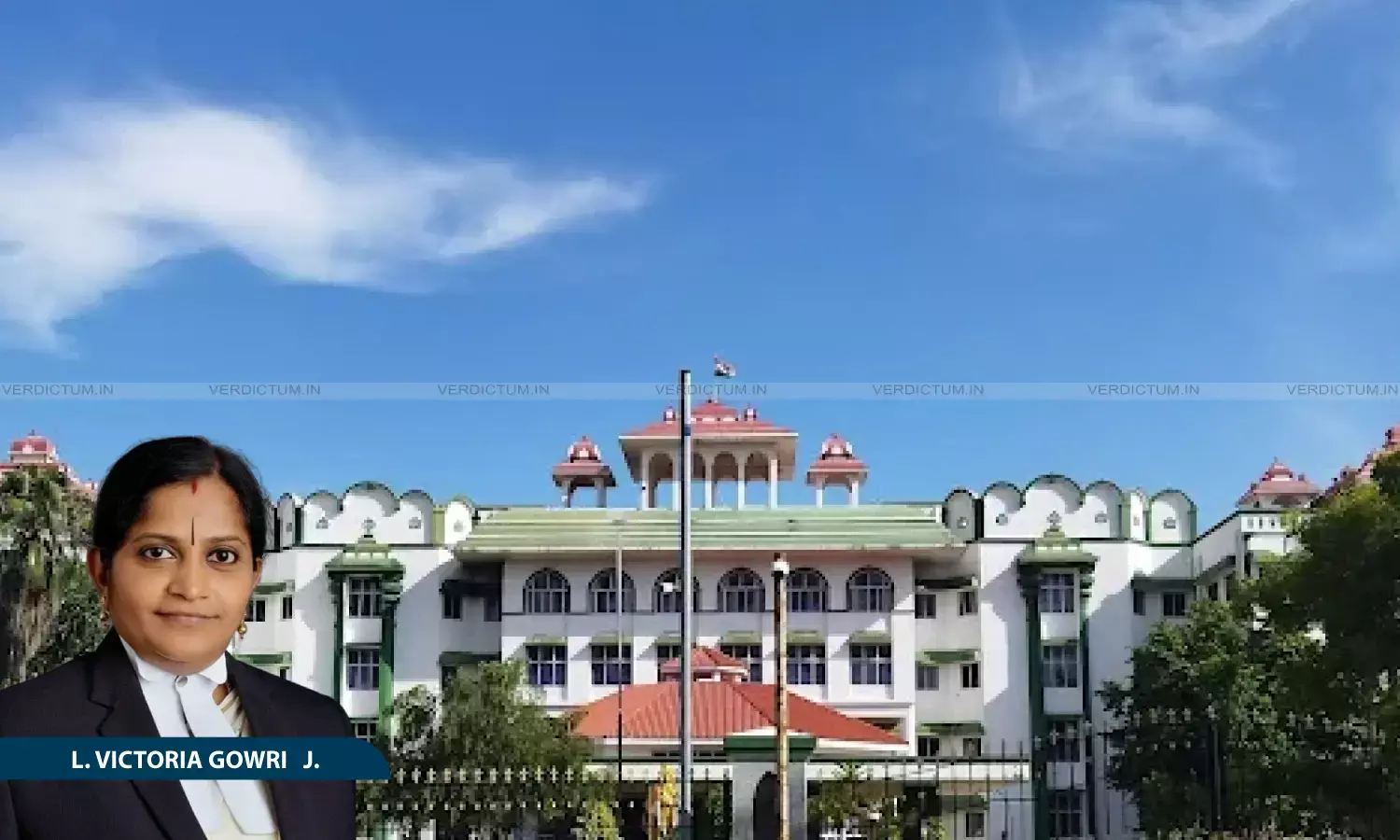
Justice L. Victoria Gowri, Madras High Court, Madurai Bench
The Madras High Court has directed the State authorities to consider framing and formulating a coordinated State-wide sensitisation programme titled “SINGAPEN SENSITISATION WORKSHOP” focusing upon trauma-sensitive implementation of the Protection of Children from Sexual Offences Act, 2012, child psychology, emotional wellbeing and ethical handling of child victims within the criminal justice framework.
The Court was hearing a batch of petitions filed under Section 528 of the Bharatiya Nagarik Suraksha Sanhita, 2023, seeking quashing of criminal proceedings arising out of separate prosecutions under the POCSO Act. The matters involved allegations concerning emotional manipulation of children, misuse of criminal process, coercion behind complaints, familial disputes and concerns regarding institutional handling of children under the POCSO regime.
A Bench of Justice L. Victoria Gowri clubbed four matters together in the form of a single compendium of judicial orders, as a “child-welfare centred constitutional exercise intended to provoke institutional introspection, academic engagement, policy reflection, and systemic reform concerning the manner in which children are presently dealt with within the criminal justice administration”.
Though arising from different factual backgrounds, districts, and individual narratives, the Court observed that all four cases “revealed one deeply disturbing common feature, namely, that children who entered the justice delivery system under the protective umbrella of the POCSO Act ultimately became exposed to varying degrees of emotional confusion, psychological strain, procedural insensitivity, institutional inadequacy, repetitive narration of allegations, social stigma, family conflict, and systemic mechanicalness”.
The Court, accordingly, directed the state to “consider framing and formulating a coordinated State-wide sensitisation programme titled SINGAPEN SENSITISATION WORKSHOP”, focusing on “trauma-sensitive implementation of the POCSO Act; child psychology and emotional wellbeing; responsible handling of child victims; prevention of misuse of POCSO provisions; sensitivity during recording of statements; ethical child interviewing techniques; and awareness regarding Section 22 of the POCSO Act”.
Advocates P. Selvakumar, T. Seeni Syed Amma, P.M. Vishnuvarthanan and P. Akarathi appeared for the petitioners. M. Sakthi Kumar and B. Thanga Aravindh, Government Advocates, along with Senior Counsel B. Saravanan and other counsel, appeared for the respondents in the connected matters.
Background
The first matter arose out of allegations that a minor girl had been emotionally manipulated into lodging a criminal complaint under the POCSO Act at the instance of another individual. The Court noted allegations regarding emotional coercion, misuse of legal process and discrepancies relating to enrolment credentials furnished before the Bar Council by an advocate who later came to be impleaded suo motu during the proceedings.
The second matter related to allegations of repeated sexual assault by a relative. During the proceedings, the victim made a statement before the Magistrate exonerating the accused and stated that the complaint had been lodged owing to pressure exerted by others in the background of family disputes.
The third matter concerned allegations of aggravated penetrative sexual assault against the father of a child victim. The mother and grandmother of the child subsequently filed affidavits stating that the allegations had arisen amidst matrimonial discord and emotional instability within the family.
The fourth matter arose out of allegations under Sections 7 and 8 of the POCSO Act, where the accused contended that the prosecution was instituted as a counterblast to an earlier criminal case arising out of pre-existing village hostility and factional rivalry between families.
During the pendency of proceedings, the High Court appointed child counsellors and psychologists in several matters to independently assess the emotional condition, vulnerability, welfare concerns and psychological state of the children involved.
Court’s Observation
At the outset, the High Court observed that all four matters disclosed recurring concerns regarding the manner in which children entering the justice system under the POCSO framework were being exposed to emotional confusion, social stigma, institutional insensitivity and psychological strain.
The Court observed: “The soul of child protection jurisprudence lies in preserving childhood dignity, emotional safety, educational continuity, psychological healing, social reintegration, and constitutional compassion.”
The Court further observed that enactment of welfare legislation by itself cannot secure constitutional objectives unless the implementation framework also evolves with corresponding institutional sensitivity, coordination and expertise.
The High Court identified several recurring institutional deficiencies, including repetitive narration of allegations by children, absence of trauma-informed investigation, lack of coordinated welfare intervention, inadequate counselling mechanisms, insufficient understanding of child psychology and excessive dependence upon adversarial criminal procedures.
The Court observed: “The criminal justice system continues to function in a manner primarily focused upon procedural completion rather than holistic child welfare.”
While dealing with the first matter, the Court examined the counselling report submitted by the Child Counsellors and observed that the victim was emotionally vulnerable, estranged from stable parental support systems and psychologically susceptible to emotional intimidation and influence. The Court also noted allegations that the criminal complaint had been drafted and pursued under pressure and threats.
Referring to the legal profession, the Court observed that the profession occupies a constitutionally significant position within the justice delivery system and that instances involving fake lawyers, forged enrolment credentials and unethical professional conduct seriously undermine public confidence in judicial institutions.
The Court observed: “If persons lacking genuine credentials infiltrate the legal profession and thereafter utilise legal knowledge to threaten, manipulate and exploit emotionally vulnerable citizens, the same would strike at the very root of public confidence in the justice delivery system.”
In the second matter, the Court noted that despite the victim having made a categorical exculpatory statement before the Magistrate under Section 183(6)(a) BNSS, the investigating agency mechanically proceeded with the prosecution without adequately examining the evidentiary significance of such a statement.
The Court further noted that the counselling report revealed that the victim had already undergone prior traumatic experiences and belonged to an emotionally unstable family environment, rendering her vulnerable to external influence and emotional manipulation.
The Court observed that irresponsible invocation of stringent penal provisions under the POCSO Act adversely affects both innocent individuals and the credibility of genuine child protection mechanisms.
While dealing with the third matter involving allegations against the father of a child victim, the Court observed that criminal law cannot become a purely ritualistic exercise where a child is knowingly pushed into a hostile criminal trial despite the practical collapse of the prosecution's case.
The Court observed: “The true purpose of the statute is not merely to punish offenders but to ensure sustained safety, psychological recovery, educational continuity, and social reintegration of the child.”
The Court further held that the distinction between punitive justice and welfare justice must always remain central while implementing the POCSO framework, stating: “The POCSO Act is fundamentally child-centric legislation. The Court cannot lose sight of the distinction between punitive justice and welfare justice. The true purpose of the statute is not merely to punish offenders but to ensure sustained safety, psychological recovery, educational continuity, and social reintegration of the child”.
The Court also examined Rule 9 of the POCSO Rules, 2020 relating to compensation and rehabilitation and observed that though the statutory framework provides for victim compensation, insufficient attention continues to be paid towards long-term psychological, educational and vocational rehabilitation of child victims.
The Bench remarked: “This Court is constrained to observe that while the POCSO Rules, 2020 provide for victim compensation under Rule 9, there remains an alarming absence of sustained rehabilitative mechanisms to restore the educational, vocational and psychological stability of vulnerable victims. Such legislative gaps require immediate policy attention”.
In the fourth matter, the Court expressed concern regarding situations where children may be repeatedly compelled by adults to narrate false allegations of sexual assault amidst village rivalry and factional hostility.
The Court observed that misuse of child protection laws for personal vendetta or private disputes ultimately converts childhood itself into collateral damage within adversarial litigation.
The Court concluded: “The cases forming part of this compendium collectively reveal that the protection of children cannot be achieved merely through the mechanical invocation of penal provisions. True child protection lies in the manner in which institutions respond to children after the legal process begins. The justice system must therefore evolve from being merely accusation-centric into becoming genuinely child-sensitive, trauma-informed, rehabilitative, and psychologically aware”.
Conclusion
The High Court partly allowed and disposed of the Criminal Original Petitions by adopting what it described as a calibrated welfare-centric approach balancing child protection, psychological rehabilitation, institutional sensitivity and the need to prevent abuse of criminal process.
In two matters, the Court quashed the criminal proceedings after holding that continuation of prosecution would amount to abuse of process of law in the peculiar facts and circumstances of the cases. In another matter, the Court declined to quash the prosecution but directed a focused preliminary enquiry regarding possible offences under Section 22 of the POCSO Act and also directed verification of enrolment records before the Bar Council of Kerala.
The Court further issued several consequential directions relating to counselling support, vocational rehabilitation, welfare monitoring by District Child Protection Units, periodic reporting before jurisdictional Courts and awareness measures concerning responsible invocation of the POCSO Act.
The Court additionally directed institutional stakeholders, including police authorities, social welfare departments and psychologists, to adopt trauma-sensitive and child-centric approaches while dealing with children under the POCSO regime.
The High Court further directed the State authorities to consider framing a coordinated State-wide sensitisation programme titled “SINGAPEN SENSITISATION WORKSHOP” focusing upon trauma-sensitive implementation of the POCSO Act, child psychology, emotional wellbeing, ethical interviewing practices, responsible handling of child victims, prevention of misuse of POCSO provisions and awareness regarding Section 22 of the Act.
The Court further directed the Inspector General of Police, Singapen Special Striking Force and the Directorate of Social Welfare to jointly coordinate implementation of the sensitisation programme across the State
Cause Title: Mikavel v. State of Tamil Nadu & Ors. And Connected Matters
