

Madras High Court Censures Supreme Court's Decision To Remit 2016 Assembly Election Petition To High Court After Stay For Six Years
The High Court warned that the judiciary's failure to adhere to the statutory mandate for the swift resolution of election disputes undermines adult franchise and risks sliding the nation into autocracy.

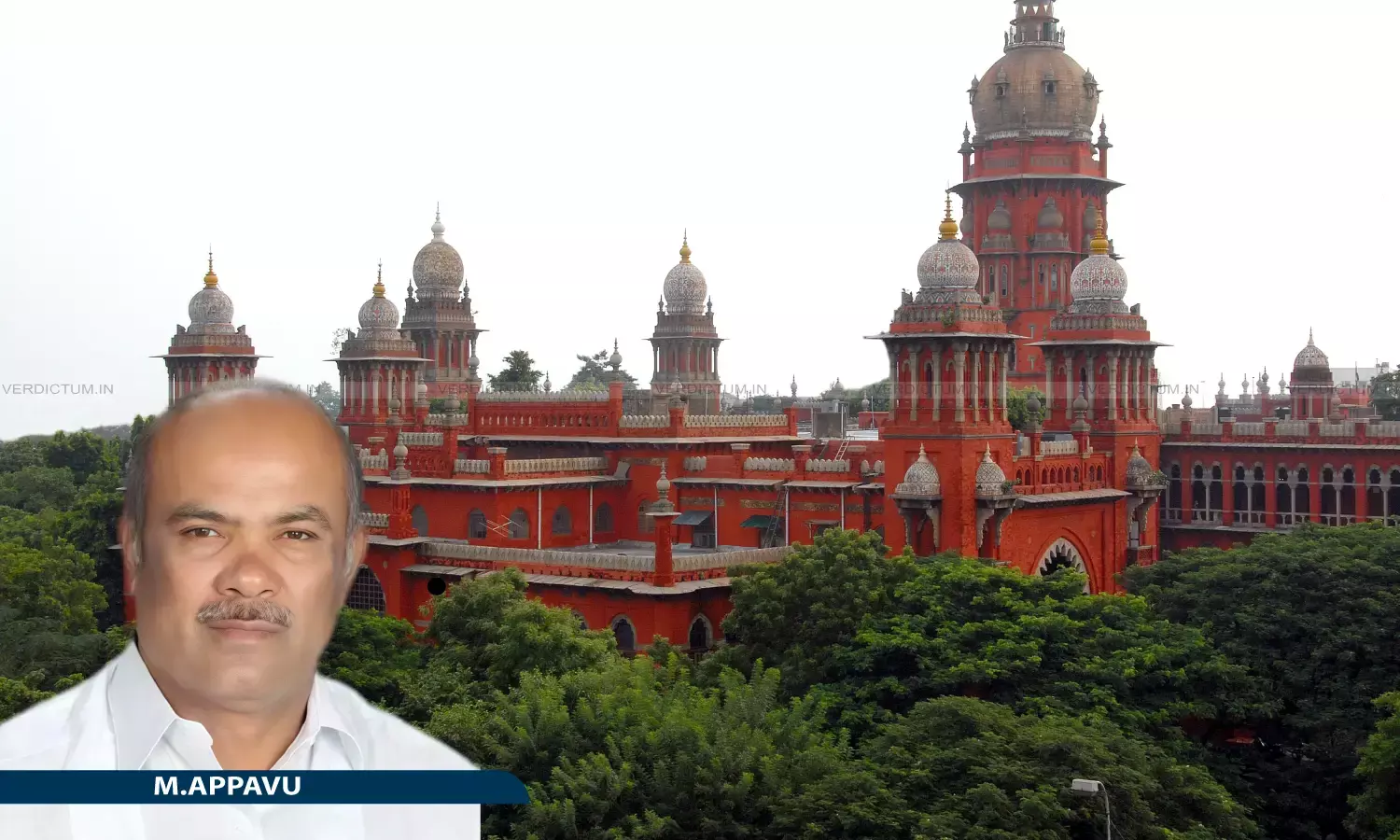
The Madras High Court allowed an election petition preferred by M Appavu, declaring his 2016 election victory from the Radhapuram Assembly Constituency after a decade-long legal battle, while observing that the Supreme Court should have conclusively answered the core legal question rather than leaving it open after keeping the appeal pending for six years, especially since the High Court had already delivered a clear finding on the issue as the court of first instance.
The Court warned that the judiciary's failure to adhere to the statutory mandate for the swift resolution of election disputes undermines democracy and adult franchise, cautioning that if courts continue to ignore established precedents on minimizing delays, the nation risks sliding into autocracy like Pakistan.
Holding that the statutory mandate to resolve election disputes within six months was conveniently ignored, the High Court observed that such protracted delays reduce the adjudicatory process to a mockery of justice and risk pushing the nation toward autocracy.
The Bench of Justice G Jayachandran observed, "Judiciary in this Country, being the custodian of the Constitution, should act in tandem with the other organs of the Constitution, to retain the pride of this Nation as one of the largest democratic Countries in the world, among the Nations which resorted to democratic form of Government on gaining Independence, post World War-II. Non-adherence to the mandate contained in Section 86(7) of the Representation of the People Act, 1951, will undermine democracy and the true spirit of adult franchise. If Courts continue to ignore their own observations made in Mohd.Akbar case (cited supra), I fear that this Country may also go in the way of other autocratic Countries which gained Independence around 75 years ago, along with us."
Advocate A.E.Ravichandran appeared for the Petitioner, while Advocate N.C.Ashok Kumar appeared for the Respondents.
The Court also said, "The Hon’ble Supreme Court, after keeping the matter pending for about six years, thought fit that the question has to be kept open in view of the lapse of time and the term of office having expired and no useful purpose would be served in adjudicating upon the said question in the Civil Appeal. With great respect, the Hon’ble Apex Court should have answered this question since this Court has already as Court of first instance/trial Court given a finding in respect of the above question."
Brief Facts of the Case
The election petition was preferred by M. Appavu of the DMK, who challenged the assembly election results after being declared unsuccessful by a razor-thin margin of 49 votes to I.S. Inbadurai of the AIDMK. He asserted that the initial rounds of counting placed him in a comfortable lead, but subsequent rounds and the processing of postal ballots were severely manipulated.
During the proceedings, critical discrepancies emerged regarding the maintenance of statutory counting records by the election machinery. Specifically, the Returning Officer failed to fill up the mandatory result-recording fields in the statutory forms for the final three rounds of counting, instead recording them on a separate sheet. Furthermore, a substantial chunk of 203 postal ballots cast in favor of the petitioner was summarily rejected by the election officials on the grounds of improper attestation.
The High Court had previously directed a physical recounting and re-verification of the disputed electronic voting machine rounds and all postal ballots. Although the counting proceeded under judicial supervision and the results were preserved in a sealed cover, the final determination was kept in abeyance for several years due to interim stay orders operating from the Supreme Court. The Apex Court eventually disposed of the appellate proceedings without deciding the core legal issue, leaving it open and directing the High Court to pass consequential orders.
Contentions of the Parties
The Election Petitioner argued that the election process was heavily manipulated in connivance with the Returning Officer during the final rounds of counting to artificially boost the tally of the returned candidate. It was argued that valid postal ballots cast in his favor were rejected on flimsy, hyper-technical grounds, thereby materially affecting the final outcome of the election.
It was also said that the en masse rejection of 203 postal ballots on the pretext that they were attested by Middle School Headmasters—alleging they were not Gazetted Officers—was entirely illegal and contrary to prevailing government rules.
The Returned Candidate (Respondent No. 1) countered that the election petition lacked cause of action and deserved outright dismissal at the threshold stage. It was said that the rejection of the 203 postal ballots was completely justified and in strict compliance with the election rules, which mandated that such ballots must only be attested by a duly recognized Gazetted Officer.
Observations of the Court
The High Court expressed deep anguish over the extraordinary delay in resolving the dispute, terming the decade-long pendency a grave mockery of justice that forced the electorate to bear a representative who was not dynamically and duly elected.
"The term ‘unfortunate’ may not be an adequate expression to describe the present case since in view of this Court, a grave mockery of justice, under the guise of dispensing justice been committed to the people of India, particularly the voters of No.228 Radhapuram Assembly Constituency, Tirunelveli District, who were forced to bear a person as their Assembly representative though he is not duly elected", the Court said.
The Court observed that statutory mandates requiring election petitions to be tried expeditiously within six months were conveniently ignored. It noted that when the resolution of election disputes outlasts the legislative tenure itself, the entire adjudicatory process is reduced to a paper exercise, damaging the institutional credibility of the judiciary and undermining democratic principles.
On the merits of the recount report, the Court observed that the re-verification of the sealed cover data delivered a definitive conclusion. Out of the 203 rejected postal ballots, the petitioner had secured 153 valid votes, whereas the returned candidate secured a solitary vote.
On the pivotal question of law, the Court held that the state government rules clearly recognized Middle School Headmasters as Gazetted Officers. Consequently, their attestation on the postal ballot declarations was perfectly valid, and the sweeping rejection of those votes by the Returning Officer constituted a patent illegality.
Consequent upon the clear findings of the trial and the recount data, the High Court allowed the election petition and passed the direction that the election of the returned candidate from the Radhapuram Assembly Constituency was declared null and void.
M.Appavu was declared as the duly elected Member of the Tamil Nadu Legislative Assembly for the legislative term spanning from 2016 to 2021, having won the election by a lawful margin of 103 votes.
The Secretary of the Tamil Nadu Legislative Assembly was directed to substitute the name of the election petitioner as the rightful legislative representative for the concerned term in all official and state archives.
The returned candidate was ordered to forego all consequential benefits flowing from the seat, including any pensionary benefits allocable for the disputed term. However, since the lapse was attributable to administrative errors and not corrupt practices, the order did not entail any personal disqualification for future elections.
Cause Title: M. Appavu v. I.S. Inbadurai and Ors. [Election Petition No.2 of 2016]
Appearances:
Petitioner: Advocate A.E.Ravichandran
Respondents: Advocate N.C. Ashok Kumar
Click here to read/download the Order