Grave Misconduct: Madras High Court Upholds Dismissal Of Prison Warden For Supplying Ganja To Convicts
The Court held that prison records disproved the warden’s claim that he was absent on the day of the alleged supply, while digital-payment records showed that he had received money from a convict’s friend on four occasions.
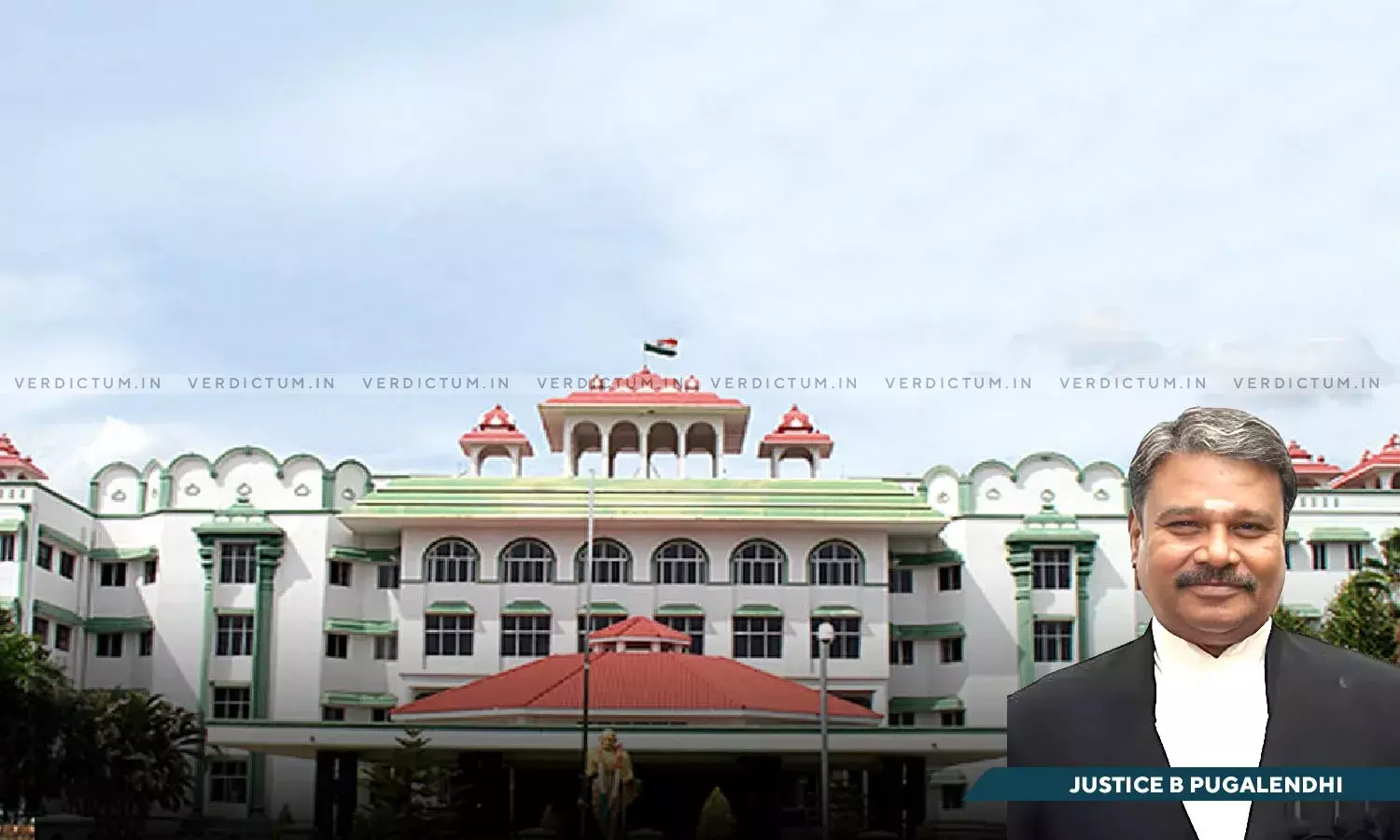
Justice B. Pugalendhi, Madras High Court, Madurai Bench
The Madras High Court has upheld the dismissal of a Grade-II Prison Warden for supplying ganja to convict prisoners, consuming alcohol at a convict’s house and receiving money from the convict’s friend.
The Court held that the conduct constituted grave misconduct and a serious breach of the discipline expected from a prison officer, making dismissal from service proportionate.
The Court was hearing a writ petition challenging the disciplinary authority’s order dismissing the petitioner from service and the appellate authority’s decision confirming the punishment. The petitioner alleged that the departmental inquiry violated the governing rules and principles of natural justice.
A Bench of Justice B. Pugalendhi observed: “… the petitioner himself has admitted consuming alcohol at the house of a convict prisoner and receiving money from a friend of the said prisoner. It is relevant to note that even maintaining familiarity with the prisoners or having correspondence with friends of such prisoners is prohibited under Rules 146 and 147 of the Tamil Nadu Prison Rules 1983.”
The Bench added: “… every prison officer has a duty to prevent, the introduction and giving to prisoners, of any prohibited articles, as per Rule 134(2) of the Tamil Nadu Prison Rules 1983. However, the petitioner in this case, who has a duty to prevent the introduction of contraband, has himself supplied ganja to convict prisoners. Certainly, this is a grave misconduct and violation of discipline, expected from a prison officer. Therefore, the punishment of dismissal from service, cannot be said to disproportionate and warranting the interference of this Court.”
Senior Advocate Ajmal Khan appeared for the petitioner, while Government Advocate S. Sivasubramanian appeared for the respondents.
Background
A special team conducted a surprise inspection at the Central Prison, Madurai, and recovered 10 grams of ganja from a convict prisoner’s undergarment. The prisoner gave a written statement alleging that the petitioner had supplied the ganja while assigned to duty near the prison’s bakery unit. Ganja was also recovered from another prisoner, who stated that he had received it from the first prisoner.
During the preliminary inquiry, the petitioner admitted that he and another Grade-II Warden had visited the house of a convict who was on escort parole and consumed alcohol there. He also admitted receiving ₹5,000 through a digital payment from the convict’s friend.
The petitioner was placed under suspension and issued a charge memorandum under Rule 17(b) of the Tamil Nadu Civil Services (Discipline and Appeal) Rules. He was charged with violating Rules 126, 134(2), 146, 147 and 298 of the Tamil Nadu Prison Rules, 1983, along with Rule 20(1) of the Tamil Nadu Government Servants’ Conduct Rules.
The Enquiry Officer found the charges proved, following which the disciplinary authority dismissed the petitioner from service. His departmental appeal was also rejected.
Before the High Court, the petitioner contended that the prisoner who allegedly received the ganja had not been examined during the departmental inquiry and that no CCTV footage was produced. He claimed that he had been on leave on the date of the alleged supply.
The petitioner further argued that the Enquiry Officer had relied upon material collected during the preliminary inquiry and had also questioned witnesses in the absence of a Presenting Officer. According to him, this amounted to the Enquiry Officer assuming the role of the prosecution and violated the principles of natural justice.
The State submitted that the petitioner’s presence in the prison was established by entries in the bakery duty register and the prison’s entry and exit register. It also relied upon his admission concerning the visit to the convict’s house, the statement of the accompanying warden and digital-payment records showing four payments of ₹5,000 each from the convict’s friend.
Court’s Observations
The Court reiterated that judicial review of departmental proceedings is confined to examining perversity, violations of natural justice and non-compliance with statutory procedure. A writ court does not ordinarily reassess factual findings recorded during a disciplinary inquiry.
It observed: “At the outset, it is relevant to note that the scope of judicial review in departmental proceedings is limited and courts should refrain from interfering in the findings of facts recorded in a departmental proceeding, except in circumstances such as perverse findings, violation of principles of natural justice and violation of statutory procedures. Further, Courts cannot interfere in the proportionality of the punishment, unless the same shocks its conscience.”
The Court accordingly examined whether the findings were supported by some evidence, whether the petitioner had received a fair opportunity to defend himself and whether dismissal was disproportionate to the proved misconduct.
The Court found that the prison records established the petitioner’s presence on duty on the day he was alleged to have supplied the ganja. The records showed that he had reported for duty in the morning and left the prison only in the evening.
The petitioner had admitted visiting the convict’s house and consuming alcohol there. The other warden accompanying him had made a corresponding statement. The convict’s friend, whom the petitioner examined as a defence witness, admitted transferring money to the petitioner.
The Court observed: “Further, the screenshots of the G-Pay transactions, were also marked in the enquiry proceedings. From these screenshots, it appears that the petitioner has received Rs.5,000/- on four occasions on 08.09.2022, 13.07.2023 and 15.06.2024. Therefore, the contention that the enquiry officer arrived at a conclusion, without any evidence, cannot be countenanced.”
The Bench consequently rejected the petitioner’s contention that the findings rested entirely upon untested statements recorded during the preliminary inquiry.
The Court found that the petitioner had inspected the relevant documents, submitted explanations on two occasions and cross-examined the departmental witness. It therefore rejected his contention that he had not received an effective opportunity to present his defence.
It held: “It is relevant to note that the petitioner perused the documents on 04.09.2024 and he submitted explanations on 20.08.2024 and 20.09.2024. Further, he has cross examined the witness on the side of the department. Thus, the petitioner was provided with an opportunity to present his defence and this contention cannot be accepted.”
The Court also rejected the argument that the inquiry stood vitiated merely because the Enquiry Officer had questioned witnesses in the absence of a Presenting Officer.
Relying on Mulchandani Electrical and Radio Industries Ltd. v. Workmen (1975), the Court held that an Enquiry Officer may ask questions for clarification where necessary, provided the witnesses are subsequently made available for cross-examination. The decision had followed the principle stated in Workmen v. Buckingham and Carnatic Mills, Madras (1970).
The Court noted that Rules 146 and 147 of the Tamil Nadu Prison Rules, 1983 prohibit prison officers from treating prisoners with familiarity or maintaining unauthorised dealings and communication with prisoners, their friends or relatives.
Rule 147 provides: “No prison officer shall lend money to, borrow money from, or incur any obligation in favour of any other prison officer or any prisoner or correspond with, or hold any intercourse with, the friends or relatives of any prisoner or have any unauthorised communication with any prisoner or with any person whatever as to matters concerning the prison.”
The petitioner’s admitted visit to the convict’s house, consumption of alcohol there and receipt of money from the convict’s friend were therefore conduct expressly prohibited by the Prison Rules.
The Court further noted that Rule 134(2) placed prison officers under a duty to prevent prohibited articles from being introduced or supplied to prisoners. The petitioner’s own supply of ganja was directly contrary to that duty.
Conclusion
The High Court found no perversity, procedural illegality or violation of natural justice in the departmental proceedings. Considering the evidence, the nature of the charges and the limited scope of judicial review, it held that dismissal from service was not disproportionate.
The writ petition challenging the disciplinary and appellate orders was accordingly dismissed.
Cause Title: M. Aashik Mohammed v. Director General of Prison and Correctional Services & Others