

Returning Officers Can Reject Fraudulent Nominations; Writ Petition Seeking Intervention Mid-Election Liable To Be Dismissed: Madras High Court
The Court dismissed a writ petition which sought a mandamus for stricter administrative scrutiny of nomination papers in Scheduled Caste reserved constituencies across Tamil Nadu.

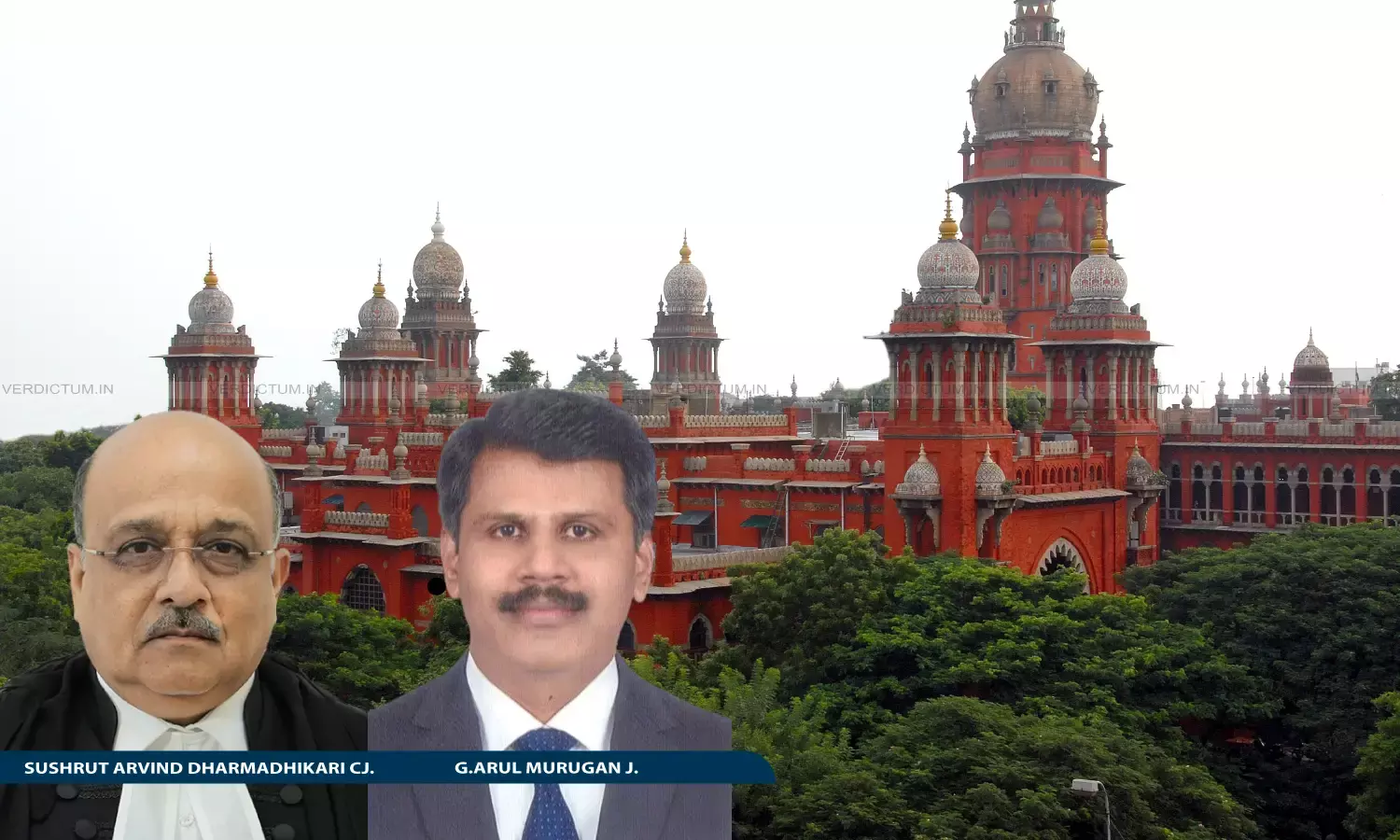
Chief Justice Sushrut Arvind Dharmadhikari, Justice G. Arul Murugan, Madras HC
The Madras High Court dismissed a writ petition seeking advanced scrutiny of Scheduled Caste candidates, holding that Article 329(b) bars mid-stream electoral interference and Returning Officers are already fully empowered to weed out fraudulent nominations.
The Court observed that the legal machinery is already fully armed under Section 36(2) of the Representation of the People Act, 1951, granting Returning Officers ample summary powers to examine and reject unqualified or fraudulent nominations at the scrutiny stage itself.
Emphasizing the absolute constitutional bar under Article 329(b) against interrupting or micromanaging an ongoing electoral process, the Bench held that in the absence of concrete evidence showing systemic failure, any grievance concerning a candidate's latent religious conversion or disqualification must be ventilated exclusively by way of an election petition post-declaration of results.
The Bench of Chief Justice Sushrut Arvind Dharmadhikari and Justice G. Arul Murugan observed, "The Returning Officers possess summary powers under Section 36(2) of the Representation of the People Act, 1951, to examine nomination papers and reject any nomination, where it is clear that the candidate is not qualified or is disqualified from filling the seat. The legal machinery is fully armed with the necessary powers to reject nominations backed by fraudulent certificates or false declarations at the stage of scrutiny itself. If a fraudulent candidate slips past this stage, the aggrieved party has an unhindered statutory remedy of filing an election petition."
Advocate S.Karthikei Balan appeared for the Petitioner, while Standing Counsel Niranjan Rajagopalan appeared for the Respondent.
Brief Facts of the Case
The petitioner filed the present writ petition under Article 226 of the Constitution of India seeking the issuance of a writ of mandamus to direct the respondent to consider their representations. The petitioner prayed for appropriate orders to scrutinize the nomination papers filed by candidates contesting from the Scheduled Caste (SC) reserved constituencies in the State of Tamil Nadu.
The petitioner sought such scrutiny by taking into account Clause (3) of the Constitution (Scheduled Castes) Order, 1950. The petitioner, claiming to be a public-spirited individual, raised serious concerns regarding the potential infiltration of non-Scheduled Caste candidates into reserved electoral constituencies by way of fraudulent declarations.
Contentions of the Parties
The petitioner contended that the unique constitutional protections, reservations, and benefits carved out specifically for the socio-economically marginalized Scheduled Caste communities were being systematically eroded and hijacked by ineligible individuals.
It was further contended that individuals who had voluntarily converted to other religions not recognized under Clause 3 of the Constitution (Scheduled Castes) Order, 1950, such as Christianity or Islam, continued to actively hold and utilize their erstwhile Scheduled Caste community certificates, which amounted to a deliberate fraud on the Constitution.
It was argued that the existing verification mechanisms and the scrutiny performed by the Returning Officers (ROs) under the current rules were superficial and inadequate to detect cases of latent religious conversion, as the administrative machinery merely looked at the face of the community certificate without conducting a deeper, substantive inquiry into the actual religious profession of the candidate at the time of filing the nomination.
Per Contra, the respondent countered the maintainability of the writ petition by contending that the electoral process could not be halted, modified, or interfered with mid-stream under Article 226 of the Constitution of India. It was submitted that the proper and exclusive legal remedy for challenging any irregularity, fraud, or qualification issue arising during an election was by way of an election petition as provided under Section 100 of the Representation of the People Act, 1951, post-declaration of results, and no writ petition could lie at the intermediary stage.
It was further submitted that the issue as to who was entitled to contest in a reserved constituency was entirely occupied by the provisions of the Constitution (Scheduled Castes) Order, 1950, and that the Supreme Court of India in its recent ruling in Chinthada Anand had comprehensively reiterated the earlier position of law, leaving no requirement for fresh directions or judicial intervention.
Observations of the Court
The Court observed that the primary hurdle blocking the path of the petitioner was the unequivocal bar contained in Article 329(b) of the Constitution of India, which mandates that no election to either House of Parliament or the State Legislature shall be called in question except by an election petition presented to the prescribed authority.
It was noted that Section 100 of the Representation of the People Act, 1951, comprehensively delineates the grounds for declaring an election void, which explicitly includes instances where a returned candidate was not qualified or was disqualified to fill the seat under the Constitution or the Act.
On the substantive merits, the Court observed that the petitioner's apprehension regarding individuals professing religions other than Hinduism, Sikhism, or Buddhism escaping scrutiny was entirely misplaced. The Court highlighted Clause 3 of the Constitution (Scheduled Castes) Order, 1950, which explicitly states that no person who professes a religion different from Hinduism, Sikhism, or Buddhism shall be deemed to be a member of a Scheduled Caste.
The Court observed that the administrative framework built to execute this law was robust, noting that the long-standing instructions issued by the Election Commission of India (ECI) comprehensively occupied the field. These guidelines explicitly mandated that Returning Officers (ROs), at the time of scrutiny of nomination papers, must thoroughly satisfy themselves that candidates genuinely belong to the SC or ST community by insisting on the production of a valid certificate issued by a competent authority.
It was observed that Returning Officers possess ample summary powers under Section 36(2) of the Representation of the People Act, 1951, to examine nomination papers and reject any nomination where a candidate is unqualified or disqualified. The Court held that the legal machinery was fully armed to reject nominations backed by fraudulent certificates or false declarations at the scrutiny stage itself, and if any fraudulent candidate slipped past, the aggrieved party retained an unhindered statutory remedy by way of an election petition.
"In the case at hand, the petitioner has failed to provide any evidence of a candidate contesting the recent elections using a fraudulent certificate, or of the Returning Officer overlooking the same", the Court said.
Consequently, in view of the constitutional bar under Article 329(b), the statutory alternative remedy under Section 100 of the Representation of the People Act, 1951, and the existing guidelines of the ECI, the Court concluded that there was neither any legal vacuum nor any ground to issue fresh directions.
The Court held, "In view of the clear bar under Article 329(b) of the Constitution of India, the statutory alternative remedy of filing an election petition as provided under Section 100 of the Representation of the People Act, 1951, and the existing detailed guidelines issued by the Election Commission of India on 2.7.2008, there is neither any legal vacuum nor any ground for this court to issue any directions."
The Court held that the writ petition was entirely devoid of merits and accordingly dismissed the same without costs, resulting in the closure of the connected interim application.
Cause Title: Arjunan Sampath v. The Chief Electoral Officer [W.P.No.13425 of 2026]
Appearances:
Petitioner: Advocate S.Karthikei Balan
Respondent: Standing Counsel Niranjan Rajagopalan