

Right To Resign Legislative Seat Can’t Be Burdened With Extra-statutory Conditions By Judicial Order: Madras High Court
The Madras High Court was considering a Public Interest Litigation filed by a practising advocate.

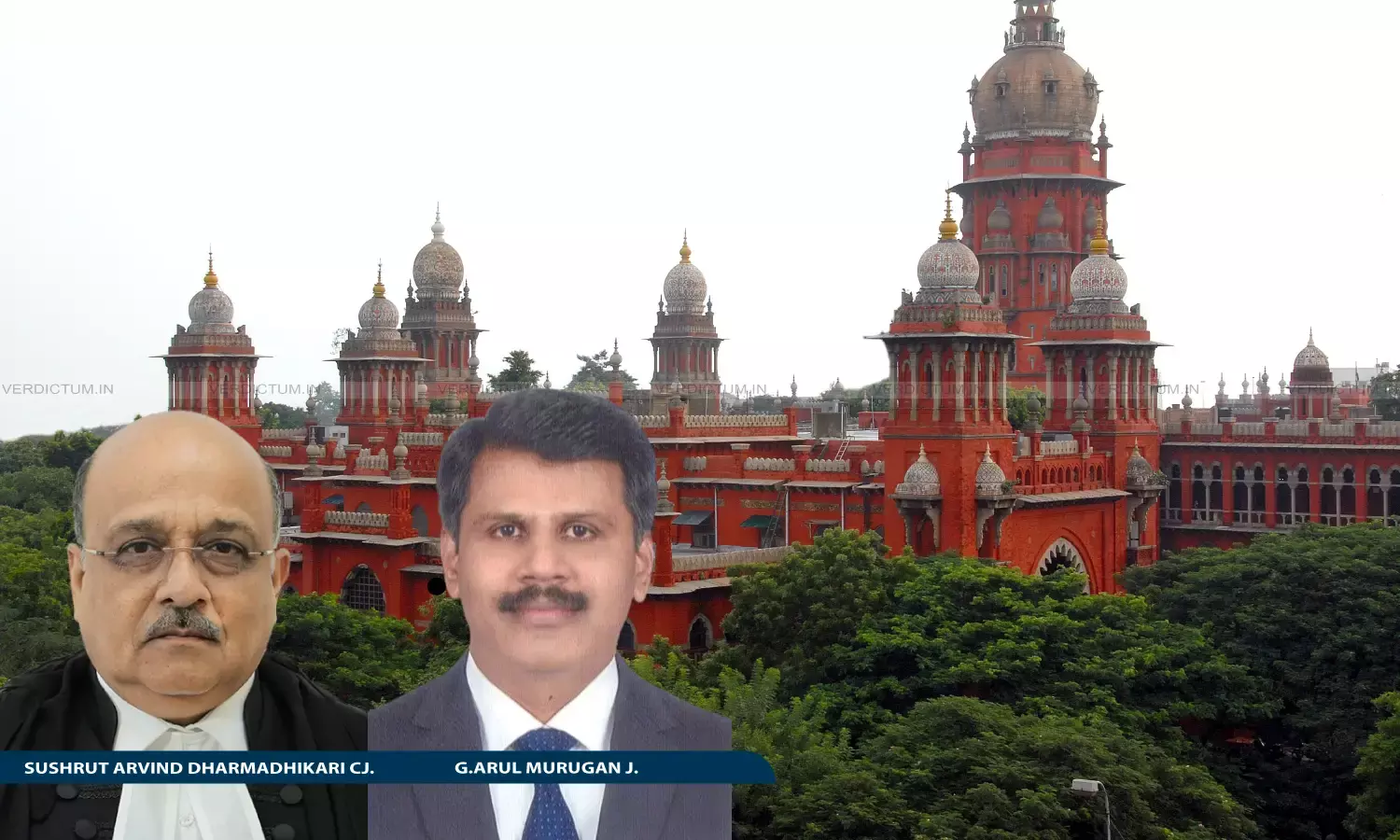
Chief Justice Sushrut Arvind Dharmadhikari, Justice G. Arul Murugan, Madras HC
While observing that the right to resign a legislative seat is a facet of the constitutional scheme and cannot be burdened with extra-statutory conditions by judicial order, the Madras High Court has dismissed a PIL seeking framing of an "Election Expenditure Security" mechanism and a five-year disqualification for voluntarily resigning legislators.
The High Court was considering a Public Interest Litigation filed by a practising advocate, who had filed the petition seeking a direction to the Election Commission of India and the Chief Electoral Officer, Tamil Nadu, to frame a mechanism called an "Election Expenditure Security", under which a sitting MLA who resigns voluntarily and later wants to contest the bye-election caused by that resignation must first deposit an amount equal to the public money spent on holding that bye-election.
The Petitioner also sought a direction to the same authorities to introduce a five-year disqualification for any MLA who resigns voluntarily, without a compelling reason, from contesting any election to Parliament or a State Legislature during that period.
The Bench Of Chief Justice Sushrut Arvind Dharmadhikari and Justice G. Arul Murugan held, “It is also necessary to notice that, in the case at hand, the reliefs sought are directed against six named individuals by name, based on the timing of their resignations. Assuming arguendo that some mechanism was desirable as a matter of policy, a court-ordered scheme confined to these six persons would run athwart Article 14 of the Constitution of India. The right to resign a legislative seat is itself a facet of the constitutional scheme governing membership of a House, and cannot be burdened with extra-statutory conditions by judicial order, however sound the underlying concern may be.”
“For the aforegiven reasons, the prayer for a mandamus directing the framing of an "Election Expenditure Security" mechanism and a five-year disqualification for voluntarily resigning legislators cannot be granted, as this Court cannot convert an executive or legislative option into a judicial command”, it ordered.
Senior Counsel R. Singgaravelan represented the Petitioner while Central Govt Standing Counsel R.K.Thirukkumaran represented the Respondent.
Factual Background
The petitioner claimed that following the 2026 General Elections to the Tamil Nadu Legislative Assembly, six elected members resigned their seats within a short span of the results being declared. It was the case of the petitioner that none of these resignations was on account of death, permanent incapacity, disqualification, or any other compelling circumstance and each had necessitated a bye-election under Section 151A of the Representation of the People Act, 1951, funded from the public exchequer. The petitioner asserted that the public should not be made to pay twice for the same seat because of an individual's personal or political choice to give it up.
The petitioner had earlier addressed representations to the respondents, urging them to consider the two measures. Having received no response, he approached the High Court under Article 226 of the Constitution of India.
Reasoning
The Bench was of the view that the petitioner sought the creation of two new and substantive features of electoral law that do not presently exist anywhere in the Constitution or in the Representation of the People Act, 1951, viz., a security deposit calculated with reference to actual public expenditure on a bye-election, and a five-year bar on contesting future elections. The Bench noted that the petitioner himself did not dispute this and he mentioned in his own affidavit that the mechanism he proposes "is presently not incorporated into Indian electoral law".
“ We are, therefore, not being asked to fill a gap in the machinery for implementing an existing right. We are being asked to design a punitive and financial regime that would operate as a fresh disqualification under the Constitution of India and would curtail the statutory right to contest an election. In our considered opinion, the same is a matter of legislative policy, not of judicial direction”, it held.
The Bench next dealt with the prayer for the creation of an entirely new disqualification, viz., a bar on contesting elections for five years, and a forfeitable financial deposit calculated on a case-by-case basis with reference to public expenditure. The Bench clarified that the right to resign a legislative seat is itself a facet of the constitutional scheme governing membership of a House, and cannot be burdened with extra-statutory conditions by judicial order, however sound the underlying concern may be.
The Bench thus dismissed the petition.
Cause Title: K.Suthan v. Union Of India (Neutral Citation: 2026:MHC:3908)
Appearance
Petitioner: Senior Counsel R. Singgaravelan, M/s.R. Jayaprakash
Respondent: Central Govt Standing Counsel R.K. Thirukkumaran, Advocates Niranjan Rajagopalan, Advocate General Vijay Narayan, Special Government Pleader J. Lenin, Advocates P.J. Rishikesh, G. Murugendran