

Child Will Grow Up With Stigma: Madras High Court Denies Leave To Triple Murder Convict To Undergo Fertility Treatment
The petition before the Madras High Court was filed seeking the quashing of the records of the order passed by the Superintendent of Prisons.

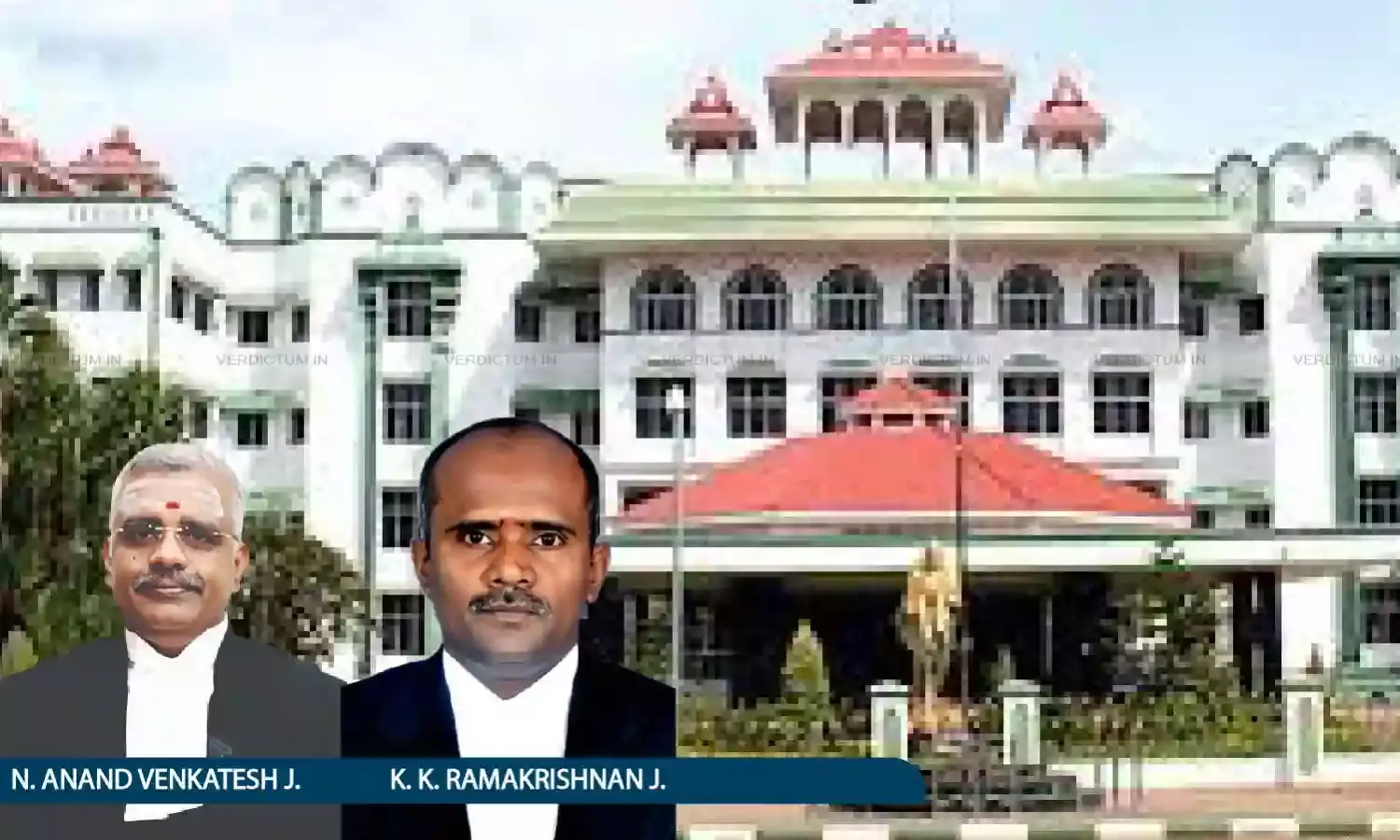
Justice N. Anand Venkatesh, Justice K. K. Ramakrishnan, Madras High Court
The Madras High Court has upheld an order rejecting the request for granting leave to a triple murder convict to undergo fertility treatment while observing that the child, when it enters the world, will grow up with a stigma that it is the child of a life convict, who is serving a sentence for having committed a heinous crime involving triple murder.
The petition before the High Court was filed seeking the quashing of the records of the order passed by the Superintendent of Prisons and consequently directing the authorities to grant 21 days ordinary leave without escort to the petitioner's husband.
The Division Bench of Justice N. Anand Venkatesh and Justice K.K. Ramakrishnan held, “In the case in hand, both the petitioner and the convict are conveniently ignoring the right of a child, to be born. The child when it enters this world will grow up with a stigma that it is the child of a life convict, who is serving sentence for having committed a heinous crime involving triple murder. In such a scenario, this Court cannot merely act upon the right that is claimed by the petitioner and ignore the interest of the child, which will carry such a stigma throughout its life.”
Advocate S.Srikanth represented the Petitioner, while Additional Public Prosecutor A.Thiruvadi Kumar represented the Respondent.
Factual Background
The petition was filed by the wife of a convict, who underwent trial on the file of the Special Court for Exclusive Trial of SC/ST Act Cases. The convict was sentenced to undergo life imprisonment on three counts. The petitioner submitted a representation before the respondents seeking ordinary leave on the ground that the petitioner was desirous of having a child through the convict, and for this purpose, the petitioner had to undergo fertility treatment. Therefore, ordinary leave was sought for on this ground. Upon rejection of the representation made by the petitioner and aggrieved by the same, the Writ Petition came to be filed before the High Court.
Reasoning
On a perusal of the Tamil Nadu Suspension of Sentence Rules, 1982, the Bench explained that Rule 20 deals with the grounds for the grant of ordinary leave but does not provide for granting ordinary leave to enable the petitioner and/or the convict to undergo fertility treatment. “As was rightly contended by the learned Additional Public Prosecutor, this Court is not dealing with a right of the convict and at the best, what has been granted under the Suspension of Sentence Rules, 1982 is only a privilege and therefore, we have to necessarily satisfy ourselves that such privilege is sought for in accordance with the requirements provided under the Rules”, it added.
Showing its concern regarding the welfare of the child, the Bench stated that the child, if born, would face consequences psychologically exerted by society for the heinous acts committed by the convict. “The theory of reformation is focused on the convict and that has nothing to do with the desire of a convict to have a child, which for no fault on its part is going to carry a stigma throughout its life. Neither the petitioner nor the convict will have the right to place the child in such an unfortunate position right through its life”, it stated.
Thus, finding no illegality with the impugned order, the Bench dismissed the Writ Petition.
Cause Title: A v. The Deputy Inspector General of Prisons (Case No.: W.P.CRl..(MD).No.1695 of 2026)