Madras High Court Flags Parallel Petition In Christian Reservation Case; Terms It Forum Shopping
The Madurai Bench flagged an identical writ filed at the Principal Seat after it had already admitted the challenge.
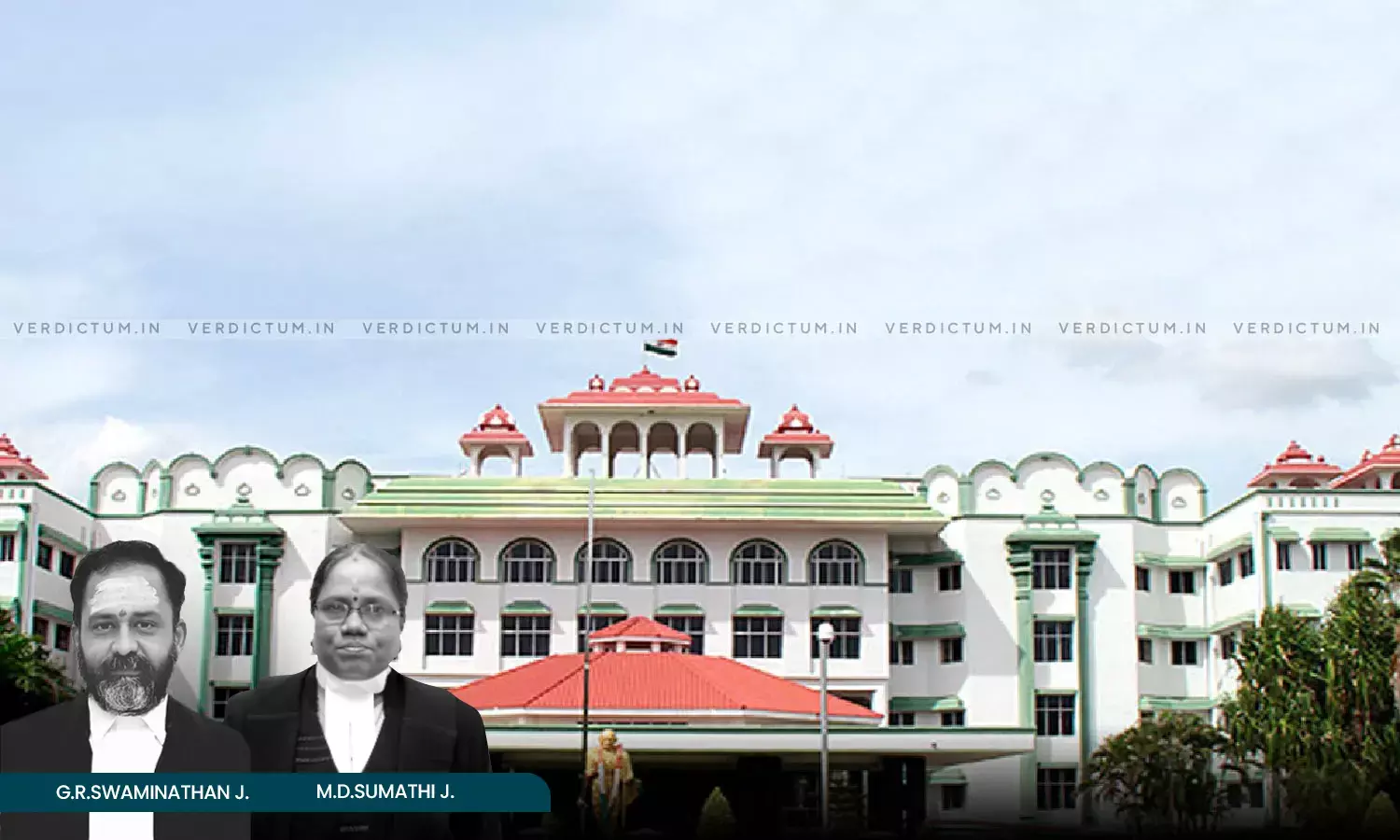
The Madras High Court has flagged the filing of a parallel writ petition at its Principal Seat raising the same challenge to the BC/MBC status conferred on specified Christian communities and converts to Christianity after the Madurai Bench was already seized of the matter.
The Court said that the subsequently instituted proceeding should abide by the outcome of the first petition as a matter of good practice to prevent multiplicity of litigation.
The High Court, while further taking note of the Advocate General’s submission that another writ carrying an identically worded prayer was filed before a Division Bench at the Principal Seat, remarked that the filing of such a petition, after the Madurai Bench had admitted the first petition, appeared to be an attempt at forum shopping.
The Court was hearing an interim application in a writ petition challenging entries in Schedule I to the Tamil Nadu Government Servants (Conditions of Service) Act, 2016. The challenged entries confer Backward Class or Most Backward Class status on various Christian communities and converts to Christianity.
The interim application sought to restrain the Tamil Nadu Public Service Commission from publishing the final selection list, conducting counselling and issuing appointment orders against the relevant reserved turns in its Group IV recruitment.
A Division Bench of Justice G.R. Swaminathan and Justice M.D. Sumathi observed: “When the Madurai Bench is seized of the matter, the very filing of a writ petition with the same prayer smacks of lack of bona fides. More so, when it is by a lawyer who is the petitioner therein. It appears to be an attempt at forum shopping. It is time to issue a practice direction to prevent such attempts in the future.”
The Court, nevertheless, underscored that the counsel on both sides “agreed that pleadings would be completed at the earliest and that the matter can be taken for final hearing by this Court on 18.12.2026”.
Advocate K. Suresh appeared for the petitioner. Senior Counsel Raju Ramachandran, Advocate General Vijay Narayanan, Additional Advocate General P.V. Balasubramanian, and Additional Advocate General B. Saravanan appeared for the respondents.
Background
The principal writ petition challenges specified entries in Schedule I to the Tamil Nadu Government Servants (Conditions of Service) Act, 2016. The entries extend Backward Class or Most Backward Class status to identified Christian communities and converts from certain communities.
The Madurai Bench admitted the petition and issued rule nisi. After the Tamil Nadu Public Service Commission issued notifications for Group IV recruitment, the petitioner moved an interim application concerning the reserved turns claimed by candidates falling within the challenged entries.
The petitioner’s submissions raised questions concerning whether social backwardness rooted in the Hindu caste system could continue after conversion to Christianity and whether membership of a church, established through baptism and a clergy certificate, could by itself establish membership of a backward class.
The petitioner also questioned whether the communities had been identified as socially and educationally backward and inadequately represented in State services on the basis of relevant criteria and quantifiable data.
The submissions raised further issues concerning different treatment of converts, classification allegedly based only on religion, earlier commission findings, the continued use of old data and the effect of the challenged entries on other Backward Class candidates.
The State questioned the petitioner’s locus and bona fides. It submitted that reservation for Christians enjoyed protection under the Ninth Schedule to the Constitution and sought time to file its counter and argue the interim application. It maintained that no interim relief should be granted.
The Advocate General informed the Court that another writ petition carrying an identically worded prayer had been filed before a Division Bench at the Principal Seat. He initially stated that the coordinate Bench had directed the papers to be placed before the Chief Justice for the potential constitution of a larger Bench.
The Madurai Bench examined the coordinate Bench’s order before signing its own order. It clarified that no suggestion had been made for constituting a larger Bench. The coordinate Bench had instead directed that the papers be placed before the Chief Justice so that the two petitions could be tagged and heard together before the appropriate Bench.
The High Court had earlier highlighted that OBC status was neither axiomatic nor eternal and that the State must demonstrate that the inclusion or continued retention of a community in the OBC list was constitutionally justified. It had found that the challenge raised a prima facie case warranting deep constitutional scrutiny.
Court’s Observations
Parallel Filing Raised Forum-Shopping Concern
The Court considered the procedural implications of instituting a second petition after the Madurai Bench had already admitted the first challenge.
The Bench observed: “But then, the cause of action is one and the same and the relief sought is also one and the same. Just as CPC gives precedence to the suit instituted first, there is no reason why the very same approach cannot be extended to writ petitions challenging the vires of a Statute.”
The Court said that the later petitioner could have sought intervention in the first proceeding instead of instituting a parallel writ petition. It considered a practice direction necessary to discourage similar attempts and prevent multiple proceedings concerning the same statutory challenge.
Res Judicata And Res Sub Judice Are Rules Of Public Policy
The Court referred to Daryao v. State of Uttar Pradesh (1961) for the principle that res judicata, as a rule of public policy, may apply when fundamental rights are pursued through writ petitions. It also referred to V. Subramanian v. Union of India (2004), in which the Madras High Court had extended the underlying principle to public-interest proceedings even where the parties were not identical.
Extending that reasoning to simultaneously pending matters, the Bench stated: “The same logic underlying res judicata also applies to res Sub judice, both being rules of public policy.”
The Court reproduced Section 10 of the Code of Civil Procedure, 1908, and referred to National Institute of Mental Health and Neuro Sciences v. C. Parameshwara (2005) on its object. It noted that the provision seeks to avoid parallel trials on the same issue and conflicting findings where the matter directly and substantially in issue is identical.
Later Writ Should Abide By First Proceeding
The Court acknowledged that the petitioner before the Principal Seat was an independent person and did not claim through the petitioner before the Madurai Bench. It nevertheless considered the identity of the cause of action and relief sufficient to justify giving precedence to the first proceeding when the vires of a statute were challenged.
The Bench observed: “In fact, the subsequently instituted writ proceedings should be made to abide the outcome of the first instituted writ petition. This alone would constitute good practice and can prevent multiplicity of litigations.”
The Court, however, expressly qualified the status of this proposed approach by adding: “However, these are just our thoughts.” It also stated that its order would abide by any order passed by the Chief Justice, who is the master of the roster.
Conclusion
The High Court fixed the challenge to the Backward Class and Most Backward Class entries for final hearing after recording the parties’ agreement to complete their pleadings.
Cause Title: G. Kodeeswaran v. State of Tamil Nadu and Others
Appearances
Petitioner: K. Suresh, Advocate
Respondents: Raju Ramachandran, Senior Counsel, assisted by Shruti Narayan, Advocate, and M.P. Senthil, Special Government Pleader; Vijay Narayanan, Advocate General, assisted by M. Kannan, Special Government Pleader; P.V. Balasubramanian, Additional Advocate General, assisted by M. Mohaboob Athiff, Special Government Pleader; B. Saravanan, Additional Advocate General, assisted by V. Panner Selvam, Standing Counsel